A simple theory could explain the fundamental shift in Western politics in recent years. I propose that we are witnessing a shift in the way governments acquire and maintain legitimacy in the eyes of their populace. In determining whether governments and regulatory bodies are “legitimate”, judgements fall primarily into one of two beliefs: process legitimacy, or outcome legitimacy. Until recently, Western polities overwhelmingly believed in “process legitimacy”: democratically elected governments were inherently legitimate because they followed the process, i.e. they obeyed the laws, and came and went with elections. Whether they passed good or bad policies would make them more or less popular, and would help them to win or lose the next elections, but rarely did their basic legitimacy to govern depend on whether their policies were good or bad.
In recent decades, though, this has begun to shift, and the populaces of western polities increasingly believe in “outcome legitimacy”: governments are legitimate or illegitimate as a function of how well they respond to the socioeconomic and sociocultural insecurities of their constituents. Many polls and studies reveal this deteriorating belief in democracy. Belief in the legitimacy of the Supreme Court or Congress are abysmal. We can see this in stark relief not only Trumpist claims to the illegitimacy of pluralistic Democratic victories, but also in France where Macron is decried as illegitimate in his accused abandonment of the working class. For the former, consider this excerpt:
“Even if they don’t subscribe to the more outlandish conspiracies propagated by Trumpists, many Republicans agree that the Democratic party is a fundamentally illegitimate political faction – and that any election outcome that would lead to Democratic governance must be rejected as illegitimate as well. Republicans didn’t start from an assessment of how the 2020 election went down and come away from that exercise with sincerely held doubts. The rationalization worked backwards: They looked at the outcome and decided it must not stand.”
And for the latter example of Macron, FranceInter could not put better the differences in claims to legitimacy:
Sur le plan institutionnel, les règles de la démocratie sont simples et claires, le président de la République est celui des candidats qui a obtenu la majorité des suffrages exprimés. Sur ce plan, la légitimité d’Emmanuel Macron est donc incontestable.
Pour autant, au soir du premier tour, sur les plateaux de télévision, il y avait quelque chose d’indécent dans la suffisance et l’auto-satisfaction des « dignitaires du régime », souvent passés par des gouvernements de gauche et de droite, avant d’échouer en Macronie… Comme un manque de gravité qui ne correspondait pas aux circonstances et aux enjeux…
Pourquoi cela ? Parce que si la victoire d’Emmanuel Macron est indiscutable, la crise de la démocratie est, elle aussi, indéniable. Le président de la République a été réélu sur fond d’abstention massive, en particulier des actifs, face à une candidate qui continue à être délégitimée et même vilipendée par presque tous.
On an institutional level, the rules of democracy are simple and clear: the President of the Republic is the candidate who has obtained the majority of the votes cast. In this respect, Emmanuel Macron’s legitimacy is therefore unquestionable.
And yet, on the evening of the first round, there was something indecent about the smugness and self-satisfaction of the “dignitaries of the regime” on television panels—figures who had often passed through both left- and right-wing governments before ending up in Macron’s camp. There was a certain lack of gravity that did not match the circumstances or the stakes at hand.
Why is that? Because while Emmanuel Macron’s victory is indisputable, the crisis of democracy is equally undeniable. The President of the Republic was re-elected amid massive voter abstention, particularly among the working population, against a candidate who continues to be delegitimized and even vilified by almost everyone.
It is not the first time that outcome legitimacy has been significant in the west: as Jurgen Habermas claims in his 2013 The Lure of Technocracy, “The [European] Union legitimized itself in the eyes of its citizens primarily through the results it produced rather than by fulfilling the citizens’ political will.” But in general this belief about legitimacy is new to the modern West. It is, however, perfectly valid in other cultural and political systems around the world: Middle Eastern monarchies make no pretense to democracy (in many the denizens are deemed subjects, not citizens, implying no role to play in the political life of the state); in China, the Communist Party historically has relied heavily on its ability to buoy material prosperity and defend China’s image abroad as its primary claims to legitimacy, rather than on claims to democratic processes or popular election (though China does maintain some nominally democratic institutions).
A fair follow up question to ask here is why this process has occurred. I am not entirely sure, but I have some hypotheses. The first is that the one-two punch of terrorism and the recession in the early 2000s created a climate of increased material insecurity and a need to ensure that governments were actually producing results that protected people physically and economically. A second, non-exclusive reason would be the Gurri hypothesis that distributed network technologies are making people more skeptical of governments and institutions, and want more explicit proof that they are working in the public interest. Other explanations surely abound and I would love to hear them in the comments.
One could conclude that if this trend towards valuing outcome legitimacy continues, Westerners will become increasingly tolerant of undemocratic and unlawful acts on the parts of their governments, so long as they are able to deliver desired results. The stunned tolerance of Elon Musk’s activities in the US Federal Government, to the extent that it holds, may be due in part to a sense of awe that he is able to move so rapidly and effectively and produce the kind of results that Trump campaigned on.
The murder of Brian Thompson is a morally and emotionally challenging event. Many people feel that some sort of justice was administered, even though the matter concerns premeditated murder. What is justice in this situation? Why has this event provoked such strange and passionate reactions?
We return to a topic I wrote about recently, the difference between deontological and consequentialist moralities. In the deontological sense, murder is usually considered to be wrong (it depends on precisely which deontological system we are referring to, but most moral systems tend to say that murder is always wrong). In the consequentialist sense, murder can be moral if the results are sufficiently beneficial. The idea that this murder was justice derives from a consequentialist understanding of justice: a sufficiently ostentatious display of a punishment for a behavior, even a brutal and disproportionate punishment (think cutting the hand off of a thief and hanging it above the city gate), can prevent the offending behavior from re-occurring and thus in the long term improve the aggregate quality of life.
When I posted on social media explaining the consequentialist justice argument, a wise acquaintance responded asking if it was not exactly the same as pro-lifers advocating the killing of a doctor who performs abortions. He also posted Meditation 17 by John Donne:
No man is an island, entire of itself; every man is a piece of the continent, a part of the main; if a clod be washed away by the sea, Europe is the less, as well as if a promontory were, as well as if a manor of thy friend’s or of thine own were; any man’s death diminishes me, because I am involved in mankind, and therefore never send to know for whom the bell tolls; it tolls for thee.
I appreciated the critique and understood the invocation against murder. I agree that consequentialist reasoning can potentially be used to excuse anything, and a world in which more people felt emboldened to murder those they had sociopolitical disagreements with would be a worse one for everyone. But consider the following: what if Thompson had been shot with a bullet that instead of inflicting physical damage had instead inflicted bankruptcy and years of heartache and misery like his choices had done to his clients?
What I mean to say is, consequentialist excuse for murder is a game anyone can play at, progressives and pro-lifers alike, yes, but for those who revel in the murder, Brian Thompson’s own actions and executive choices as symptomatic of another brand of legal and moral decay, one that allows the wealthy and powerful to prey on the weak with complete impunity so long as it follows the byzantine prescriptions of laws written by the same ilk for their own benefit. Should the penalty for this immorality be murder? Deontologically, clearly not. Even consequentially, as I said, it would be bad if everyone started murdering everyone they disagreed with. But I think even deontologists agree that there should be severe punishment for the actions of Brian Thompson and those who do similar things – enough to force those in his position to think twice about the welfare of their clients whose lives and livelihoods depend on the companies delivering certain services. This is a legal and institutional failure. The solution for the pro-lifers was to take control of institutions and effect the legal changes to make abortion stop in the polities they control.
The answer is institutional and legal, then: if the clients of a company could all get together and vote to dispense bankruptcy and misery on CEOs who did this kind of thing to them, then that would probably be a better world from both consequentialist and deontological perspectives.
Until then, the question is: which is closer to justice for the actions of Brian Thompson: murder, or impunity?
Natalism, the belief in the need for higher birthrates, is increasingly a topic of concern for various thinkers and prognosticators (Robin Hanson, Tyler Cowen, Zvi Moskowitz, and Elon Musk among many others). However, the calls for natalist policies are almost unanimously from the political right. I would like to argue that it would behoove the political left to take on this banner as well.
The reason that the left has been reluctant to promote natalism are somewhat obvious. One of the core ideological constituencies of the political Left in many developed countries is young educated professionals, many of whom are child-free: some simply by the vicissitudes of professional life, and some of whom by ecological or personal choice. For the child-free members of this group, to embrace natalism would be hypocrisy. And for a leftist group or party to embrace natalism would be to risk alienating this important source of votes, funds, and political energy. Natalism is closely associated with the “traditional family” and “family values”, typically conservative calling cards.
That said, there are a two strong arguments to make for the left embracing natalism, one of them Machiavellian and the other Darwinian.
The Machiavellian argument is simply that natalism could be a powerful argument and political tool for advancing many leftist causes. I will take the American example here, even though the US is out of step with most western countries on these issues, but the example should be illustrative to other political systems nonetheless. Some of the dreams of the American left include expanding public healthcare, instating paid medical and parental leave policies, and funding public schooling, including higher education. A powerful political argument from the natalist perspective is that the cost and burden of having, raising, and educating a child is too prohibitive and that this is a significant reason for the choice of many adults in developed countries not to have children. By putting in place these policies, the cost of having, raising, and educating a child is distributed to society as a whole, just as the benefit of having that additional participant in the economy is distributed – public goods should have public funding. Should the American political left embrace natalism, it could seek common cause with natalists on the right to find compromises on these policies for the benefit of boosting the birthrate.
On the Darwinian side, Leftists should consider embracing natalism to ensure their ideological and demographic sustainability. In the short-term national scale, if left-leaning individuals and groups continue to have lower birth rates compared to their right-leaning counterparts, the political landscape could shift significantly over a few decades; higher birth rates on the right could lead to a future where conservative values and policies dominate simply due to numerical superiority and intra-familial transmission. As Robin Hanson argues, over time this could mean a far future that is populated by the descendants of high-fertility subcultures like Amish and Ultra-Orthodox Jews, who are of course very religious and conservative. When Hanson first promulgated this idea, I was resistant and argued that
“The idea that society will be dominated by the high-fertility subcultures is reductionist and assumes that the part of society one is born into is nearly perfectly correlated with the part of society one affiliates with as an adult, which is not the case. Conservative religious groups have higher fertility, but many people raised in those environments convert to more secular or liberal worldviews as adults. Parts of society that don’t have high fertility compete with high-fertility parts by being more alluring. Equilibrium can continue indefinitely.”
However, I did the math, and posited a scenario in which there is a dominant culture D with fertility rate 1.5, and subculture S which is only 5% of the population but has a fertility rate of 4. To ensure that S never becomes dominant, the conversion rate from S to D needs to be approximately 29.33% per generation. This means that for every 100 S individuals, at least 29.33 need to convert to D each generation to prevent S from ever becoming the majority. 29% is a high barrier, considering that fewer than 10% of Amish leave their communities. It would be much easier to simply increase the fertility rate of mainstream society.[1] By promoting and supporting family-friendly policies that encourage higher birth rates within their communities, leftists can help ensure the populational vitality of the coalition.
In the long term global perspective, falling birth rates in secular, developed countries can lead to a significant population imbalance compared to developing countries, which, without stereotyping, are on average less secular and egalitarian than western countries. This will put secular liberal values at a disadvantage globally in bodies such as the UN or its successors. Further, countries experiencing starkly declining populations may increasingly rely on immigration to sustain their economies and address labor shortages (NB: I am pro-immigration and this is overall a good thing!). However, as shown in the previous link, this immigration will increasingly have to come from nations with more conservative cultures, posing increasingly difficult demands on systems of integration/assimilation, which may over time threaten the influence of liberal and secular ideals (we don’t have to go full Houellebecq and see some abrupt takeover). This process can be slowed and eased by boosting domestic fertility.
[1] Note that this sort of scenario only really plays out in a peaceful world; in a more belligerent time like in most of human history, dynamism in social organization and scientific and technological advance allowed the dominance of countries with small populations over larger ones; see, for example, the Mongol, British or Japanese victories over China, or Prusso-German successes over Russia, or for the most extreme examples the incursions of Pizarro and Cortez in the Americas.
Navigating the Predestination of Sexual Orientation in the Bible Belt
Christianity has long held a view called “predestination” – the idea that God plans out the entire moral course of human lives, and determines before birth whether a person is destined for salvation or damnation. The early church had detractors from this view, for example the fourth century Pelagian heresy espoused a more maximalist view of human self-determination (believing that it was principally human acts, not divine planning, that destined someone for heaven or hell), but ultimately ever since Saint Augustine of Hippo most brands of Christianity accepted the idea of Predestination.
A natural critique of the position that one’s fate is unalterable is to give in to anarchy and nihilism: why not be an immoral rake, whoring, drinking and stealing to one’s heart’s content, if none of it matters anyway for one’s outcome? As a result of this natural critique, many theologians moderated the position in different ways throughout the ages, allowing some small role for human will to “desire” or “deserve” the salvation that was already chosen for them. With the renewed theological intensity of the Reformation, however, some reformist hardliners went back to the stark belief, none more so than the Calvinists. The early Calvinists promoted the idea of Unconditional Election (i.e. not dependent on any human will) of a select few, chosen by God to be saved, while most of humanity was condemned to hell. To avoid the loophole of amorality and nihilism, in the Calvinist view, the elect would naturally embody the values that had commended them to salvation, and as such would be morally irreproachable. For the zealous Calvinist, then, social interaction became a theater of moral one-upmanship, everyone going out their ways to demonstrate their moral superiority, even though such moral acts had no eschatological or soteriological consequences.
This belief has mostly faded from contemporary mainstream Christianity [don’t ever underestimate the extent to which antiquated theological extremes can persist in isolated communities for centuries or more], but the model of “immutable predetermined status begetting moral competition” remains one that we can see in other places and times. In my personal experience this model perfectly describes perceptions of sexual orientation during my adolescence.
I grew up in the American Bible Belt and was an adolescent in the early 2000s. I first learned from my peers, when I was about 10 or 11, of categories called “gay” and “straight”, and that one should definitely try to be “straight” and that essentially nothing was more ostracizing for an adolescent male than to be “gay”. As my adolescence went on, I learned increasingly that there were signs of one’s gayness or straightness, and that if one were incapable of properly replicating and affecting the signs of straightness, it would indicate one’s true gay nature. Growing up in this environment, every action, every gesture, every preference seemed to be scrutinized for clues about one’s “true” sexual orientation. I remember the subtle ways in which we policed ourselves and each other, seeking to conform to the expectations of an immutable reality. Among the list of signs I had to police myself for were the following:
When carrying schoolbooks in the hallway, they had to be held at my waist by a straight arm; carrying them in the crook of my elbow at chest level was gay
When crossing my legs while sitting, the raised shin had to be held horizontally across the other leg; having the leg folded over with the back of my knee resting on the lower thigh was gay.
My socks had to be short or pushed down to my ankles; wearing my socks up too high was gay
I had to demonstrate knowledge of appropriate musicians and sports stars; not liking sports or listening to “gay” music like classical music was a sure sign that one was gay
It should be noted that I was a bit more delicate, nerdy, “unmasculine” than many of my peers. I did prefer listening to classical music, drinking tea from a formal British tea set, and would have rather watched Lord of the Rings than sportsball any day. As such, I was in a state of constant torment through most of my teen years, horrified by the possibility that I might be, unbeknownst even to me, gay, even though I felt attracted exclusively to women. But the battle to Not Be Gay was so utterly consuming that it impeded me from considering the issue with any rational thought, and indeed I was stridently anti-gay even as many of my friends began supporting gay rights and signing petitions to launch a GSA chapter (Gay-Straight Alliance) at my high school – I recall ashamedly that a friend slid the petition to me at the lunch table, and I ostentatiously slid it immediately onward.
It was in this context that I first encountered an openly gay person. As one did, I was bantering with a friend and I, unable to think of a witty comeback, called out “oh yeah, well I think you’re gay!”. He responded with an accepting, almost bemused “yeah, so?”. I was rendered, for I believe the first and only time in my life, a speechless, mouth agape cartoon character, unable to process what I had just heard. I was the modern incarnation of a 16th-century Calvinist whose neighbor had just told him he worshipped the devil. Someone had openly declared themselves anathema in what was then the most salient identitarian issue of my life.
It was only with great hesitation, delay, and reserve that I shed the arms and armor of that identitarian struggle. It required several people in my close circle of friends to come out, and I still look back with remorse on my initial incredulous, mocking reactions. In one sense my perspective was not truly my fault, for I was a product of my environment. But I would be a poor rationalist if I did not say that I was at least somewhat at fault for not being sufficiently critical of that environment.
The model of Unconditional Elect still holds, and can likely be seen in other places. I would welcome any input about where we can see it at work.
Farmers are special in a lot of ways. They receive enormous amounts of subsidies from governments in a way that no other industry does. In most industries, free trade agreements prevent member governments from giving government subsidies to their industries; these would be unfair advantages that defeat the purposes of trade agreements. However, agriculture is by and large exempt from these free trade agreements. Why? A lot of food is easily freezable, cannable, refrigerable, processable and shippable around the world, and if we had a world with fully free trade, imported food from Far-Eastern Europe, Latin America, Africa and South Asia would be far cheaper than domestic production, and the agricultural production of wealthy countries would go the way of the textile production of wealthy countries – i.e., it would be uncompetitively expensive except as niche and artisan purchases, and soon there would be very few farmers or agricultural production in wealthy countries.
And this is really bad PR, and, potentially, bad policy. Why? Countries like to be able to say that they can feed themselves. If the voting public in some countries got wind that their government approved a policy that made their country completely dependent on foreign imports to get fed, they would burn down the halls of power (though many wealth countries with high populations and low arable land area, like Japan or the Netherlands, have been deeply dependent on food imports for decades – and microstates like Singapore are completely dependent on exports for basically everything, one reason why small states are historically big proponents of free trade: they just can’t aren’t big enough for self-sufficiency to be a realistic goal).
But like I said, it’s not just bad PR, it’s also potentially bad policy. The Pandemic years were a wake-up call to many countries that it might not be a bad idea to make sure one’s supply chains were robust and that one’s stocks of essential goods were secure. The world witnessed (despite efforts at censorship) starvation in a modern wealthy city (Shanghai and other Chinese Cities) when draconian covid lockdowns strained supply chains to their breaking point. It has long been military policy of many countries like the US to ensure that their agricultural production would allow the country to feed itself in the event of a trade-destroying war, and this makes a lot of sense because the US could realistically defeat any conventional enemy in conventional war but if faced with domestic starvation would be crippled.
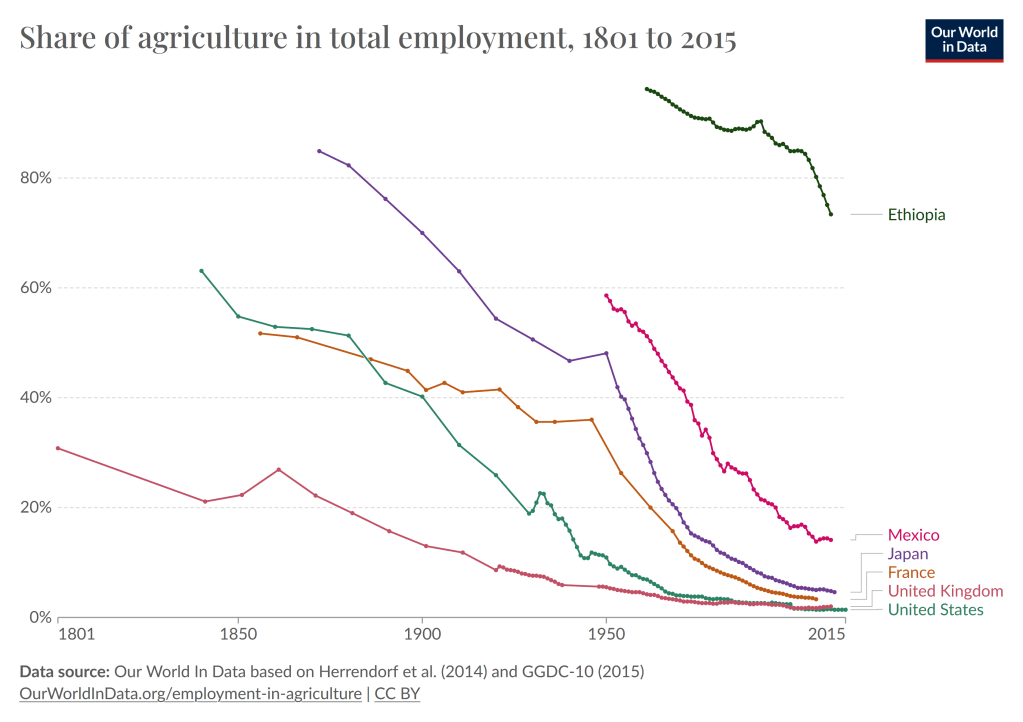
There’s also the pure PR power of farmers that makes them punch far above their weight in cultural and political discourse: except for the bluest of bluebloods, we all have farmers in our very recent ancestry, and until the 19th century most people in most countries were farmers.
Thus, many wealthy countries have gone out of their way to subsidize their agricultural sectors and keep farming productive and competitive – and farmers quiet. However, it has become increasingly apparent to policymakers that their treatment of farmers is potentially anti-environmental (https://whitherthewest.substack.com/p/the-danger-of-eating-locally) and inegalitarian. I’ll address each of these points in turn. Regarding the environment, farming can be highly polluting – not just via fertilizers and pesticides, but by outdated farm equipment; as an aside, I once heard a French farmer’s solution to a badger on his land was to pour gasoline into its burrow.
Regarding equality, remember how I said that wealthy countries want to keep agriculture out of free trade agreements so that they don’t get overwhelmed with cheaper products from Latin America, Africa, Far-East Europe and South Asia? Well, Latin America, Africa, Far-East Europe and South Asia are rather unhappy about that – agriculture is often their comparative advantage, and they find it deeply unfair that the things wealthy countries produce (manufactured goods) are subject to reduced tariffs, but the things they produce efficiently (agriculture and forest products) are magically kept out by tariffs for “nAtiOnAl sEcUrItY ReASons”.
This brings us to today. Many on the left side of the political spectrum in the EU are aware of these two issues (environment and inequality) and are pushing for changes that would not benefit the EU agricultural sector but would privilege environment and global social justice – reductions in subsidies, enforced environmental protections, and ongoing free trade negotiations with Mercosur (a Latin American trade bloc). With the latest push for the Green New Deal in Europe, farmers around the continent decided to see how much heft they had in the European political machinery. And it turns out, they have quite a bit, seeing as after only a few days of protest they secured key concessions from the French government – an exemption from the diesel subsidy phaseout, and continued “No” from France on negotiations with Mercosur. And European far right groups are linking arms with farmers, pushing for increased emphasis on sovereignty and territoriality against the “hegemonic” imposition of EU rules.
The upcoming European Elections will decide a lot of this – will the right’s courting of farmers work, or will Europeans tire of the antics before June rolls around – but to some extent the battle is already lost. The fact that left-environmentalism seems to see agriculture as fair game means that the PR armor of farmers has already been breached, and more reforms in the direction of both environment and global equality are likely to come in the future.
In modern usage, the term “accelerationism” is claimed by far-right groups as a philosophy of destabilizing society to bring about a more authoritarian and conservative future. However, soi-disant accelerationists have no monopoly on accelerationist ideas. That is to say that the perspective of “acceleration” of society through stages is neither new nor confined to the political right; accelerationist mindsets are espoused by various groups aspiring to “accelerate” society toward some predicted end and effect a transformation to a more “ideal” version of society. Though the nominal idea of accelerationism is widely conceived as radical and dangerous in most interpretations, the general concept of “accelerating” society toward a predefined end has a long history on many points on the political spectrum and has through its real-world political effects substantially influenced the modern world. To understand where accelerationist ideas come from, it is worthwhile to investigate, in brief, their history and legacy. It is also worthwhile to investigate their fundamental flaws.
The Philosophical Underpinnings
The concept of society moving toward an inexorable end is not new, but neither is it universal; many ancient peoples kept time with respect to dynasties or the founding of cities, commencing cycles that were inevitably reset every time a dynasty or city fell – for a modern relic of this system, we can see the Japanese imperial calendar or gengō system, in which the current year is Reiwa 2, second year of the reign of the new emperor. Ancient Romans kept time with relation to the founding of the city or by reference to the consuls who were in power in a particular year.[i] With the rise of monotheistic religion, however, societies began keeping time with respect to immutable events, such as the birth of Jesus or the Hijra of Mohammed – fixed dates that allowed a linear outlook on time irrespective of the city or ruling family one happened to live near. These societies also prophesied the eventual arrival at some future event, be it the end of the world or the coming of the Messiah, and even into the early modern era it was common to think that human actions could help bring it about – for example, in the 1500s, Jews began settling in the holy land, not to create a Jewish state like the modern Israel, but rather, they “hoped to accelerate the coming of the Messiah”[ii]. In the late 18th century, the German philosopher Friederich Hegel gave rise to a conception of history moving through a set of defined stages. For Hegel, this progress was most clearly visualized in the form of European civilization passing from pre-civilized barbarism, to slavery under classical societies, to the theological thought during the middle ages and culminating (for him) in the humanism and enlightenment philosophy of his time. For Hegel, this furthering of civilization was in turn furthering the evolution of the Weltgeist, or the Worldspirit, the collective mental and spiritual progress of humanity that developed inexorably toward greater liberation.
“[…]The world spirit, has possessed the patience to pass through these forms over a long stretch of time and to take upon itself the prodigious labor of world history, and because it could not have reached consciousness about itself in any lesser way, the individual spirit itself cannot comprehend its own substance with anything less.” – Hegel, Preface, Paragraph 29[iii]
Left-Accelerationism
Without question the most famous application of Hegelian history was made by Karl Marx, who took the idea of historical stages and wedded them to another (and more long-lived) Hegelian philosophical invention of “dialectics” – the idea that a prevailing and dominant idea (a “thesis”) is at some point confronted with a contrary or opposite idea (the “antithesis”), and the result of this conflict of ideas is that one of the ideas would win out but be altered in the process, producing a new idea (the “synthesis”), which in being dominant would be the new thesis, continuing the cycle. Marx took this Hegelian dialectic formula and famously applied it to social classes, seeing one dominant class as the thesis, a rival class as the antithesis, and the result of their inevitable conflict would be a new synthesis and new social order, which would inevitably be challenged by a new class. Thus society progressed from slavery to feudalism to capitalism to communism.
What does this have to do with Accelerationism? Well, the first real example of Accelerationism is tied to Marxist thought. Communism, according to Marx, could only come about once the philosophical infrastructure of Capitalism was in place, for only the underclass of capitalism, the proletariat, could overthrow the oppressive bourgeoisie and institute Communism. Marx was wedded to the inevitability of the entire endeavor:
“The advance of industry, whose involuntary promoter is the bourgeoisie, replaces the isolation of the labourers, due to competition, by the revolutionary combination, due to association. The development of Modern Industry, therefore, cuts from under its feet the very foundation on which the bourgeoisie produces and appropriates products. What the bourgeoisie therefore produces, above all, are its own grave-diggers. Its fall and the victory of the proletariat are equally inevitable.” – Marx and Engels, 1848[iv]
But to Marxists such as Lenin and the Bolsheviks in Russia during the late 19th and early 20th centuries, the ideal socialist society they longed for was decades or centuries away: according to most observers at the time, Russia was not yet even capitalist – rather, with the ascendancy of the church, the czar, and the nobility, (Orthodoxy, Autocracy, Nationality, went the triune slogan of Russian conservatism) Russia was still trapped, economically and socially, in a kind of feudalist proto-capitalism. Thus, in the years leading up to the Bolshevik Revolution in Russia, would-be Communists were deeply conflicted over the question of Marxists stages of history. The communists wanted Communism now, but according to Marx they would first have to usher in an era of capitalism to create the necessary foundations for their long-awaited Communist system. As a result, many Russian socialists and communists in the early 20th century embraced the possibility that Russia might have to undergo a capitalist, liberal revolution before the infrastructure could be laid for a second, socialist revolution. In the 1920s, after the Russian Civil War had been put to rest, The Communist Party of the Soviet Union embraced the “New Economic Plan” which was (relative to the “war socialism” the Bolsheviks emplaced during the late teens) a market-based system of exports and investment that would aim to get the USSR’s productive capacity on par with the capitalism they sought to surpass. Mao Zedong would embrace the same kind of stepwise thinking at times, not between capitalism and communism, but rather socialism and communism, in the lead-up to the infamous “great leap forward”[v].Should the communists, therefore, support the rise of capitalism? An idea that arose to deal with this problem is an early formulation of accelerationism. If a society has to go through stages to reach a desired end-goal, then those who want the desired end-goal should do their best to speed up the natural processes.
Accelerationism is, then, in its fundamental form, a belief in some kind of set of stages that society needs to be walked through—and support for attempts to destabilize the current system or otherwise put in place the necessary conditions to see the change transpire organically
In the 1970s, Marxist political philosophers Hardt and Negri published an unexpectedly popular book, “Empire”, examining the way in which American Capitalism pervaded the world, but also looking (in a devil’s advocate manner) at ways in which Capitalism was setting in motion global progress toward what would come next. For example, they noted the ways in which corporations were astutely indexing and integrating all world resources and productive capacities into a networked global market. Socialists and communist grappled onto these ideas, contending, as Bolsheviks had done decades before, with the possibility that the best way to arrive at a global transition to socialism was actually to support the growth of these capitalist global structures:
“The huge transnational corporations construct the fundamental connective fabric of the biopolitical world in certain important respects. […] Some claim that these corporations have merely come to occupy the place that was held by the various national colonialist and imperialist systems in earlier phases of capitalist development, from nineteenth-century European imperialism to the Fordist phase of development in the twentieth century. This is in part true, but that place itself has been substantially transformed by the new reality of capitalism. The activities of corporations are no longer defined by the imposition of abstract command and the organization of simple theft and unequal exchange. Rather, they directly structure and articulate territories and populations. They tend to make nation-states merely instruments to record the flows of the commodities, monies, and populations that they set in motion. The transnational corporations directly distribute labor power over various markets, functionally allocate resources, and organize hierarchically the various sectors of world production. The complex apparatus that selects investments and directs financial and monetary maneuvers determines the new geography of the world market, or really the new biopolitical structuring of the world. The most complete figure of this world is presented from the monetary perspective. From here we can see a horizon of values and a machine of distribution, a mechanism of accumulation and a means of circulation, a power and a language.”
In other words, corporations are not merely exploitative, extractive engines serving the interests of the bourgeoisie in the global north, but are rather organizing forces that mobilize resources (notably labor power) into a global connected system. Thus, Hardt and Negri argue, the modern corporation may be moving some people toward the proletarian organization that early Marxists sought to effect through cadres and labor unions. Echoing Hardt and Negri’s work, it is common these days in some corners of the internet to talk about “late-stage capitalism”, an overt assumption that society progresses in stages and that capitalism’s stage is on the way out, laying the foundation for a transition to socialism[vii]. These communists pay heed to the inevitability in Marx’s work, the teleological inexorability, which classes would find their way to conflict without need of the cadre-driven insurrection embraced by Bolsheviks and Maoists, who truly believed that they could “accelerate” the stages of history, rather than simply letting them unfold naturally.
Technological Accelerationism
Another form of accelerationism that had a short-lived but influential moment in the late 20th and early 21st centuries is that of a pseudo-apolitical techno-futurist accelerationism. In this conception of futurism, which held precedence just before the far-right swing in nominal futurism mentioned above, acceleration is viewed in a technological sense: society must invest in technological progress to speed us through this era of directionless sociopolitical uncertainty. In a 2017 conception,
This accelerationism has a conservative flair (at least in the American sense): government should get out of the way and allow technology leaders to chart the path to the utopian post-scarcity future. This is a vision of acceleration, and a known future state, strongly influenced by trends of Science Fiction. “In an era where left-of-center voices increasingly paint a dark vision of the future as fraught with ecological dangers, science fiction conservatives have a near monopoly on utopian dreams of a tomorrow of abundance and technological wonders.”[viii] A prominent proponent of this conservative techno-utopian ideal was former Speaker of the House Newt Gingrich, a self-described pursuer of Star Trek-like visions of the future, who advocated a libertarian approach to scientific advancement: “If you take all the money we’ve spent at NASA since we landed on the moon and you had applied that money for incentives to the private sector, we would today probably have a permanent station on the moon, three or four permanent stations in space, a new generation of lift vehicles. And instead what we’ve had is bureaucracy after bureaucracy after bureaucracy, and failure after failure”.[ix] This same techno-libertarian futurism was on full display as late as the 2016 Republican National convention, in which billionaire tech investor Peter Thiel declared that “today our government is broken. Our nuclear bases still use floppy disks. Our newest fighter jets can’t even fly in the rain […] Instead of going to Mars, we have invaded the Middle East […] When Donald Trump asks us to Make America Great Again, he’s not suggesting a return to the past. He’s running to lead us back to that bright future.”[x]
It was as an outgrowth of this culture – conservative, sci-fi influenced techno-utopianism, that in the late 2010s observers characterized “accelerationism” in the following way:
“Accelerationists argue that technology, particularly computer technology, and capitalism, particularly the most aggressive, global variety, should be massively sped up and intensified – either because this is the best way forward for humanity, or because there is no alternative. Accelerationists favour automation. They favour the further merging of the digital and the human. They often favour the deregulation of business, and drastically scaled-back government. They believe that people should stop deluding themselves that economic and technological progress can be controlled. They often believe that social and political upheaval has a value in itself. Accelerationism, therefore, goes against conservatism, traditional socialism, social democracy, environmentalism, protectionism, populism, nationalism, localism and all the other ideologies that have sought to moderate or reverse the already hugely disruptive, seemingly runaway pace of change in the modern world.”[xi]
Right-accelerationism
Today, however, “accelerationism” is nominally more of a right-wing ideology. How did it make this transition? Communists did not maintain a monopoly on the concept of accelerating society through stages. In the 1920s, the German Nationalist (and proto-Nazi) philosopher Carl Schmitt embraced accelerationist attitudes in his belief in the need for a strong authoritarian center for modern society. Given that “the sovereign power of the king has been dissolved, disembodied, and dispersed in the communication flows of civil society, and it has at the same time assumed the shape of procedures, be it for general elections or the numerous deliberations and decisions of various political bodies,” Schmitt believed that it would be necessary for people to develop a new kind of sacred reverence for a new source of authority and legitimacy. Schmitt believed that even supposedly liberal democracies were authoritarian at the core, and that when real and consequential decisions had to be made (e.g. to fight against terrorism or a global pandemic), the pretense of procedural democracy would always be shunted aside. More specifically, he conceptualized that even a liberal democracy would encounter moments—crises—in which “exceptions” had to be made, and as Schmitt put it, “Sovereign is he who decides on the exception.”[xii] To that end, right-accelerationism attempts to bring about precisely that destabilization of society in order to reach the exception, with a kind of conservative authoritarianism able to check the undesirable aspects of liberal democracy. His answer was to call for a mythologizable and revered leader, very much like what Nazi ideology embraced regarding Hitler.
Ever since the chaos of the 1930s and resulting ascension of fascism, political observers have noted the relationship between a breakdown in the normal fabric of society and the resulting popular support for authoritarianism. For example, economic shocks such as market collapse are often associated with increased support for tougher, roughshod measures to get things back on track.[xiii]
This brings us to the typical modern instantiation of accelerationism: the white supremacist and far-right accelerationism embraced by, among others, the shooter who murdered 49 mosque-attendees in New Zealand in March 2019. The terrorist attack, committed in the explicit name of “accelerationism”, has set the standard for the popularity and use of the term (see: fig. 1)[xiv]. These accelerationists believe that western liberal democracies must embrace authoritarianism to rid themselves of weak and detracting elements – namely non-white people, feminists, and other components of what they consider to be “others” and part of the cultural left. Further, they feel that this sort of society will naturally come about when society is destabilized enough that the majority demands stronger security and policing. As such, they advocate chaos and anarchical behavior to shock and terrorize society in radical lockdowns and internal transformation.
The Fundamental Error
Accelerationist ideas across all political ideologies stem inexorably from a preconception about two things: first, a prescience about the future trajectory of the sociopolitical; second, a belief in the ability to bring about that future trajectory. From Leninists who believed that a campaign of Bolshevistic force could bring about the necessary transition to sustainable socialism to the New Zealand shooter who believed that his actions would contribute to a destabilization of society sufficient that a critical mass would call for a revocation of liberal and multicultural values, the fundamental assumption of accelerationists is an ability to tell the future. Accelerationists of all political stripes believe that the future is inherently more in line with their political goals and preconceptions, and that certain institutions of the status quo must be overcome or changed in order to arrive at that utopian end.
Indeed, many observers, even those of us who do not believe ourselves to be “accelerationists” of any stripe are guilty of some form of this. A common instantiation of this error is that of the so-called “Whiggish” view of history, that is, that “the arc of history is long and it bends toward justice”. Though this may have been the general trajectory for the past few hundred years, to extrapolate this out a few centuries hence and to assume that society can go in no direction other than the maximization of justice is somewhat presumptive. Believing that the future is inherently on one’s side, and that all one must do to bring about one’s ideal future is clear away certain blockers in the present (e.g. removing certain injustices to accelerate the arrival of an inexorably just future) is certainly a form of accelerationist mindset, albeit a relatively dilute one.
But such an assumption is not unique to those who view inexorable progress only in sociocultural terms – indeed, those who view progress in technological terms are equally fallible, for as desirable as the post-scarcity utopias of Star Trek and related visions of the future may be, they hinge as much on a fixed interpretation of the arc of human progress: indeed technological progress could allow humanity to escape the Malthusian trap and create a prosperous world free of competition, but it could just as likely lead to a world of Orwellian or Huxleyan social control.[xv]
To that end, the way to avoid making the errors and assumptions of accelerationism is as follows: one must forget one’s idea of what the future will be like. Working towards a particular end will not necessarily bring it about, and may, through the invocation of opposition, bring about a countervailing reaction that undoes the entirety of one’s progress. The vicissitudes of history are fierce and many, and few institutions have the capacity to see through plans and goals through more than a few decades before “today’s problems [become] the result of yesterday’s solutions”.
[i] Day, Abby. “Sacred Time”. The International Encyclopedia of Anthropology, 1-8. 2018. doi:10.1002/9781118924396.wbiea1919
[ii] Abulafia, David. The Great Sea. 2012. Ebook version, Section 4, Chapter III, Paragraph 5.
[iii] Hegel, Friedrich. The Phenomenology of Spirit. 1807.
[iv] Marx, Karl and Friedrich Engels. “Manifesto of the Communist Party”. 1848
[v] Meisner, Maurice. “Mao’s China and After: A History of the People’s Republic”. Simon and Schuster, 1999.
[vi] Hardt, Michael and Antonio Negri. Empire. Harvard University Press, 2001.
[vii] Reddit. “/r/latestagecapitalism”. www.reddit.com/r/latestagecapitalism. Retrieved June 11, 2020. At the time of retrieval, the community had 538,889 subscribers.
[xii] Schmitt, Carl. Political Theology: Four Chapters on the Concept of Sovereignty. George D. Schwab, trans. (MIT Press, 1985 / University of Chicago Press; University of Chicago edition, 2004 with an Introduction by Tracy B. Strong. Original publication: 1922, 2nd edn. 1934.
[xv] A particularly insightful comparison can be drawn from McMillen Stuart, “Amusing Ourselves to Death”, Recombinantrecords.com, May 2009. However, McMillen deleted his claim to this comic given claims by copyright holders of Postman, Neil. “Amusing Ourselves to Death”. Viking Penguin, Methuen, UK, 1985.
What are Deepfakes? Fake videos that are too good for most people to tell apart from the real thing.
These have long been used for entertainment, but it is clear the dangers that these can pose to the political and informational system. Unfortunately, we have to start treating videos with as much skepticism as we do images and news articles – they can all be faked, and the most damaging fakes are the ones that are only subtly faked and highly credible. They can and will deceive the cleverest and most scrutinizing of viewers – yes, even you.
There are two ways around this: either require that everything you believe be seen live with your own eyes – in which case all digital news and media becomes useless – or trust in institutions that can do the research for you. The latter is more difficult, yes, but the truth is we do this already, all the time. People cannot be experts in every aspect of modern life; some things have to be taken on trust in competent regulatory authorities. How would a layman with no particular interest in science even know where to start finding out the efficacy of medicines? Is everyone an expert in automobile safety, consumer financial products, food safety, product safety, medicine, law, building codes, etc.? No one can be. You and I take some of those things on trust in authorities or we live the most joyless life imaginable. We simply have to add “news” to this list. It must be regulated in the way that medicines had to be regulated after babies were being given cocaine and influenza was being treated with river water.
Unless we embrace regulatory bodies and authoritative institutions to help us sort through this coming quagmire, we are left crippled and blinded to any news or information whatsoever. Institutions that embrace peer-review, that embrace criticism, that embrace transparency – those are to be trusted. We have to. Modern civilization depends on it.
Nevada is probably about to pass the National Popular Vote Compact, meaning that it will give its electoral votes to the winner of the nationwide popular vote for president. This reform is a necessary one for the benefit of democracy.
A snide retort that I saw to this news is “Tyranny of the Majority…”. This seems to me a very elegant way to say “the system is rigged in my favor so I want to keep it that way”.
A Wyoming voter receives 3 times the representation in the electoral college that a California voter does. Do opponents of these reforms care so little for equality? Are Americans not all supposed to be equal under the eyes of the law?
The size of the House of Representatives – and thus the size of the electoral college – is not written in the Constitution, but was set in 1911, when the distribution of population among the states was far, far more equal than it is today. There is something to be said for letting sparsely populated states have a little more representation to ensure that they are not taken for granted, but giving their citizens three times the voice of their fellow Americans in more densely populated states? Such a disparity is certainly unjust.
Further, “Tyranny of the Majority” is a term first used by enlightenment thinkers like the Founding Fathers to refer to the danger of giving political power to the poor or uneducated. Since this opponent seems not to like the idea of a tyranny of the majority, should we weight votes by educational attainment instead?
Well, depending on what you value in your policymaking, perhaps…
The Chinese Communist Party has ruled over the People’s Republic of China ever since its victory over Nationalist forces in 1949. For the past six decades it has maintained a monopoly on political power despite wars, crises and political dissent, and today is the largest and one of the longest-ruling political parties in the world. Nevertheless the party’s rule does not come easily, and the CCP has turned to various strategies over the years to end dissent and lend legitimacy to the one-party system. To solidify its rule, though, the CCP has turned consistently to two main ways of satisfying the 1.3 billion people of China: first, it taps into strong sentiments of nationalistic pride and identity and binds them to the CCP, and second, it seeks to improve the material quality of life of its citizens and endeavors to present itself as the best means of doing so. It is through these two avenues that the CCP has maintained its power in China both historically and today. Yet even these time-tested methods of legitimation have their intricacies and drawbacks, leaving the CCP in a precarious position of tentative rule.
The Chinese sense of nationalism has been one of the grassroots bases of support for the CCP since the 1930s and the struggle against Japanese invasion and occupation. By the end of the war in 1945 the Communists had seized on nationalism as a powerful recruitment mechanism and articulated it even more effectively than the so-called Nationalists, garnering the momentum necessary to win the ensuing civil war but with the side effect of internalizing nationalist sentiment as a source of identity and legitimacy as a ruling party. On proclaiming the People’s Republic in 1949, Mao declared that “the Chinese people have stood up,” a humble yet blatantly nationalist remark that broke with the universalist Marxist ideology (e.g. “workers of the world unite!”) which the CCP at least nominally followed.
Even as other claims to legitimacy have fallen to the wayside, nationalism still forms part of the backbone of CCP ideology, outlasting even the namesake communism. Indeed, “the Communist Party stirs patriotic feelings to underpin its legitimacy at a time when few, even in its own ranks, put much faith in Marxism” (Kahn). Various issues today lend strength to those Chinese citizens who take a hard line on nationalism as well as providing issues by which the CCP can articulate its nationalist identity, ensuring nationalism plays an important role in both domestic and foreign policy of the CCP.
“Japan, which China says killed or wounded 35 million Chinese from 1937 through 1945, gets the most attention” on the Chinese nationalist front (Kahn). Of course, as the primary opponent against which the CCP built its nationalist identity, Japan naturally feels the brunt of Chinese nationalism. Anti-Japanese sentiment has surged in recent years, with events such as the outrage over the Zhao Wei dress incident and glorification of Feng Jinhua’s desecration of the Yasukuni shrine perhaps only the first in a long line of anti-Japanese outbursts in China (Gries “New Thinking” 832, 5).
Though Japan may be the most prominent target on the CCP’s nationalist agenda it is certainly not alone, as “official propaganda and the national education system stress the indignities suffered at the hands of foreign powers from the mid-19th century through World War II,” known as China’s “Century of Humiliation” (Kahn). During that time period European, American, and Japanese interests subjugated China, inflicting wounds which still scar the Chinese consciousness. However, the re-acquisition of Hong Kong and Macau in the 1990s served as a rallying point for Chinese nationalist who depicted China as a lion roused from slumber, all of which played perfectly into the age-old narrative that the CCP was leading China to national might.
However, amidst the pride of power comes apprehensiveness of weakness compared to the United States, as illustrated by the 1999 bombing of the Chinese embassy in Belgrade. The incident, despite American assurances that it was purely accidental, stoked a firestorm of anti-western and, more specifically, anti-American sentiment. However, through Chinese eyes, the bombing “was not an isolated event; rather, it was the latest in a long series of western aggressions against China” (Gries “CNN” 17). The Chinese public was outraged, and the CCP, reflecting such strong national sentiment, echoed the people’s outcries of intentionality and called for apologies from the US (Gries “CNN” 19-20).
This illustrates an important change: the power of nationalism can be at times unwieldy and has become a force beyond the CCP’s control. “The 1990s witnessed the emergence of a genuinely popular nationalism in china that should not be conflated with state or official nationalism…the party’s legitimacy now depends on accommodating popular opinion” and as such the CCP has in recent years become subject to the force it once commanded (Gries “CNN” 20). This has dire ramifications for the future of Chinese power, as the CCP can no longer direct a course in its foreign affairs but must placate the hardliners in populist fashion. The issue of Japan is one which may play out worst for China’s future. The CCP is unable to pursue any conciliatory policies with Japan for fear of appearing “weak before nationalists at home” and thus cannot use Japan to counterbalance the influence of the United States – an outcome which is in the long-term worst interest of a China with global ambitions (Gries “New Thinking” 848).
Thus nationalism, long one of the CCP’s reins of power, may have lost its power to effect loyalty and fully legitimize CCP rule. Instead of using nationalism to its advantage, it has become a necessity for party survival, even if its application may be to the long-term detriment of Chinese power. Unfortunately for the CCP, nationalism and foreign policy may not be the only areas wherein necessity, not desire, has become the call to action.
The other traditional area in which the CCP has articulated its legitimacy has been its stewardship of the people, bettering their lives materially and reducing inequality and exploitation by the ruling class. At the outset of the People’s Republic this was the nominal goal of the communists (and indeed communism in general) but over the course of the next thirty years, disastrous policies in socialist and communist endeavors resulted in the Reform and Opening of the post-Mao era (Thornton). Since that time China has transitioned to a full market economy, shedding almost all vestiges of its communist origin and namesake, “gambling that people would overlook the failure of communism as an ideology if Communists could make them richer” (Pan 117). What has resulted, ironically, is the exact exploitation that the CCP came into power to eradicate: authorities systematically repress peasants, income inequality is on the rise, and corruption and graft deprive the people of wealth and opportunity. Yet the CCP attempts to address all of these issues and others, managing to cleave tentatively to power by supposedly bettering the lives of its people.
Pension reform represents a major way in which the CCP has averted unrest in recent years while simultaneously addressing issues of inequality, with efforts to provide a basic social safety net materializing in the Social Insurance Law passed in 2010. Representing “a major step in the CCP’s efforts to tackle problems of income inequality and inadequate welfare” the legislation aims to unify and codify many of China’s disparate and inadequate welfare systems (Frazier 386). By this increase in welfare and pension benefits, the CCP sought to avoid the “often dramatic urban protests” which “posed multiple challenges to the CCP’s legitimacy” and thus the party shored up support amongst the urban poor and re-affirming its narrative of working for the betterment of the people.
One of the longest-standing and most well-known of the CCP’s solutions has been the One Child Policy which is aimed at controlling once-unsustainable birthrate by limiting most families to having one child. Through the policy, “officials have sought to curb the excesses and inequities and have argued that the policy has prevented roughly 400 million births and allowed the country to prosper and better live within its resources” allowing material wealth and opportunity to be distributed amongst fewer people overall, helping to secure their welfare in the long term (Yardley). However, the policy threatens a future drawback: demographic crisis. “China’s fertility rate is now extremely low, and the country’s population is aging rapidly,” indicating that in the near future, young workers may be insufficient to sustain the more populous elderly (Yardley). In response to this looming issue, CCP policymakers have flirted with altering or ending this longstanding policy, demonstrating that working for the good of the people has been the goal all along: first reducing birthrates to prevent overpopulation, then relaxing restrictions to prevent demographic collapse, both of which work in the interest of national stability, ensuring government legitimacy.
Perhaps most importantly, the struggle against corruption has been one in which the CCP aims to garner loyalty by casting itself as a staunch defender of the people, against abusive local officials. In recent years corruption cases such as that of party officials in Shenyang and “shoddy construction” of earthquake-felled buildings in Sichuan has revealed enormous corruption at the local level (Pan 131, Alpert). Without fail, however, the “state media [present] the case[s] as an example of the party’s resolve to keep its cadres honest” and unerringly portrays corruption as a purely local issue and anathema to the CCP’s national practices and ideals (Pan 131).
Yet despite all its toil and propaganda, the CCP’s decades-old narrative of working for the good of the people may finally be beginning to wither away, for “China’s propaganda machine…is sometimes hamstrung in the age of the Internet, especially when it tries to manipulate a pithy narrative about the abuse of power” (Wines). As news such as the Li Gang case spreads around the country and the national populace becomes aware of the “scale of malfeasance” transpiring around them, it may not be long before the legitimacy of one-party rule is irreparably damaged (Pan 131).
So how does the Chinese Communist Party maintain its power today? It does so in the same ways it always has. By taking up the banner of national pride and strength, the CCP earns the support and loyalty of nationalist elements. And by portraying itself as the supporter and benefactor of the people it gains the trust of the common man. But as the tides of history turn and the people learn to contest the monopoly of Communist power, the CCP may find its twin pillars of legitimacy looking remarkably fragile in the coming years.
Works Cited
Alpert, John and Matthew O’Neill. China’s Unnatural Disaster: The Tears of Sichuan Province. Dirs. Jon Alpert and Matthew O’Neill. 2010.
Frazier, Mark. “From Status to Citizenship in China’s Emerging Welfare State.” Gries, Peter Hays and Stanley Rosen. Chinese Politics: State, Society and the Market. RoutledgeCourzon, 2010. 386-404.
Gries, Peter Hays. “China’s “New Thinking” on Japan.” The China Quarterly (2005): 831-850.
—. China’s New Nationalism. Berkeley: University of California Press, 2004.
Kahn, Joseph. “Beijing Finds Anti-Japan Propaganda a 2-Edged Sword.” The New York Times 3 May 2005.
Pan, Philip. Out of Mao’s Shadow. New York: Simon & Schuster, 2008.
Thornton, Patricia. “Comrades and Collectives in Arms: Tax Resistance, Evasion, and Avoidance Strategies in post-Mao China.” Gries, Peter Hays and Stanley Rosen. State and Society in 21st Century China. RoutledgeCourzon, 2004.
Wines, Michael. “China’s Censors Misfire in Abuse-of-Power Case.” The New York Times 17 November 2010.
Yardley, Jim. “China wants gradual shift away from its one-child policy.” The New York Times 8 December 2008.






 Whither the West?