Author: Scott Mauldin

  • A Quick Intro to Aliens

    It seems that this may be the year when average people start looking to the skies to see whether we are alone in the universe.. For those who have never been interested in science fiction and whose only conception of aliens has been jokes about little green men, crop circles, and that story your crazy uncle told you about what happened when he was alone on that road one night, this can all seem a little “kooky”. But believe it or not, a lot of scientists and serious people have spent a lot of time contemplating whether we are really alone in the universe, and billions of dollars has been invested in the possibility. For those who are unfamiliar with this area of scientific speculation, there are two fundamental ideas you should be familiar with: the Drake Equation and the Fermi Paradox.

    The Drake Equation is an attempt to figure out how many intelligent species are out there. It looks like this (don’t worry that it looks a little complicated – I’ll simplify it after):

    N = Rstar x fp x ne x fl x fi x fc x L

    • Rstar is the average rate of star formation in our galaxy
    • fp is the fraction of those stars that have planets
    • ne is the average number of planets that can potentially support life per star that has planets
    • fl is the fraction of planets that could support life that actually develop life at some point
    • fi is the fraction of planets with life that actually go on to develop intelligent life (civilizations)
    • fc is the fraction of civilizations that develop a technology that releases detectable signs of their existence into space
    • L is the length of time for which such civilizations release detectable signals into space

    If you put it in simpler terms, it’s basically this:

    Number of alien civilizations in the galaxy =
    [number of stars in the galaxy] x [average number of planets per star] x
    [average chance that a planet will develop life] x [average chance that that life will create a civilization]

    This ignores the parts about the idea that alien civilizations could have colonized the galaxy a billion years ago and we’d never know about it if they all died out, but let’s keep it simple.

    Obviously we don’t know all the numbers to plug into this formula. But even if you imagine that the last few parts of this equation are really, really low, like 0.001% chance of each, we now know that the first two [100,000,000,000 stars]x[quite possibly an average of 1.6 planets per star] are so high that the answer is pretty much guaranteed to be “more than one” (and this is just for our galaxy – multiply that by another 125,000,000,000 galaxies and it becomes basically a mathematical certainty that there’s life elsewhere in the universe).

    So the Fermi Paradox responds, “so where the hell are they”? If there is pretty much a mathematical guarantee that someone should be out there, why has there been no confirmed contact with any aliens? This Fermi Paradox has generated a number of possible responses. One is the “Zoo Hypothesis” – the idea that these alien civilizations actively don’t want us to see them – they’re observing us from afar, either for nefarious purposes (like harvesting us once we’ve done the dirty work of extracting all Earth’s minerals or something) or for benign purposes (like waiting for us to develop on our own to a certain point (you may be familiar with the Star Trek version of this idea, the Prime Directive, in which it’s forbidden to interfere with civilizations that haven’t figured out to travel faster than light)). The other, scarier hypothesis, is the “Great Filter” – the idea that maybe plenty of civilizations arise but that something – nuclear war, rogue AI, Reapers, take your pick – inevitably prevents civilizations from staying together for long enough to go out and colonize the galaxy.

    Recently, futurist Robin Hanson and a team of colleagues proposed a new answer to this question in a paper (https://arxiv.org/abs/2102.01522) – basically that the absence of evidence of alien civilization is a pretty strong indicator that we are “early” to the galactic playground, and may be able to expand for many light-years before bumping into another similarly expanding galactic civilization.

    Likely, no one reading this blog will ever hear of any definitive evidence of extraterrestrial life, either that which has visited Earth or that circling distant suns. But as has often been the case, the idle speculation of today becomes the testable hypothesis of tomorrow, and the sound science of centuries to come.

  • Mask Mandates Violate Our Rights. I Support Them Anyway.

    States of Exception are Exceptions, and Karens are a Necessary Evil

    As local governments and federal agencies around the US struggle with the contentious question of mask-wearing and the closures of non-essential businesses and venues, it is worthwhile to consider the question of the extent to which these measures violate our rights of freedom of speech and assembly.

    There is both an idealistic and a prosaic way of analyzing this question.

    The Idealistic View

    In the absolutist idealistic sense, they unquestionably violate our rights. The first amendment of the US Constitution guarantees a right to peaceably assemble — a right that is unquestionably violated by laws preventing assemblies. The first amendment also guarantees freedom of religion, a freedom that is clearly violated when church services cannot be held (ask any minority religious group in a religiously oppressive country what a notional “freedom of religion” means when services cannot be legally held). The fifth amendment also states that “No person shall[…]be deprived of life, liberty, or property, without due process of law; nor shall private property be taken for public use, without just compensation”. And yet many of these orders were put in place by executive action, and much of the country was morally elated when a Tennessee man was forced by the state attorney general into donating his legally-acquired property for no compensation. Were we to poll the American people in 2019 and ask them whether anything would legally or morally justify laws that require they wear a certain article of clothing or stay at home, I can only assume that the overwhelming majority of respondents, myself included, would have answered a wholehearted “no”, and most of us would have cited constitutional reasons for that objection.

    And yet the majority of the American people, myself included, have by and large supported social distancing laws and mask mandates that have been implemented to slow the spread of Covid-19. Why and how do we rationalize this dissonance — or is it simple hypocrisy? The term “state of emergency” and “state of exception” define this period well, and are widely recognized by all manner of legal bodies — from the ancient Roman Senate’s idea of iustitium to modern US Congress’s National Emergencies Act — as being times in which the rules cannot and should not apply because the pace and severity of the threat is such that quick and decisive action must be taken. The Roman iustitium ended roughly when a new ruler was able to establish himself as legitimate; the National Emergencies act stipulated the conditions and limitations of executive power. In contrast to these more orthodox opinions on the matter, the Nazi legal scholar Carl Schmitt used such times as proof that in truth, the modern liberal state was at its core authoritarian, and that the formalism of procedural and deliberative democracy would always be cast aside like so much tattered clothing as soon as soon as “real” decisions had to be made.

    The Prosaic View

    To take a more nuanced and prosaic look at this question, consider an exchange to which I was party in which a mask-wearing proponent asked the question “if you think that mask requirements are violating your rights, please tell me exactly which rights you think they are violating.” An indirect but nonetheless effective retort in this conversation was “If you think that being forced to wear a burqa would violate your rights, please tell me exactly which rights you think it would be violating”.

    Exploration of these two mirrored questions is worthwhile for figuring out It is long established by US law that clothing can constitute a form of free speech as much as it can constitute a form of religious expression. However, popular jurisprudence also clearly upholds that some infringements on general principles of clothing as free speech are necessary and allowable. For example, many jurisdictions have bans on nudity that are upheld by court ruling. To generalize, the government can’t mandate *what* you wear but it can mandate *that* you wear.

    The question is not “does mandating a mask violate your rights”. It does violate an absolutist position on a right to free expression as much as a burqa violates an absolutist position on the right to religious expression. The question is whether — and legal scholars love these questions — the dangers to public health are significant enough that the absolutist position should not be maintained. Jacobson V. Massachusetts was clear that violations of bodily autonomy (in that case vaccines) are allowed to preserve public health. I really don’t see how mask mandates would not be allowed under the same logic. But the fact remains: the difference between a burqa mandate and a mask mandate is not in whether one is a violation of rights and not another. They both are violations. The question is whether the public interest merits the violation. It’s hard to see how a burqa is in the public interest. But the benefit of masks is undeniable.

    Conclusion

    In both the idealistic and the prosaic reading of the law and the cultural context in which US jurisprudence is situated, we reach a similar conclusion: freedoms are not absolute. To quote from the ruling of Jacobson V. Massachusetts, “The liberty secured by the Constitution of the United States does not import an absolute right in each person to be at all times, and in all circumstances, wholly freed from restraint, nor is it an element in such liberty that one person, or a minority of persons residing in any community and enjoying the benefits of its local government, should have power to dominate the majority when supported in their action by the authority of the State.” In other words, rights and liberties exist, certainly, but they are not unstoppable weapons nor impenetrable shields when extreme circumstances demand they not be. I hope that most people would not follow Schmitt’s logic to argue that we must discard the trappings of democracy and embrace the authoritarianism inherent in any governmental system. We must realize, rather, that there are simply two systems at work: the democratic, rights-based one that prevails in normal times, and the emergency one that activates temporarily to save us in the face of imminent danger like that posed by Covid-19. I strongly disagreed with the goals of the armed protestors who demand an immediate end to emergency restrictions. And I disagree with the so-called “Karens” who refuse to wear masks and react with righteous indignation at the suggestion that they should make a small sacrifice for the greater good. They contravene the advice of public health officials the world over, and put at risk the health of the entire country and world. However, their acts of resistance and protest are a necessary evil, for they remind us that this state of exception must remain just that: an exception. They represent the political cost that a free people must impose on a government in order to prevent such exceptional circumstances and such obvious — but necessary — abrogation of rights from becoming a more widespread or permanent condition.

  • Peculiarities of China

    I have now spent nearly 1.5 years in China. I thought it fitting that I take some time to try to remember the things that were shocking to me when I first arrived, before everything becomes normalized to me.

    You Can Turn Around Wherever the F*** You Want

    20191215_150722.jpg

    Without question one of the most shocking things about China is the culture of driving. It is simultaneously terrifying and amazing. There are two simple rules that everyone follows to the letter: 1, do whatever the f*** you want. Now obviously I exaggerate a bit for effect, but compared with the US, it certainly seems to be a laissez-faire driving environment. You can get into the other lane whenever you want, pull a three-point turn in the middle of a busy thoroughfare, or make right turns whenever other people are going that way, or turn left against traffic on green. This works because of the next rule: 2, be prepared to stop on a f***ing dime. In this regard, Chinese drivers are surely among the best in the world. Everyone is sublimely excellent at watching their own asses. Chinese drivers are incredibly alert. Every single time I take a car anywhere I witness behavior that would without question cause an accident in the US. But in China, it doesn’t, because the drivers are just excellent.


    Pollution is Serious

    20191211_103944

    Despite declaring a war on pollution and having a lot of success in tackling it, China’s pollution is still really bad. I reside in one of the best areas in the country for pollution, but still experience days that are rated as “very unhealthy” according the World Health Organization Standards. And unfortunately, despite constant moves toward green energy, China is still building an enormous number of new coal-powered plants – equal, in fact, to the total amount that the rest of the world has taken offline in recent years, meaning that a whole lot of the successes that western environmental movements have made in reducing carbon emissions will essentially be neutralized in the next few years.

    The Old China is Still Around

    20191214_163610.jpg

    Despite acclamations of the rise of New China, even here in the heart of Shanghai you find tiny little shops filled with hand tools and artisans. Nevertheless…


    The New China is Big and Beautiful

    20191207_193117

    China is heaven for fans of modern monumental architecture. Interior spaces are utterly massive, and many have incredible lighting and exterior design. Every time I look at a Chinese skyline at night I feel that the cityscapes – even in smaller towns – have overshot the visual aesthetics of sci-fi worlds like Blade Runner 2049 in their attainment of senses of superhuman grandeur. But these imposing edifices are  thrown into even starker relief in places where…


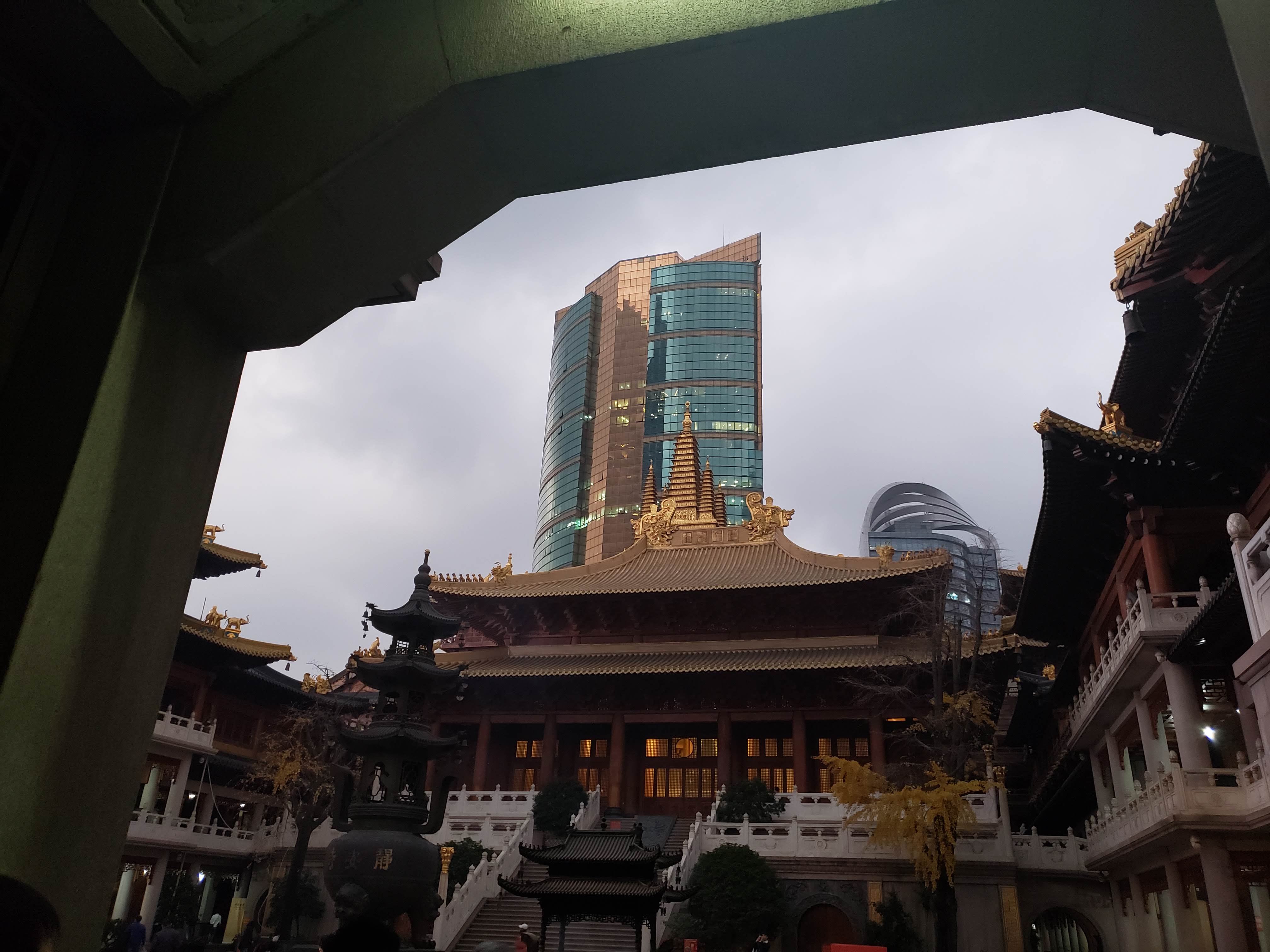
    Old and New Sit Side-by-Side
    20191214_170403

    One hears this truism far too often, but it is far too true. Much of China’s development has been haphazard, and high-tech commercial areas sometimes happen to spring up very near to ancient monuments. Shanghai is one such example, where dozens of temples around the city sit nestled among skyscrapers and Buddhist monks bump elbows with CEOs on the sidewalk. In fact it’s hard not too, considering that

    Chinese Crowds are Next F***ing Level

    20191214_173618

    One knows that China is heavily populated, but the extent to which that is true eludes the imaginations of those who have never been there.  If you dumped the entire population of Europe and Latin America into the United States it would still be hundreds of millions shy of the population of China. And it’s mostly concentrated in cities. 6 of the 10 most populous cities in the world are in China, including spots 1, 2, 3, and 4. You could triple the downtown population of New York City and it would be only about that of Shanghai and still far under Chongqing. You do not know crowded if you don’t know China crowded. Which can get extremely unpleasant when you factor in the facts that:

    Smoking is Ubiquitous

    What’s that guy doing?
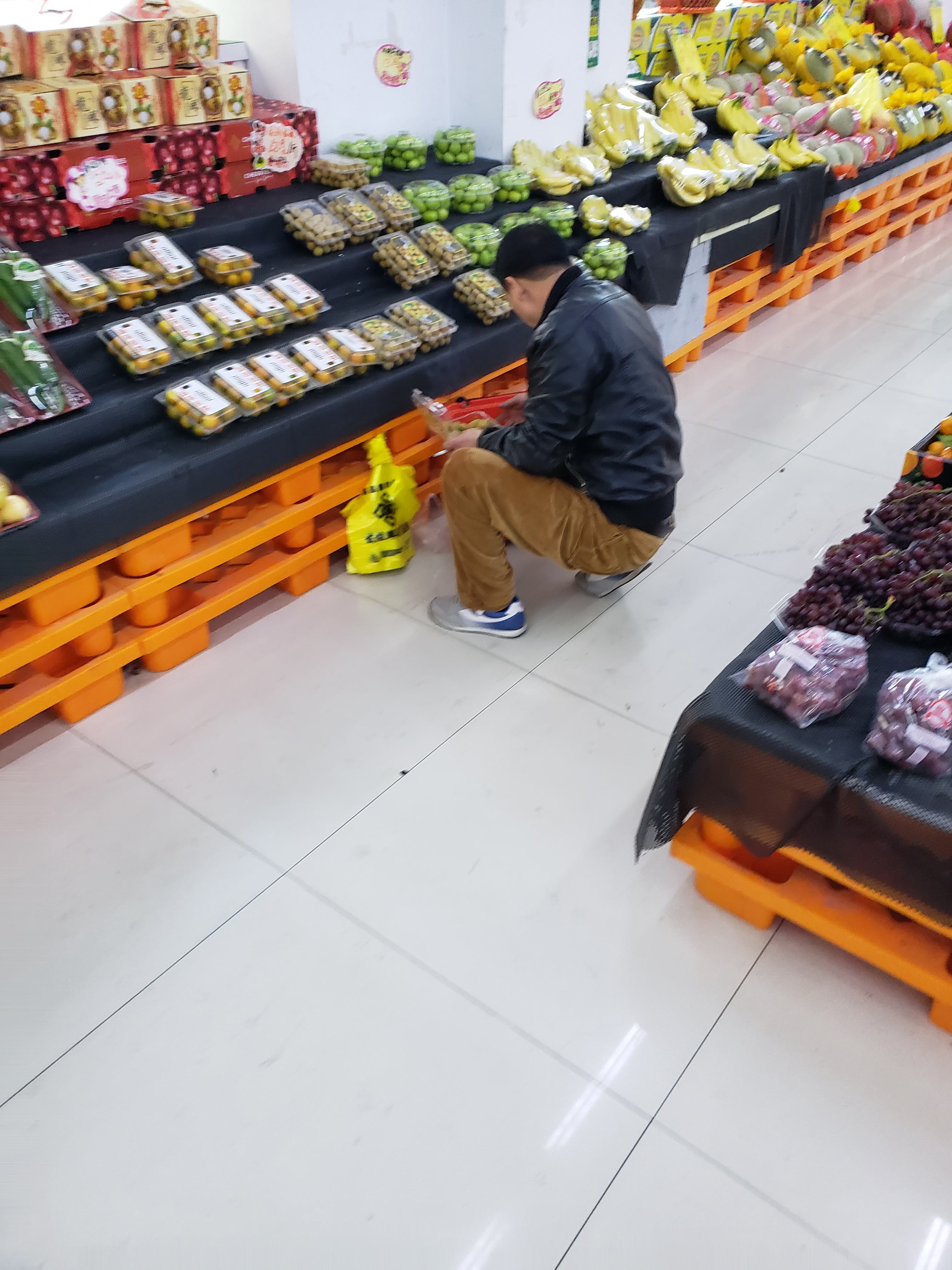
    20191215_150914

    Picking out fruit in the fruit store. While smoking a cigarette.

    What’s this guy doing? 20190814_111559

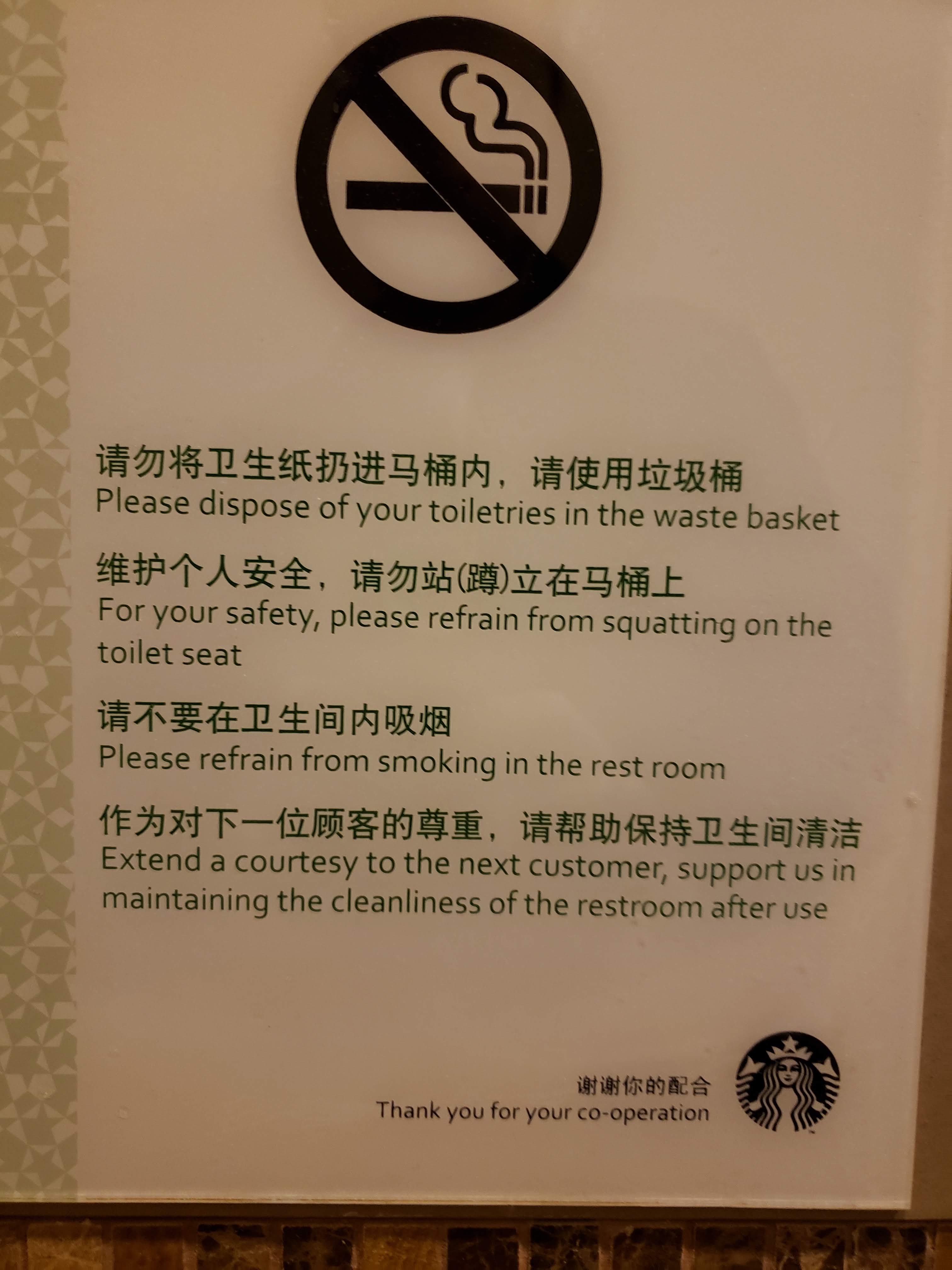
    standing next to a no-smoking sign. While smoking a cigarette (I asked this person if he could read, and he just glowered at me). More than a third of the Chinese population smokes (however this statistic exhibits strong sexual dimorphism, with the rate for Men being over 50% and that for women being under 5%) . I have heard anecdotally that one reason for the high smoking rate is that cigarette sales taxes are a huge source of revenue for local governments, but I do not understand the structure of Chinese civic finance enough to verify or refute that assertion. However, I have recently noticed a sharp uptick in the number of anti-tobacco messages through various channels. No-smoking signs exist in most of the places you would expect to find them in the West, but they are routinely ignored as a matter of principle, to the extent that I have taken to using the simile, “as useless as a Chinese no-smoking sign”. It is particularly accepted – to the extent that it is essentially the rule – to smoke in bathrooms, and every train station bathroom I have ever been in has reeked of cigarette smoke. Despite the signs.

    Squatty Potties

    20191206_17263120191201_113516

    One hears about there being squatting toilets in China. However, a typical reaction is to assume that they are the old style toilets of poverty, and that modern toilets are new and sitting-style. This is absolutely not the case: the squatting toilet featured here is on a new model high-speed train. Many people simple prefer the squatting potties because they can actually help with defecation. The problem, however, is that many people take that preference so strongly that they insist on squatting on western-style sitting toilets, such as the one at the Starbucks where the sign was posted. Starbucks felt the need to respond to that proclivity with the second point on the sign listed here.

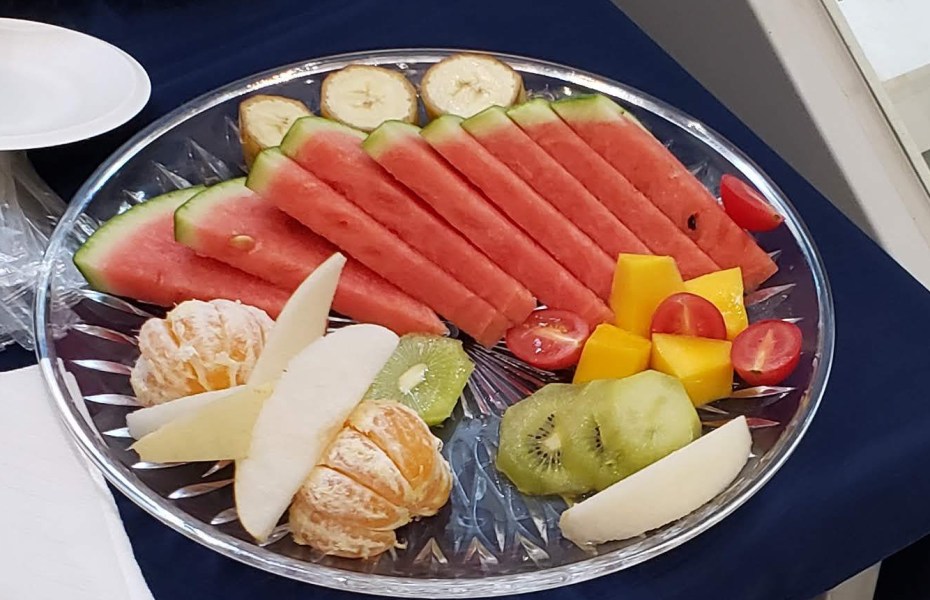
    Cherry Tomato is a Fruit
    20191206_102253.jpg

    There is an aphorism in English that “intelligence is knowing the tomato is a fruit; wisdom is not putting it in a fruit salad”. The Chinese would take great offense to that, as cherry tomatoes are regular features of fruit salad – in fact one of the most common ingredients. Cherry tomatoes are featured atop fruit pizza, in yogurt, and even candied to sprinkle atop ice cream. In case you’re wondering, they’re no sweeter than American varieties; in fact, I’ve had many varieties in the US that were far sweeter and less tart.

    Eating on the job in professional settings

    20191201_182730.jpg


    What you see in this photo is a pharmacist, in her lab coat, in a store that is open for business, eating her dinner with a companion in the middle of the store. This behavior is extremely common. There is no shame or embarrassment or even an attempt to hide it behind a counter. Nope – plonk a table down in the middle of the store and chow down.


    White people for advertising purposes
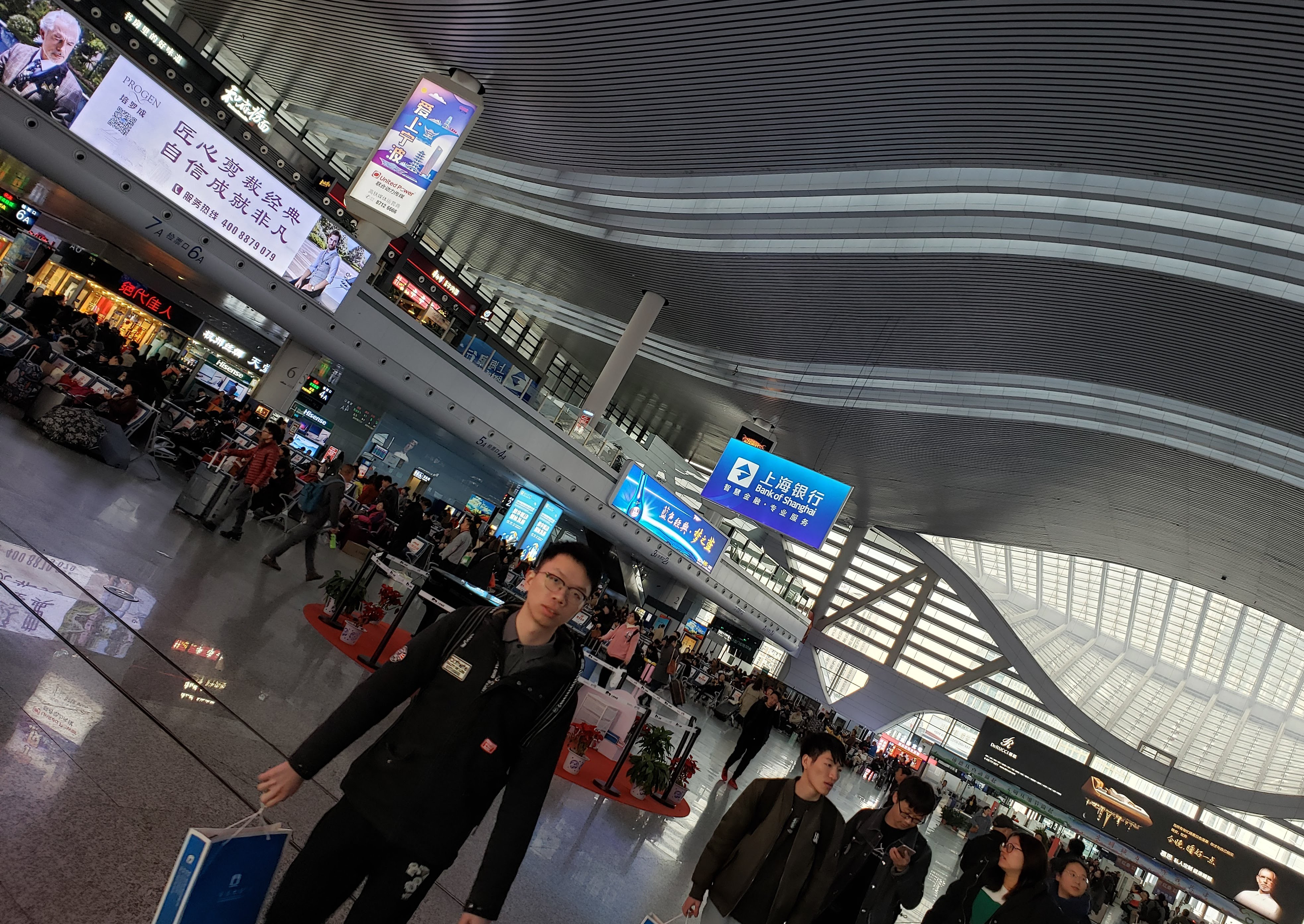
    20191201_134457.jpg

    It may be somewhat hard to see in this photo, but there are three white people used for advertisements in this photo – one in the bottom right and two at the top left. Regardless of the product, white people are often used to give a luster of quality and classiness to a product, particularly older white men who look like they could be professors. Though the official line is that China must walk past the West, in practice a lot of Western things are still celebrated as ideals.

    Atypical food combinations

    20191129_181432

    What, you don’t put cheese and mustard on your waffles? What about mayonnaise and corn on your pizza? How about espresso lemonade, beer-flavor latte, or yogurt and green tea? For me the things that are completely foreign in China are not shocking; it’s the the complete re-appropriation and recombination of Western foods that makes me do a double-take. And although it’s usually shocking, I’m constantly appreciative of the willingness to completely reimagine the artificial boundaries we place on food in our own cultures.

    Very strong opinions about borders

    20191129_181455

    China does not see eye-to-eye with its neighbors regarding where international boundaries lie, and makes sure to defend its position at every opportunity. Legally, all maps and globes printed in China must display the government’s official opinion on borders, including the famous nine-dash line of maximalist claims in the South China Sea (reaching all the way to the coast of Borneo). And by all maps, I mean all maps, even novelty things or those in a children’s movie. In fact, these kinds of things are perhaps most important of all from the perspective of the government: it’s important that kids be raised from birth always seeing the maximalist territorial claims, always believing such positions as “Taiwan is an inseparable part of China”.

    A lot of dress-up

    20191207_194855.jpg

    Many people like dressing up in, let’s just say “atypical” clothing in China. The two most common kinds are this kind of Victorian Doll type getup as seen here, or more commonly “Hanfu“, “Han clothing”, an anachronistic mishmash of any kind of historical attire worn in China from really any pre-modern period. As long as it looks historical and Chinese-y. This movement is often, but not always, associate with a Chinese nationalist movement to reject Western-influenced attire.


    Lots of thermoses

    20191207_202638.jpg

    This photo depicts a thermos store. A store…entirely of thermoses. This was not even the only one in this particular mall. Many Chinese carry thermoses ubiquitously, usually filled with tea leaves, and no airport, train, or waiting room is complete without a complementary hot water dispenser so that people can top-up their tea bottles. In literally every taxi I have ever been in in China, the driver has a thermos full of tea (this is not always the case for Didi, the Chinese Uber clone, for some reason)
  • Embracing the Anthropocene

    There’s an idea that I’ve been tossing around in my head for quite some time, and I wanted to start laying the groundwork for putting into text. The gist of the idea is this: we’re probably too late to stop the worst of climate change. Therefore, does it not behoove us to at least consider how to make the most of the completely Anthropocene world we are creating?

    Some things to consider:

    1. As global temperatures rise, very cold and barely habitable places like Siberia, Alaska, Greenland, Northern Canada, and Antarctica are going to become habitable. Colder habitable areas, e.g. New England, the Upper Midwest US, Northern Britain, Scandinavia, Hokkaido, Manchuria, Tierra del Fuego, and New Zealand will have “better” overall temperatures. Altogether, these are enormous areas (Canada and Siberia particularly). The biodiversity of arctic and semi-arctic areas is very small compared to more temperate areas – broadly speaking, more energy in an environment means more life –  and we need to investigate the possible upsides of cultivating these areas. The conversion of tundra to taiga, taiga to coniferous forest, and coniferous forest to temperate deciduous forest stands to be an enormous boon in some respects.
    2. The opening of sea lanes is going to be monumental. For centuries, explorers sought Northwest and Northeast passages from the Atlantic to the Pacific; those passages are becoming available. Ships are now beginning to ply the waters of the Arctic ocean, and soon will be a regular occurrence, shaving as much as 40% off of current routes through either the Panama or Suez Canals.This point has already received a great deal of attention, and many skeptics point to the fact that, e.g. trade between China and Norway is extremely small, or that ports of call are nonexistent along the Arctic coast. However, these estimations are making the fatal flaw of dealing with the situation as it stands, not as it may be a century hence. As natural resources beneath the arctic are exploited and shipping expands, new settlements and ports are bound to be founded, and the Arctic Ocean will likely in future decades be dotted with lights throughout its sunless winters.To this end, the Bering Strait may well be the Bosporus of the next Century, and the United States and Russia would likely both benefit from improving infrastructure at the strait, both port entrepot facilities and rail/road/pipeline connections.

    3. Higher atmospheric CO2 concentrations will mean faster plant growth. Already, the average color of the earth is becoming greener, and greater forestation in China and India are substantially to thank. Combined with the effects from point 1, there could end up being enormous booms of plant growth in the higher latitudes in coming decades.
  • Alex Tabarrok on “Is Democracy Doomed?”

    Marginal Revolution has an interesting discussion on the question here.

    A highlight:

    if the average nondemocracy in their sample had transitioned to a democracy its GDP per capita would have increased from $2074 to $2489 in 25 years […] If we want countries to adopt democracy, twenty percent higher GDP in 25 years is not a big carrot.

  • An Economic Policy Film Review: “Default”

    An Economic Policy Film Review: “Default”

    mv5bowexyzlinjytmmvhyi00ntdmlwe1ogitztnmyty2yzzmnznhxkeyxkfqcgdeqxvyoda4odiwndm40._v1_

    I recently had the opportunity to watch the Korean film “Default” (Gukgabudo-ui Nal) (2018). The film models itself quite transparently on “The Big Short” (2015), aiming to be a behind-the-scenes tell-all about the lead-up to the Korean chapter of the 1997 Asian Financial Crisis. To the extent that I knew far too little about this Korean leg of the crisis, the film was informative and interesting; however, I was awed with how much this film seemed to advocate policies that ran counter to good and standard economic practice, and how much of a biased and one-sided perspective the film took against everyone’s favorite perennial punching bag, the IMF. Allow me to give a quick summary before giving a few salient scenes and a counter from the perspective of orthodox economic policy.

    In 1997, The East Asian Financial Crisis was underway due to a sudden loss of confidence in East Asian governments/economies and a pull-out of credit and investment from global investors. The intricately interwoven economies of the area fell like dominoes as each country had to call in favors and liquidate investments in the next in order to stave off complete collapse. In the fall of that year, after it seemed that most of the damage had been confined to Southeast Asia, Korean policymakers came to realize that they were overexposed and would soon go over the cliff as well. Quixotic Bank of Korea head of monetary policy Han Shi-hyeon, the film’s main protagonist, is shown attempting to take the side of “the people” against the banks and big corporations who, as the film would portray, created the mess.


    Criticism 1: Money alone does not an economic crisis make

    As the drama unfolds, the governments economic officials strongly urge that no information about the impending crisis be made public, but the film wishes us to side with Ms. Han’s plan to “tell the people” about the issue so that they can begin saving and can avoid making poor investment and savings decisions. To really sell this argument, the film weaves in another vignette of a factory owner who takes out a large loan just hours before news of the crisis breaks. The film’s obvious lesson and argument are that “the government should have been transparent about the problem as soon as it could, and the opacity caused undue tragedy for common people”.

    So what exactly is wrong with this perspective? The simple answer is that economies are not made up entirely of dollars and products. They are equally composed of expectations and perceptions. As John Maynard Keynes dubbed them, “animal spirits” like consumer confidence can cause economic effects that dwarf many material realities. It is not balance sheets, but rather perceptions of and reactions to those balance sheets, that make a crisis. An issue on a balance sheet can be corrected, or policy safeguard can be effected, without consumers or traders ever knowing and without a crisis ever occurring. The goal of any government in such a situation should be to delay the public realization of a problem as long as possible while stopgaps and corrections can be put into place. It is a race against the public finding out – to go directly to the public and announce a crisis is to call one into being. The couple of factory owners who make bad investments because of the lack of news surely exist, but are red herrings here, very small unfortunate situations in the scheme of an economy of millions of people.


    Criticism 2: Whether to Turn to the IMF

    A little later in the film, the question comes up of whether to turn to the IMF for help. Just a few of the the most egregious tidbits:

    • “The IMF Doesn’t just lend money. They’ll make demands about running our economy”
    • Ms. Han: “In return for a bailout loan, they[the IMF]’ll require unreasonable conditions”

    This line of critique of the IMF is extremely common, but misses the point entirely. The IMF is a lender of last resort. Any country would rather go to a bank or an allied national creditor first. No one compels a country to go to the IMF. The IMF is bitter medicine for a country in such a bad financial situation that no other bank or lender in the world wants to take a risk. And if a country has gotten itself into that situation, it needs medicine, no matter how bitter. The reforms required by the IMF are often radical, though are always in line with global economic best practices and policies for restoring financial solvency. But any country has the option of not agreeing to those reforms and not taking the loan. As the IMF representative in the film retorts to Ms. Han, the IMF offers nothing other than “the funds you asked for…you’re not exactly in a position to make a deal”.

    Relatedly, Ms. Han’s proposed alternative, going to the US and EU for loans and then “using government-owned assets as security” for ABS (Asset-Backed Security) bonds, is not different in principle from a common IMF policy of selling off bloated government assets into the market to raise capital. Either way, government assets are being marketized.


    Criticism 3: the Nature of Developing-Country Economic Crises

    This criticism is a bit of my own soapbox about an issue that I have never seen put in the terms that I think of it in. As Ms. Han states in the film, “The question of improving the Korean economy should be considered separately from the foreign reserves issue.” But to counter Ms. Han, when a developing country has a crisis, it does not have just one crisis. If it has an economic crisis, it also has a financial crisis and the two are inextricably linked, with only one way out. This presents a terribly inflexible situation.

    To explain what I mean, let us consider how things work in a “developed” country like the United States. When the US faced its financial and economic downturn in 2008, there was an immense decline in consumer confidence and consumer spending that threatened to turn a recession into a depression. At the same time, however, there was very little lack of confidence in the solvency of the US dollar or the solvency of the US government. As a result, lenders were happy to back the expansion of the US deficit to pay for TARP, the Auto Bailout, and the Stimulus, three massive Keynesian expenditures that sought to – and by all indications ultimately were able to – stabilize consumer sentiment and market confidence and reverse a slide into depression.

    When an economy has a downturn, what the government should do according to modern post-keynesian orthodoxy is inject money into the economy through stimulus programs – be they checks or tax incentives – to rev it back up. But to do this, the government must have at least one of two things: the cash reserves to do it, or the confidence of lenders to be able to finance it at a deficit.

    So how does it work differently in developing countries like 1997 Korea? Such countries often lack these latter two resources. When an economic crisis hits, developing countries often have relatively little cash on hand to directly pay for a keynesian injection of funds into the economy; they also don’t enjoy the unwavering confidence of the markets in the way the US does. So they cannot really pursue Keynesian stimulus policies to any realistic degree. One of their few policy levers available for economic stimulus in such a situation is inflation: lower the value of the currency so that the country imports less and exports more, increasing the balance of trade and helping to stabilize the economy, but coming at the cost of consumer purchasing power, as well as the competitiveness of some import-heavy sectors, as well as overall standard of living. One problem with this is that if the country’s external debts are denominated in other currencies (e.g. if Korea took out loans in Yen and US Dollars), the cost of those debts would increase in terms of the domestic currency (e.g. the Won). Thus, what is good policy for paying of government debt is bad policy for stimulating the economy, and vice versa.

    I do not envy the government of a developing country during an economic crisis.


    Criticism 4: The Bundling of Neoliberal Policy Positions with General Assholery

    This is not a policy critique exactly, but a critique-of-a-critique. In the film, the primary proponent of seeking the assistance of the IMF and pursuing neoliberal reforms in the Korean economy, the unnamed Vice-Minister of Finance, is made out to be a general asshole. Shortly after giving his strawman argument for seeking IMF assistance, he devolves into a sexist and classist tirade, insulting his female colleagues as overly emotional and demanding they – cabinet level or other high-ranking women- bring him coffee. It should go without saying that I find these attitudes repulsive in and of themselves – once again, I unabashedly favor the complete and total socio-politico-economic equality of the sexes  – but I also find it repugnant that the only defender of any sort of neoliberal policies in the film is also made to be an asshole.

    This is a common trope, without question: neoliberal reforms are heartless and cruel, they put money before people, they put big faceless institutions ahead of society, etc. Rarely do we see strong and explicit support for such policies. Rarely do we hear how free trade brings peace and prosperity; rarely do we hear about where a lack of regulation actually improves well being (not that I favor complete deregulation of the economy, far from it, but there are many wonderful bright spots – the early days of Silicon Valley come to mind). And we never get to see the counterfactuals of what countries that do seek the help of the IMF would do if the IMF did not exist.  We do not see the counterfactual world in which the moral hazard of writing off the loans of many developing countries runs rampant. And when we do get to see these policies defended in popular media, it appears to always be by the most shallow, arrogant, and cold-hearted of representatives.


    Concession and Conclusion:

    Ms. Han does have a few valid criticisms, however. She notes with alarm that some of the IMF conditionality requirements, such as the requirements of hostile takeovers and several capital and labor market reforms, coupled with the involvement of the US treasury, may serve primarily to advance US interests rather than to simply shore-up the solvency of the Republic of Korea. These criticisms are valid, and indeed there has been a chorus of criticisms for decades that IMF reforms do unfairly privilege large businesses in the market at the expense of SMEs and social stability more broadly. These critics must at least be listened to, if only to secure the legitimacy of neoliberal institutions. For if these systems and institutions are not defended, there are others waiting in the wings to take their place.

  • The Irrationality of GMO Opposition

    The way in which the issue of GMOs is framed drastically influences opinions on the subject. If we take GMOs broadly to mean their common implementation in the context of corporatized, chemical-heavy, monocultured agribusiness, few people are strongly in favor of these systems. However, if we take GMOs narrowly to mean the simple fact of inserting positive genetic traits into crops to make them for example more drought-tolerant, more nutritious, or resistant to certain pests, strong opposition plummets.

    Let us address these two definitions in turn. As regards the broad definition, in this context there are few aspects of GMO cultivation that differ from general international agribusiness. The same criticisms that are levelled at the former are levelled at the latter. The exploitation of farmers in the developing world, the destruction of natural habitats, the use of pesticides, and the creation of environmentally monotonous monocultures are problems common to any form of corporate agriculture, be it GMO or non. It may thus behoove us to consider the possibility of decoupling these two concepts: let us consider for a moment the possibility of GMOs implemented in small-scale, ecologically harmonious, potentially organic conditions – all the problems that critics may cite regarding corporatized agriculture removed from the picture, with only the GMO technology itself remaining. To what point, then, does the level of opposition fall? I am not sure how easy it would be to ascertain this information, given the need to walk poll participants through a bit of a thought experiment, but the question does remain.

    Even so, there remains a core of critics who are starkly resistant even to the technology itself. These critics primarily see the manipulation of nature via genetic modification as an inherent wrong – nature bequeaths to us a certain set of genetic variation, and it is our station to work within that framework. To these critics, it should be pointed out that the entire history of human agriculture has involved genetic manipulation – selection of desirable traits in crops and animals for the past 10,000 years has left many of them starkly different from their pre-modern forms. Genetic modification has always taken place and always will. Another line of criticism, though, concerns the dangers of genetic manipulation. Inserting pesticidal genes into human crops might be inadvertently harming humans or the rest of the ecosystem, and the results may not be apparent for years. Thus, it is better to maintain precaution by avoiding such technologies altogether.

    This argument is not entirely incorrect, but it is still not an argument against GMOs. The fault in this reasoning is that conventional plant breeding is susceptible to exactly the same problem. For a benign example, consider modern storebought tomatoes. Throughout the 20th century, grocers began noting that bright red tomatoes sold better than mottled or off-color varieties. Grocers passed this fact on to farmers and plant breeders, who responded by selecting for brighter and redder tomatoes, leaving us today with blue-ribbon tomatoes – at least on the surface. But beneath the exterior, a genetic trap was being sprung: in tomatoes, genes for color are coincidentally close on the strand of DNA to those for sweetness and flavor. And thus decades of careful breeding and selection for bright red tomatoes left us with storebought tomatoes bleached of flavor and sugar. Anyone who has ever tasted a home-grown tomato can attest to the fact that there is very little in common with the flavorless storebought varieties other than an ostensible name and exterior. We manipulated plant genetics through conventional plant breeding, and had no idea what we were doing. The result is a culinary disaster.

    But as I mentioned, that was the benign example. Other such mishaps are not so harmless. Consider, for example, the Lenape potato. In the mid-twentieth century, potato breeders sought a perfect spud to make chips with – white, flavorful, and capable of frying up with a delightful crispy crunch. But as with the tomato above, the treasure trove of conventional breeding perfection turned out to be a pandora’s box of unwanted genetic consequences. The resulting potato proved unexpectedly high in glycoalkaloids, resulting in several potato chip enthusiasts experiencing life-threatening illness.

    To this end, GMOs actually provide a solution rather than a deepening problem. Breeding of plants and animals is always a tricky proposition – in addition to the myriad of genetic shuffles that take place between the DNA of two parents, there is the randomness of genetic chance – mutations, the stuff of natural selection and evolution. Without sequencing the genetic makeup of each individual seed, it is impossible to know what exactly the final product will be. But with genetic modification, it is possible to know exactly what genetic changes have taken place; indeed, that is precisely the point. If we want to insert a gene for the production of Vitamin K from an obscure berry into a common rice plant, we don’t have to guess at what those genes are going to do: the genes for vitamin k production are read by the plant’s cells as only that. However, due to the nature of genetic variation and mutation, it is actually a possibility that through conventional breeding, a rice plant could produce offspring with the very same gene that the berry has – or to have a genetic mutation result in a gene that fills the rice plant with cyanide. Both could happen without breeders, farmers, grocers or consumers ever knowing – until it was too late.


    The Spain Study

    These things said, I would like to draw attention to a recent study on GMO cultivation in Spain. The study reveals that GMO cultivation has resulted in greater economic benefit, lower pesticide use, lower land use, and ultimately lower environmental impact than conventional agriculture. On the whole, GMO agriculture in Spain is simply better in various dimensions. It remains a fact that many of these plantations are monocrop, that they are not organic, and that they displace traditional small-scale agriculture. But what is the right comparison to make here? I propose that the comparison ought to be drawn not with organic farming, compared to which GMO cultivation can leave much to be desired for many people, but rather with conventional large-scale agriculture. On the several dimensions mentioned above, GMOs offer an improvement. And for those who would still say that it’s better to be safe than sorry on GMOs, I would argue – is keeping pesticide use and land use higher than necessary really “playing it safe”? The precautionary principle works both ways: sometimes caution is keeping a new technology out; sometimes caution is letting a new technology in. Not innocent until proven guilty, but an improvement until proven a detraction.

    Opposition to GMOs will remain widespread. The idea that humans are haphazardly tinkering with nature and creating frankenfoods has a great deal of cache. The idea that we should make do with what we have and not risk unforeseen harm is a powerful one as well. I do not ask anyone to abandon caution, or to abandon a reverence for a natural way of doing things. All that I ask is that these same principles be taken to their natural conclusions: could caution not lead us to, sometimes, accept GMOs? And with a complete reverence for natural ways of doing things, what else would we need to abandon?

  • Changing Culture

    “The central conservative truth is that it is culture, not politics, that determines the success of a society. The central liberal truth is that politics can change a culture and save it from itself.” – Daniel Patrick Moynihan

    I was speaking today [caveat: I wrote this last year] with my French father-in-law about the recent heat wave that is gripping Western Europe. I was giving him some tips about how we from the Southern United States deal with extreme heat – drinking massive amounts of ice water, avoiding walking outside too much, and rolling down the windows in our cars to let the heat out.

    There was a small problem: all three of these things are, in my experience, anathema to the French.

    First, the French drink water in miniscule quantities – my American family was once, in France, served a pitcher of water to share amongst the four of us for the entire meal. That four-person pitcher of water was smaller than many individual cups of water that one might be served at a southern American eatery and that would be refilled multiple times during the meal. Whether this trait of Americans is a reaction to warmer climes, I cannot say, but the fact is that it certainly helps us cope with warmer temperatures.

    Second, the French are a walking-friendly people. Rather, I should say, Americans are a walking-unfriendly people, for the truth is that the vast majority of the world walks to most of the places they need to go, and midwestern Americans are an exceptional bunch in their reliance on cars to go even short distances. It is consequently very easy to encourage Americans to walk less to deal with warmer weather. For the French, on the other hand, there is an opposite sort of tradeoff. The French have largely eschewed the option of living in spread-out suburbs with lots of privacy and space and distance; in return, they chose to live across the street from a bakery, a cafe, a corner market. The French by and large choose conviviality and community over privacy any day. Americans tend to choose the opposite.

    The final suggestion demonstrates one extreme of the cultural divide: Americans in the South and Midwest crack their windows as a matter of course. For the French, this is perceived (justifiedly or not) as an open invitation to rob or steal the vehicle. No one does this. To illustrate why not, side-mirrors in France are as a matter of course folded up when the car is parked. When I first encountered this, my natural naif reasoning was “oh, because many cities and streets are so compact, they fold in the mirrors to save space.” Upon venturing this guess, I was told exactly how much of a naif I was: the reason that side mirrors are routinely folded in in France is because when they are left extended, they are kicked and broken off as a matter of course. What this says to me about French culture is this: France is a country in which social cohesion is minimal and there is no trust among strangers. There is only cynicism and distaste. This seems to contrast strongly with the aforementioned observation that French choose conviviality and community – this holds true at the small scale of family and friends, but collapses beyond that. The ingroup/outgroup divide in France is thus quite strong. There is little in the way of national social solidarity – there is only the state and the family ingroups within it, and all the fellow residents of the Republique are competing for the same resources and same slice of the pie that the State dishes out.


    Given the above proclivities of French culture, vis-a-vis my own Middle American cultural expectations, it was a great surprise to me when my French father-in-law said that the public media in France were pushing all of these tips: drink lots of water, stay indoors, and even [gasp!] roll down car windows. This revelation prompted me to wonder about an important question: how much can news and policy really affect culture? There are of course examples of significant cultural changes, for example, littering. As famously shown on Mad Men, littering was a completely normal and acceptable way to dispose of trash in the 1960s.

    However, beginning in the late 60s, this began to change:

    According to Keep America Beautiful, the actual count of overall litter has decreased 61 percent since 1969. So what’s created this success? It’s taken 40 years of pushing multiple behavioral levers, including education and fines and making the desired behavior incredibly convenient.

    Sustainable Brands

    But let us examine that information. Yes, there has been a 61 percent decline [58 in a later version of the study] in littering. But it did take “40 years of pushing multiple behavioral levers”. Mao Zedong’s Great Proletarian Cultural Revolution was perhaps one of the most radical and far-reaching attempts in human history to politically reshape culture, and yet now, decades later, Chinese folklore and traditional histories are immensely popular and the Chinese Communist Party is pushing neo-Confucianism as the glue to bind together a society that is increasingly dynamic and increasingly in need of common touchstones and cultural ideologies. The ability of politics to truly reshape culture seems, at best, very limited.


    And yet: those examples are big and bold and highly visible, and rooted in direct political coercion. Is it possible that more subtle policies can be more effective at reshaping culture and behavior? Classical Liberals, Libertarians, and economists would say that the way to manipulate public behavior in a lasting way is through market mechanisms. Libertarian policy thinker Cass Sunstein notably embraced the concept of “nudges” – small market-oriented mechanisms that simply put a finger on the market scale and make it more advantageous to choose a prosocial behavior over an antisocial one (e.g. putting a small price on carbon).

  • Stories and Truth – a Rivalry?

    I recently engaged in the following conversation about the nature of stories and truth. Others’ comments in quotes, mine unquoted. All have been edited for readability and style.

    “Never let the truth get in the way of a good story”

    I strongly dislike this idea. Reality is enchanting and amazing. Things happen in history and real life that would seem utterly contrived and  unbelievable if written down. If one can’t tell a good story without bending the truth, then maybe one is just bad at telling stories.

    Facts happen once and are gone. Sharing it or writing it down completely changes what happened. The storyteller or writer chooses what to convey. So reality may be amazing, but cannot be shared in its full splendor.

    I do not agree that just because reality may be ephemeral that we should not attempt to hold ourselves to it as much as possible. Of course our forms of communication limit how much of reality or of lived events can be conveyed, but I eschew the notion that since absolute truth is not possible that we should fully abandon its pursuit.

    Adherence to facts and truth is the goal in serious journalism, but even there the journalist is limited by their subjectivity. And when the facts don’t fit the narrative it’s usually a lot more common to change the facts to fit the narrative. But the same is true of readers, who bring their own subjectivity to the reading experience. In other words, since words carry meaning, we can never have an objective recounting of the truth.

    I agree and I take these points seriously. However, there’s a postmodern idea that says that since we can never truly reach truth and objectivity, it’s pointless to try and we should indulge in subjectivity, letting one person’s biased and subjective views counter another person’s biased and subjective views. I find this unworkable and self-defeating, because why would we engage in the process of meaning-making at all if it’s ultimately impossible to arrive at an understanding of another person’s thoughts and experiences?

    I propose, rather, a neomodernist framework: we take in stride the postmodernist criticism that objective truth is an unreachable ideal, but as with any ideal we follow it as best we can. We also elevate other interpretations that aim for the same ideal and strive for critical awareness of our own biases and preconceptions, and from those triangulate what the ideal “objective truth” might be, even if it is unattainable.

    And more consequentially, we must have a shared epistemological system in order to maintain or construct a shared global culture and civilization. If every person has their own epistemological system, then the world contains more than 7 billion different cultures and civilizations, rendering a true shared human community an impossible dream. It should not be an impossible dream. It should be the goal we work toward every day.

  • The Challenge of Deepfakes and the Need for Institutions

    The Challenge of Deepfakes and the Need for Institutions

    What are Deepfakes? Fake videos that are too good for most people to tell apart from the real thing.

    These have long been used for entertainment, but it is clear the dangers that these can pose to the political and informational system. Unfortunately, we have to start treating videos with as much skepticism as we do images and news articles – they can all be faked, and the most damaging fakes are the ones that are only subtly faked and highly credible. They can and will deceive the cleverest and most scrutinizing of viewers – yes, even you.
    There are two ways around this: either require that everything you believe be seen live with your own eyes – in which case all digital news and media becomes useless – or trust in institutions that can do the research for you. The latter is more difficult, yes, but the truth is we do this already, all the time. People cannot be experts in every aspect of modern life; some things have to be taken on trust in competent regulatory authorities. How would a layman with no particular interest in science even know where to start finding out the efficacy of medicines? Is everyone an expert in automobile safety, consumer financial products, food safety, product safety, medicine, law, building codes, etc.? No one can be. You and I take some of those things on trust in authorities or we live the most joyless life imaginable. We simply have to add “news” to this list. It must be regulated in the way that medicines had to be regulated after babies were being given cocaine and influenza was being treated with river water.
    Unless we embrace regulatory bodies and authoritative institutions to help us sort through this coming quagmire, we are left crippled and blinded to any news or information whatsoever. Institutions that embrace peer-review, that embrace criticism, that embrace transparency – those are to be trusted. We have to. Modern civilization depends on it.