Tag: trade agreements

  • Why are European Farmers so Angry

    The Global Context of the Continental Uproar

    Farmers are special in a lot of ways. They receive enormous amounts of subsidies from governments in a way that no other industry does. In most industries, free trade agreements prevent member governments from giving government subsidies to their industries; these would be unfair advantages that defeat the purposes of trade agreements. However, agriculture is by and large exempt from these free trade agreements. Why? A lot of food is easily freezable, cannable, refrigerable, processable and shippable around the world, and if we had a world with fully free trade, imported food from Far-Eastern Europe, Latin America, Africa and South Asia would be far cheaper than domestic production, and the agricultural production of wealthy countries would go the way of the textile production of wealthy countries – i.e., it would be uncompetitively expensive except as niche and artisan purchases, and soon there would be very few farmers or agricultural production in wealthy countries.

    And this is really bad PR, and, potentially, bad policy. Why? Countries like to be able to say that they can feed themselves. If the voting public in some countries got wind that their government approved a policy that made their country completely dependent on foreign imports to get fed, they would burn down the halls of power (though many wealth countries with high populations and low arable land area, like Japan or the Netherlands, have been deeply dependent on food imports for decades – and microstates like Singapore are completely dependent on exports for basically everything, one reason why small states are historically big proponents of free trade: they just can’t aren’t big enough for self-sufficiency to be a realistic goal).

    But like I said, it’s not just bad PR, it’s also potentially bad policy. The Pandemic years were a wake-up call to many countries that it might not be a bad idea to make sure one’s supply chains were robust and that one’s stocks of essential goods were secure. The world witnessed (despite efforts at censorship) starvation in a modern wealthy city (Shanghai and other Chinese Cities) when draconian covid lockdowns strained supply chains to their breaking point. It has long been military policy of many countries like the US to ensure that their agricultural production would allow the country to feed itself in the event of a trade-destroying war, and this makes a lot of sense because the US could realistically defeat any conventional enemy in conventional war but if faced with domestic starvation would be crippled.

    There’s also the pure PR power of farmers that makes them punch far above their weight in cultural and political discourse: except for the bluest of bluebloods, we all have farmers in our very recent ancestry, and until the 19th century most people in most countries were farmers.
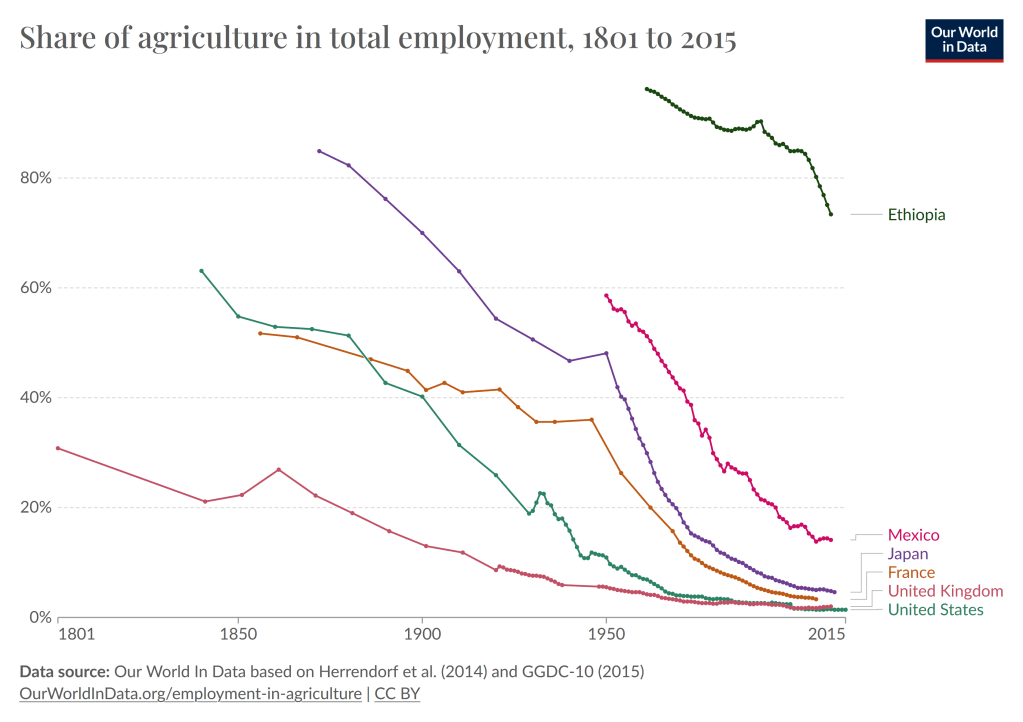
    Farmers are widely seen as embodying superhuman amounts of grit and humility, a winning personality combination in many countries. For all these reasons and more, their political clout is outsized.

    Thus, many wealthy countries have gone out of their way to subsidize their agricultural sectors and keep farming productive and competitive – and farmers quiet. However, it has become increasingly apparent to policymakers that their treatment of farmers is potentially anti-environmental (https://whitherthewest.substack.com/p/the-danger-of-eating-locally) and inegalitarian. I’ll address each of these points in turn. Regarding the environment, farming can be highly polluting – not just via fertilizers and pesticides, but by outdated farm equipment; as an aside, I once heard a French farmer’s solution to a badger on his land was to pour gasoline into its burrow.

    Regarding equality, remember how I said that wealthy countries want to keep agriculture out of free trade agreements so that they don’t get overwhelmed with cheaper products from Latin America, Africa, Far-East Europe and South Asia? Well, Latin America, Africa, Far-East Europe and South Asia are rather unhappy about that – agriculture is often their comparative advantage, and they find it deeply unfair that the things wealthy countries produce (manufactured goods) are subject to reduced tariffs, but the things they produce efficiently (agriculture and forest products) are magically kept out by tariffs for “nAtiOnAl sEcUrItY ReASons”.

    This brings us to today. Many on the left side of the political spectrum in the EU are aware of these two issues (environment and inequality) and are pushing for changes that would not benefit the EU agricultural sector but would privilege environment and global social justice – reductions in subsidies, enforced environmental protections, and ongoing free trade negotiations with Mercosur (a Latin American trade bloc). With the latest push for the Green New Deal in Europe, farmers around the continent decided to see how much heft they had in the European political machinery. And it turns out, they have quite a bit, seeing as after only a few days of protest they secured key concessions from the French government – an exemption from the diesel subsidy phaseout, and continued “No” from France on negotiations with Mercosur. And European far right groups are linking arms with farmers, pushing for increased emphasis on sovereignty and territoriality against the “hegemonic” imposition of EU rules.

    The upcoming European Elections will decide a lot of this – will the right’s courting of farmers work, or will Europeans tire of the antics before June rolls around – but to some extent the battle is already lost. The fact that left-environmentalism seems to see agriculture as fair game means that the PR armor of farmers has already been breached, and more reforms in the direction of both environment and global equality are likely to come in the future.
  • Culture as a Trade Barrier

    Or one way illiberal states get the better deal on trade agreements

    A concept that I would have imagined was thoroughly discussed, but which I somehow cannot find discussed anywhere, is the concept of culture as a trade barrier. Now the idea that culture affects trade is nothing new – no one ever claimed that every country should buy equally all the products of the world; culture is a normal and expected part of the global marketing and trade landscape. But what I have never seen discussed is the extent to which culture can act as a hard barrier which can act one way more strongly than the other, or as one that is malleable for the purposes of statecraft – particularly in the hands of totalitarian societies that can shape public opinion and craft cultural trade preferences more easily than democracies.

    What I mean when I say that culture can be a trade barrier, and often should be studied and analyzed as one, is this: different peoples in different countries tend to buy different things. Sounds simple, right? But it’s not simple. Some cultures can be very fussy about the products they consume coming in particular forms or from particular places, and these preferences can make foreign producers of ostensibly similar products (replacement goods, to use the formal term) have to fight uphill battles to get their products into those markets, even if there’s not an equivalent in the other direction (I list several examples below). These preferences can take many different forms: sometimes people tend to buy things that are from their own country, or tend not to buy things that are from a specific country, for completely irrational reasons or even without any particular reason, just by background cultural “by-default” programming. Or sometimes, because of the cultural traditions and preferences of the country, there may be an extreme difficulty getting the citizens of the country to buy things from somewhere else. Critically, these preferences are not fixed, and are susceptible to marketing campaigns, but are equally susceptible to state programs of marketing or propaganda (depending on your perspective).

    Nationalized Preferences

    For an example of “national preference” trade barriers, we need only think of “buy American” campaigns. In the context of World Trade Organization or other free trade agreement (e.g. the European Union or USMCA), national governments have their hands tied on providing direct subsidies, protections, and benefits to the industries covered by the agreement. For example, if it is agreed that countries should trade bicycles without trade barriers, it would be a violation if a party to the agreement were giving government subsidies to their domestic bicycle industry, or doing something to restrict the imports of bicycles, causing an unfair advantage in their competition with trade partners; the WTO has mechanisms for levying punishments on violations by members. However, countries have the possible workaround of trying to shift national preferences. A campaign encouraging people to “buy American” can potentially have small effects that shift buying preferences and result in some difficulty in non-American products competing in certain contexts – a slight raising of the cultural trade barrier. Though in practice these campaigns don’t have much effect in the US, in other countries waves of national sentiment can constitute huge trade barriers: the Chinese government has long fanned the flames of anti-Japanese sentiment, causing Japanese shops and factories to be damaged and close due to Chinese protests, and even causing rebranding of Chinese brands accused of being “too Japanese”; when this happens, Japanese sales to China of many goods predictably fall. Critics may argue that preferences of national origins are often “signals” of quality (i.e. with no further information about products that appear identical, most western consumers would likely judge “made in China” to be lower quality than “made in Germany”), this is not a 1:1 correlation with preferences for buying things from a specific country – people may choose to buy from one’s own country even if it doesn’t mean cheaper or better quality, or buy from “friendly” countries over “unfriendly ones” as seen by American boycotts of French-sounding products at the outset of the Iraq War. So clearly there is something else going on aside from signaling.

    Denationalized Preferences

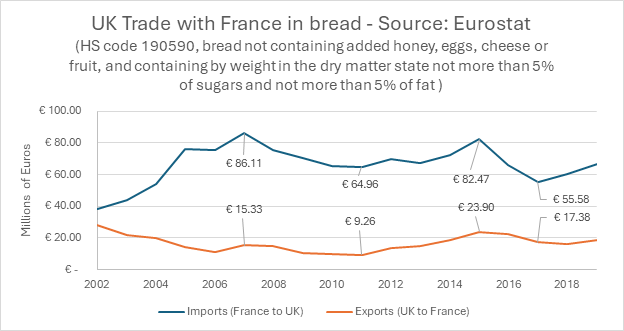
    For the denationalized “cultural preference” barrier, take milk for example. In country A people may be perfectly willing to buy and use UHT (Ultra-High Temperature pasteurized, i.e. shelf-stable) milk as any other milk. And in a neighboring country B people may overwhelmingly prefer to use fresh, refrigerated milk. As a result, country B can UHT-pasteurize and export all of its excess milk production into country A, but country A will have a much harder time shipping fresh milk to country B at affordable prices, since such shipments would require refrigerated trucks and much more efficient logistical planning to ship the milk larger distances over international borders. Thus, the culture of country B constitutes a form of trade barrier relative to that of country A. For a data-backed real-world example, consider the preferences in bread consumption of France versus the UK. In the UK, bread is often consumed, as in the US, in a soft, pre-sliced form, easy to pop in the toaster for breakfast, and just as easy to keep fresh on the shelves for days on end; in France, bread is by and large consumed fresh, with a crackly-crusty exterior while still being soft on the interior, a juxtaposition that breaks down within hours if wrapped in plastic, or becomes too dry and hard if left unwrapped – in short, impossible to pack and ship internationally. As a result, we got the following (before Brexit):

    French exports of bread to the UK dwarfed the inverse – France could produce and ship the kind of bread that Britons wanted to eat, but the UK couldn’t produce and ship the kind of bread that French wanted to eat. Thus French exports to the UK were, since 2005 or so, 3-6x UK bread exports to France. There are certainly other possible explanations for this phenomenon, but I imagine that the cultural barrier is a significant one.

    Another notable real-world example, though slightly more abstract, was salmon. Prior to the 1990s, Japan consumed very little salmon and almost exclusively in a cooked form, viewing salmon as a fish prone to parasites that should not ever be consumed raw, whereas in Norway raw or lightly smoked salmon is a staple of the national cuisine. In the late 1980s, Norwegian fishermen found themselves with a surplus of Salmon and insufficient markets to offload it into, and thus they sought to change the culture of Japan through a fierce marketing campaign that transformed the culinary culture of the land of the rising sun – salmon sushi is now arguably one of the most iconic emblems of Japanese cuisine. The culture of Japan constituted a trade barrier, and clever Norwegian marketing lowered, or even reversed, the cultural trade barrier.

    The Illiberal Advantage

    As I mentioned, one aspect of this discussion – the impacts of culture on trade – are nothing new. But what is often missed from these analyses is that it does not operate equally for all countries – some countries have much stronger cultural “walls” than others. It stands to reason that authoritarian regimes with tight media controls (e.g. China) have much more power to shift culture in a direction that  brings economic benefit – for example, encouraging Traditional Chinese Medicine as a way of stimulating the domestic market and raising a trade barrier to foreign pharmaceuticals, or perhaps doing behind-the-scenes manipulation to discourage state-affiliated firms (increasingly all major Chinese firms) from buying from geostrategic competitors. As such, liberal democracies have a strong incentive to understand this greater power of their non-democratic rivals and trade competitors to shape tradeflows and effectively circumvent and nullify aspects of free trade agreements. A solution would be to create monitoring offices at the WTO or embedded in trade agreement arbitration mechanisms to set limits on the scale or intensity of marketing campaigns or state manipulation of cultural preferences that affect trade.