Tag: the west

  • On the Relative Longevity of Chinese and Roman Civilization

    Ask yourself this question: which survived longer, China, or Rome? The conventional answer is China, of course. By why is that the conventional answer? Is that not just a story we tell ourselves?

    Why do we say that China is 2000 years old, but that the Roman Empire fell 1500 years ago? China was conquered and divided numerous times in its history, its dominant languages have changed drastically (though maintaining the same writing system so physical evidence of those changes is fleeting), and the dominant religions, customs, and institutions have oscillated and varied immensely.

    For comparison (note, this is in very broad strokes):

    • All European languages with the exception of Greek use the Roman alphabet – or Cyrillic, which was created by an Eastern Roman emperor.
    • The leaders of the Roman churches (in Rome and Constantinople) were the unquestioned religious leaders of Europe until the 1400s in the East, until the 1500s in Northern Europe, and still today in most of Southern Europe.
    • All European legal systems with the exception of the British ones derive in large part from the Roman/Justinian code.
    • The claimed successor to the Roman Empire in the West, the Holy Roman Empire, existed from 800 until the 1800s; if you count Byzantium, there was never a gap in the continuity of claimed successor empires until only 200 years ago. China, in comparison, had the Warring States Period, the Sixteen Kingdoms, the Ten Kingdoms, etc.
    • The above empire was conquered by a French Emperor presiding on a government substantially modeled on the Roman Republic including Consuls and eagle-adorned legion banners.
    • The German empire was later reformed by a Kaiser, the word being derived from Caesar.
    • Latin was the dominant academic, diplomatic, and scientific language of Europe until the 18th Century.

    This list could go on, but I’ll leave it here for now.

    I’m not attempting to make an argument for the survival of Rome per se, but merely in comparison to what is the generally accepted continuity of China, for example. If we accept the legitimacy of Chinese successor kingdoms after periods of imperial collapse and chaos, then I fail to see why the Holy Roman Empire doesn’t count as a legitimate successor kingdom to the Roman Empire by the same criteria. The HRE arguably has even more legitimacy, given that it had the sanction of an actual continuing institution of the Roman Empire, i.e. the Catholic Church, and all the while a very real Eastern Roman Empire saw themselves as every bit as Roman as the Western empire. They referred to themselves as Romaioi, for example.
  • Not Postmodern

    What is the West?

    Not Postmodern.

    Now, a lot of people like to use these terms like “modern”, “postmodern” and even “anti-postmodern” without knowing exactly what they mean. So for the sake of having some common vocabulary for once, let’s define our terms.

    Modernism – the philosophical outlook that defined the West through the late 19th and early 20th century. Essentially, a belief in progress, a belief in objective success in human development, and a belief that a better and more prosperous and free world could be achieved through the right combination of technologies and institutions. Modernism requires a belief in an objective truth, a belief in some sort of scale upon which human societies can be judged, and a belief in the power of human intellect and spirit.

    The Nobel Prize, the World Health Organization, and the Kellogg-Briand pact were examples of applied Modernism.

    So were Colonialism, Communism, and Nazism.

    Gulags, concentration camps, and apartheid were seen as necessary means for these grand visions of social progress. In the eyes of many “moderns”, force and death were unfortunate but necessary means of making way for humanity’s future, of eliminating the unwanted vestiges of the old to make way for the new.

    It is no surprise, then, that in the wake of the Second World War, some people began to question the tenets of Modernism. “Who are you,” the first post-modernists might ask, “to determine what a better society should be? What does ‘better’ even mean? How is it defined? These are socially constructed terms that don’t mean anything. I am entitled to an opinion about social progress as much as you are”.

    In the past few decades, this postmodern discourse has proven startlingly successful. Though initially postmodernists scored excellent political points against racist, sexist, and other repressive ideals, these memetic ideas, having run out of monsters to slay, have been turned in praetorian fashion against some of the core pillars of Western civilization. The attitude that “everything is opinion, and everyone is entitled to their own” and “there are no objective facts, only narratives” have taken the West by storm. This cynical weaponized postmodernism has propelled Brexit supporters to grow “tired of experts”, have propelled Trump supporters to create their own “alternative facts”, and the impulse to “question everything and think for yourself” has subsidized the rise of Flat Earthers, Intelligent Design subscribers, creationists, anti-vaccine advocates, and birthers, content to believe that “what they feel to be true” is just as valid as empirical evidence, for, after all, we are all entitled to our opinions. The pendulum of philosophical dialectic has swung far too far.

    To put it squarely – albeit perhaps too on-the-nose – postmodernism is anti-Western, for it is against the large group identities such as those of civilizations. Post-modernism is a critique of all collective values, a critique of shared assumptions, even if those values are freedoms of inquiry and debate, and those assumptions are rational and scientific ones.

    Post-modernism says “why should we privilege traditional western freedoms over other kinds of values? Why should we privilege scientific mindsets over other kinds of mindsets?”

    The Neomodernist West must respond: “because they make everything better”.


  • Not China

    I begin this blog in China, where I have just begun a sojourn of several years, so forgive me if some of the early posts in this blog ostensibly about the West discuss China. However, there is an incidental benefit to beginning in this way: in the same way that F. Scott Fitzgerald or Langston Hughes had to escape the confines of their upbringings in order to truly understand the nature of such upbringings, perhaps it is only here in China that I can begin to contemplate what it really is I understand and care about with regard to the West.

    What is the West?

    Perhaps the easiest way to define something is to point out what it is not. Some people group the Arab World into the West; some put the former USSR on the list; Latin America, Africa, the Indian Subcontinent, are all, due to their long histories of Western colonial influence, blurry areas that are in some ways Western and some ways not. Many areas seek to attenuate Western influence and cultivate native traditions and cultures, but few areas understand themselves in stark opposition to the West. China is an exception.

    In China, this is a Zhōng/Wài or 中/外 distinction. Things are of the Middle (often better translated as Central) Kingdom (中国, Zhōngguó),or they are from outside (外面, Wàimiàn).

    What is the West? Well, for starters, it’s not China.

    These days it is common to think of the world in terms of the growing rivalry between the US and China, the looming clash of civilizations before the rising China, with its billion workers, omnipresent surveillance state, social credit system, and tightly controlled media apparatuses, overwhelming the world with a model antithetical to western social norms – valuing order, stability, tradition, and social harmony over traditional Western values like freedom of speech, inquiry, and criticism, disruptive problem-solving or avant-garde creativity.

    I want to push back on that to an extent, and at least for now to say that the West is not going anywhere anytime soon. Though the West will no longer occupy the driver’s seat of global geopolitics that it has for the past 3+ centuries, the West will remain a distinct civilization that will have to be understood on new terms, without all the sinews of power and global hegemony. A post-omnipotent West; a post-hegemonic West.

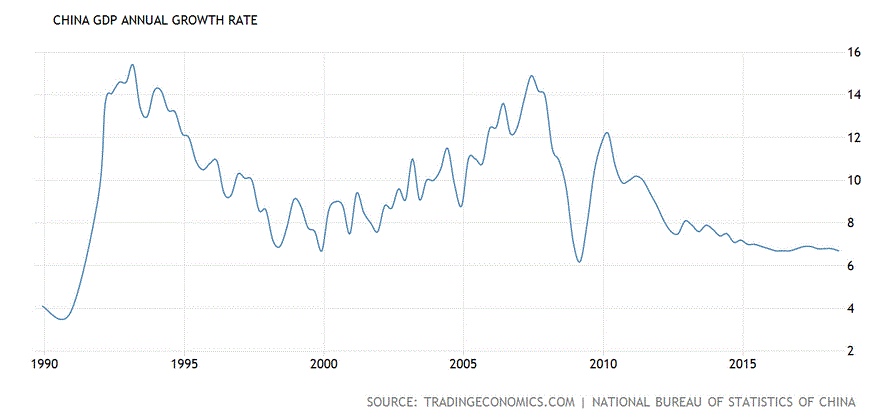
    The problem with the above model about the Chinese tide is that it blindly extrapolates China’s growth over the past 20 years into the future 20 years. The simple fact, however, is that this has already begun to change:

    ChinaGrowth

    The 8-15(!)% annual GDP growth rates that shook the world economy between 1993and 2008 have been in the rear-view mirror for nearly a decade now. Just last year, China declared that it would be a global AI leader; then just last month, China walked back all such ambition, calling for an international approach to AI development. There is now renewed talk of China sliding into the so-called Middle Income Trap, which I will elaborate on in a later post, but which is in simple terms a status in which a country can lead middle-income industries like automobile manufacturing, but fail to accrue enough human and financial capital to spark a transition into a high-value, knowledge-based economy.

    If I am permitted to make one very strong claim that I cannot prove, but would like to see if it plays out, I would say this: a culture which, like China, prides itself on order, stability, and respect for social harmony, and which limits disruptive speech and ideas, will inherently always struggle to make the transition to a creative, knowledge-based economy. The Chinese Film Industry is perhaps the most blatant example. Though the spark in Silicon Valley may have been lost, it was at one point the atmosphere of unabashed entrepreneurial creativity that led to the Digital Revolution. I shall not say that it is impossible, but from right now I struggle to see how the culture of stability, order, and harmony can push the envelope into a broad-based 21st century economy.

    I recently attended a talk by Ted Plafker, Beijing correspondent for the Economist, in which Mr. Plafker noted that China’s Great Firewall and other media policies had a significant drag on economic and scientific growth, as Chinese researchers, businesses, and innovators in all fields had an ongoing struggle to acquire data and inspiration from the rest of the world (there’s another side to the Great Firewall which I will discuss in a later post).

    Anyway, let’s see if I’m wrong.