Tag: technology

  • On Aesthetic Progress

    On Aesthetic Progress

    And where it is leading

    I have recently been contemplating the question of whether there can be said to be aesthetic (or artistic) “progress”, or whether changes from era to era are a kind of “random walk” in response to changing tastes and attitudes from generation to generation [in this post I refer primarily to visual art, but we can imagine similar discussions on the matters of literature or music]. Would someone from the 12th century walking through an art museum today see some things and say “wow, this is clearly better than anything from my time”, or would they think “hum, I don’t really see anything that appeals to my 12th century artistic sensibilities”? At some level we can say that there is unarguably technical progress, in that the invention of perspective drawing and the chemistry and economics of modern paint colors (or digital screens) enable modern artists to depict things they never would have been able to prior to the advent of these mechanisms. But how does that square with the question of tastes and sensibilities?

    To some extent this is a false binary, and a hybrid view might bring us closer to understanding the way things really work: while stylistic trends often evolve unpredictably, there is a discernible trajectory toward optimizing aesthetic effects for specific goals, an expansion of the possibility-space of art. Art is not a one-sided enterprise of the consumer, but a dualistic relationship between the audience and the artist. The artist seeks to respond to the desires of the audience, and as techniques and technology advance the artist can have a broader pallet of potential tools to meet (or shape) the demand of the audiences. The aesthetic preferences themselves may be a random walk, but the ability of artists to meet them undoubtedly progresses.

    If we look at this trend throughout history, artists have always sought to influence their audiences—this is intrinsic to artistic practice, whether trying to induce a noble to give his patronage or to elicit a religious experience by a biblical scene. What has changed in the modern world is the level of precision with which aesthetic choices can now be tailored to achieve intended effects. Previously guided by the artist’s intuition and cultural precedent, aesthetic decisions are increasingly informed by empirical research in the realms of graphic design, marketing, advertising, and Hollywood productions. The integration of psychology, neuroscience, social network data and data analytics suggests that we are advancing toward a model of aesthetic engineering capable of systematically eliciting specific emotions, or reactions from average audiences (or specific audiences). Rather than relying solely on subjective artistic instinct, creators can now leverage measurable data on human perception and cognition to optimize engagement and emotional impact.

    But where is this leading as technological progress begins to outrun human creativity? This leads to an important and dystopian question: does the increasing precision of aesthetic manipulation enhance artistic expression, or does it bleed into manipulation or outright control? While it seems evident that different personality types exhibit varying levels of susceptibility to algorithmic predictability (many people follow mass entertainment while others gravitate to niche ventures), suggesting that while the majority may be influenced by data-driven design strategies, there will always be outliers who resist standardized aesthetic appeals. However, the scope of algorithmic influence continues to expand. Psychology and neurology are very likely “solvable” problems that AGI or ASI may be able to use to decode human perception and cognition as systematically as current AI systems  are beginning to do with protein folding. If human psychological responses become fully mapped, aesthetic design may transcend broad statistical targeting and instead achieve personalized precision—where an artwork, advertisement, or political message is dynamically adapted in real time to maximize its impact on an individual’s neurological profile, or perhaps to force particular thoughts or actions. Can a human brain be subliminally “hacked” by extension of the same channels by which flashing lights can trigger an epileptic seizure in some individuals?

    I have no answers to these questions, other than suspecting that the answer is probably “yes” to all of them. If we’re going to live in a world with a machine god, we should prepare for the numinous, miraculous, and infernal.
  • Countering Chinese Nationalist Talking Points

    Countering Chinese Nationalist Talking Points

    Update: please see the update note after the guide image for some additional arguments and refutations.

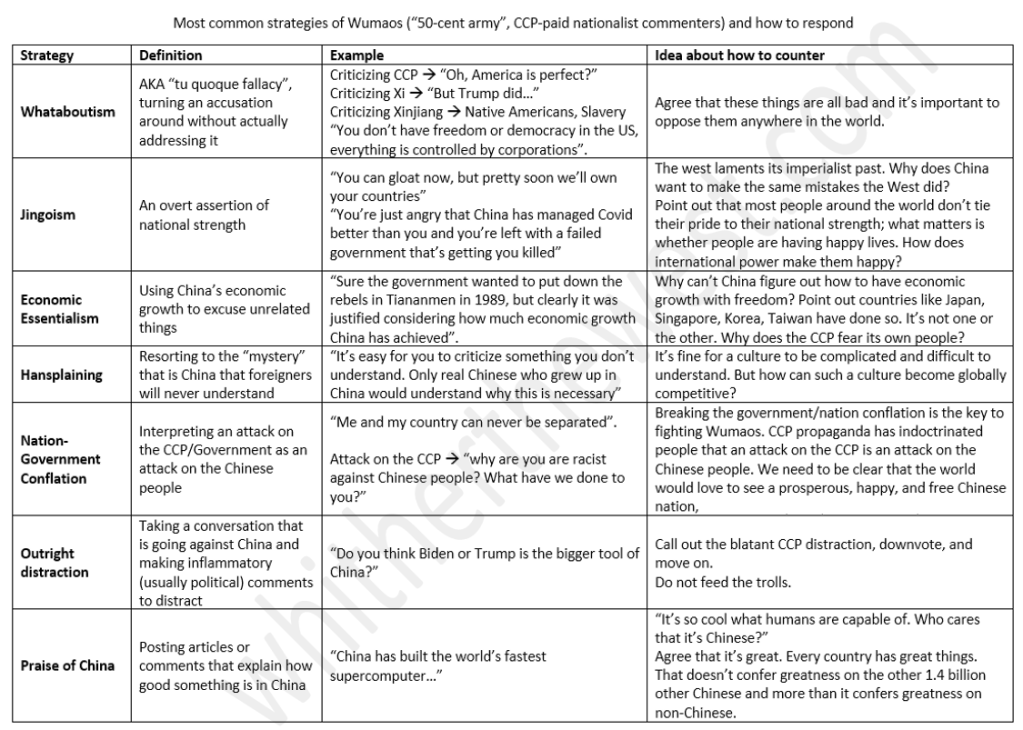
    I compiled a handy guide to some of the most common strategies and talking points by Chinese nationalists online (on forums like twitter and reddit). [Sharable image first, copy-able text follows.] This list is far from exhaustive, but should be a good base for combating most arguments. Please share additional talking points or strategies in the comments.

    One overriding thing to note: anyone in China has to use a VPN and violate Chinese law in order to be engaging on these forums in the first place. So don’t hesitate to draw attention to their hypocrisy and disrespect of Chinese law.

    Update: This was posted on reddit, and the discussion there generated many more arguments and responses. Consider

    These are really low hanging fruit. What about the more difficult points to combat that nationalists often make? How do we counter misinformation like this:

    “It’s easy to criticize the CCP, but don’t the people have a right to say they want a government and society that is different from what Americans have? How do you promote freedom and human rights without also weakening the institutions that maintain China’s independence and uniqueness we value which many other countries have lost to globalization and westernization?”

    “I think that the integration of China’s economy with the US has promoted the values we all want to see adopted by our government: free trade, freedom of movement, freedom of expression, etc. But now, the US is severing ties with China by imposing tariffs (even on goods like solar panels and EVs which are desperately needed to combat climate change), sanctioning and banning Chinese companies, and regressing to unfair trade practices like subsidizing domestic industry — practices it has criticized China for. How can the CCP in its current form be opposed when the good actors on the global stage like the US can’t be relied on to help in this fight and demonstrate correct behavior? How can we pressure the CCP when the US wants to punish China rather than shape China for the better?”

    “Whenever the extremely high incarceration rate in the US is brought up, the disproportionate imprisonment of minorities there, or the forced labor practices the US and its state governments engage in, people always do whataboutism and say hush, you have no room to talk when the CCP is doing the same and worse in Xinjiang and Tibet. I think we should oppose human rights violations no matter where they happen in the world, but the conversation always gets turned to sanctions against China and opposing the CCP. In contrast, you’ve never heard someone say ‘it’s time for regime change in the US’ or ‘why not have sanctions against the US for its crimes’, and that’s because the US is still the global policeman, judge, jury, and executioner. It’s above reproach, above the law, and unaccountable to anyone. The US should be expected to be a state party to the Rome Statute; it should be expected to support and comply with the WTO; it should be a state party in the Paris Climate Accords all of the time, not just when it feels like it. If not for its military power, the US would be considered a rogue state.”

    A (self-described) Chinese commenter replied to these points (my posting them here is not an endorsement):

    As a Chinese person to answer these questions:

    The Chinese people certainly have the right to choose a government that is different from that of the United States, but the Chinese Communist Party (CCP) has not given the Chinese people the power to choose a government that is different from that of the CCP

    The CCP has frantically suppressed civil society, from rights lawyers to investigative journalists to ordinary citizens. The CCP has used every means to crack down and persecute them. More than a decade ago, an old man took the initiative to monitor the misuse of public vehicles by officials. The CCP secret police lured him into prostitution with a scam and made it public. An attempt was made to ruin his reputation.

    The CCP does not practice free trade. Take the communications industry for example. The CCP pretended to open up the communications industry when it joined the WTO, and after it joined the WTO, it opened up only a very small number of proliferating businesses. The same thing happened to the insurance industry. The CCP has formulated a series of “documents” to create a glass ceiling for foreign investment. Foreign investors are not allowed to participate in the most important insurance business at all. By contrast, it was not until the Trump era that the US government began to restrict Chinese telecoms operators from doing business in the US.

    Liberalism itself encourages independence and uniqueness. Holding independence and uniqueness against Western civilisation, Hong Kong, the most liberal city in China, retains the most traditional culture. Under the rule of the Chinese Communist Party, people had been forced to destroy countless traditional cultures. They even destroyed the tomb of the legendary “Yellow Emperor”, the ancestor of the Chinese people. The independence that the CCP tries to retain is in fact their uninterrupted rule over the Chinese people.

    Every country violates international law to a greater or lesser extent. But the United States remains the foremost defender of the international order. On the question of the US supporting Ukraine with tens of billions of dollars against the Russian invaders, China is supporting Russia on a massive scale. Including, but not limited to, massive prepaid energy orders, drones, industrial equipment.

    Without further ado, the guide:

    StrategyDefinitionExampleIdea about how to counter
    WhataboutismAKA “tu quoque fallacy”, turning an accusation around without actually addressing itCriticizing CCP ➔ “Oh, America is perfect?”
    Criticizing Xi ➔ “But Trump did…”
    Criticizing Xinjiang ➔ Native Americans, Slavery “You don’t have freedom or democracy in the US, everything is controlled by corporations”.
    Agree that these things are all bad and it’s important to oppose them anywhere in the world.
    JingoismAn overt assertion of national strength“You can gloat now, but pretty soon we’ll own your countries”
    “You’re just angry that China has managed Covid better than you and you’re left with a failed government that’s getting you killed”
    The west laments its imperialist past. Why does China want to make the same mistakes the West did? Point out that most people around the world don’t tie their pride to their national strength; what matters is whether people are having happy lives. How does international power make them happy?
    Economic EssentialismUsing China’s economic growth to excuse unrelated things“Sure the government wanted to put down the rebels in Tiananmen in 1989, but clearly it was justified considering how much economic growth China has achieved”.Why can’t China figure out how to have economic growth with freedom? Point out countries like Japan, Singapore, Korea, Taiwan have done so. It’s not one or the other. Why does the CCP fear its own people?
    HansplainingResorting to the “mystery” that is China that foreigners will never understand“It’s easy for you to criticize something you don’t understand. Only real Chinese who grew up in China would understand why this is necessary”.It’s fine for a culture to be complicated and difficult to understand. But how can such a culture become globally competitive?
    Nation-Government ConflationInterpreting an attack on the CCP/Government as an attack on the Chinese people“Me and my country can never be separated”.
    Attack on the CCP ➔ “why are you racist against Chinese people? What have we done to you?”
    Breaking the government/nation conflation is the key to fighting Wumaos. CCP propaganda has indoctrinated people that an attack on the CCP is an attack on the Chinese people. We need to be clear that the world would love to see a prosperous, happy, and free Chinese nation.
    Outright distractionTaking a conversation that is going against China and making inflammatory (usually political) comments to distract“Do you think Biden or Trump is the bigger tool of China?”Call out the blatant CCP distraction, downvote, and move on. Do not feed the trolls.
    Praise of ChinaPosting articles or comments that explain how good something is in China“China has built the world’s fastest supercomputer…”“It’s so cool what humans are capable of. Who cares that it’s Chinese?”
    Agree that it’s great. Every country has great things. That doesn’t confer greatness on the other 1.4 billion Chinese and more than it confers greatness on non-Chinese.
  • Embracing the Anthropocene

    There’s an idea that I’ve been tossing around in my head for quite some time, and I wanted to start laying the groundwork for putting into text. The gist of the idea is this: we’re probably too late to stop the worst of climate change. Therefore, does it not behoove us to at least consider how to make the most of the completely Anthropocene world we are creating?

    Some things to consider:

    1. As global temperatures rise, very cold and barely habitable places like Siberia, Alaska, Greenland, Northern Canada, and Antarctica are going to become habitable. Colder habitable areas, e.g. New England, the Upper Midwest US, Northern Britain, Scandinavia, Hokkaido, Manchuria, Tierra del Fuego, and New Zealand will have “better” overall temperatures. Altogether, these are enormous areas (Canada and Siberia particularly). The biodiversity of arctic and semi-arctic areas is very small compared to more temperate areas – broadly speaking, more energy in an environment means more life –  and we need to investigate the possible upsides of cultivating these areas. The conversion of tundra to taiga, taiga to coniferous forest, and coniferous forest to temperate deciduous forest stands to be an enormous boon in some respects.
    2. The opening of sea lanes is going to be monumental. For centuries, explorers sought Northwest and Northeast passages from the Atlantic to the Pacific; those passages are becoming available. Ships are now beginning to ply the waters of the Arctic ocean, and soon will be a regular occurrence, shaving as much as 40% off of current routes through either the Panama or Suez Canals.This point has already received a great deal of attention, and many skeptics point to the fact that, e.g. trade between China and Norway is extremely small, or that ports of call are nonexistent along the Arctic coast. However, these estimations are making the fatal flaw of dealing with the situation as it stands, not as it may be a century hence. As natural resources beneath the arctic are exploited and shipping expands, new settlements and ports are bound to be founded, and the Arctic Ocean will likely in future decades be dotted with lights throughout its sunless winters.To this end, the Bering Strait may well be the Bosporus of the next Century, and the United States and Russia would likely both benefit from improving infrastructure at the strait, both port entrepot facilities and rail/road/pipeline connections.
    3. Higher atmospheric CO2 concentrations will mean faster plant growth. Already, the average color of the earth is becoming greener, and greater forestation in China and India are substantially to thank. Combined with the effects from point 1, there could end up being enormous booms of plant growth in the higher latitudes in coming decades.