Tag: news

  • Pillars of Sand

    Pillars of Sand

    The fundamental shift in Western legitimacy

    A simple theory could explain the fundamental shift in Western politics in recent years. I propose that we are witnessing a shift in the way governments acquire and maintain legitimacy in the eyes of their populace. In determining whether governments and regulatory bodies are “legitimate”, judgements fall primarily into one of two beliefs: process legitimacy, or outcome legitimacy. Until recently, Western polities overwhelmingly believed in “process legitimacy”: democratically elected governments were inherently legitimate because they followed the process, i.e. they obeyed the laws, and came and went with elections. Whether they passed good or bad policies would make them more or less popular, and would help them to win or lose the next elections, but rarely did their basic legitimacy to govern depend on whether their policies were good or bad.

    In recent decades, though, this has begun to shift, and the populaces of western polities increasingly believe in “outcome legitimacy”: governments are legitimate or illegitimate as a function of how well they respond to the socioeconomic and sociocultural insecurities of their constituents. Many polls and studies reveal this deteriorating belief in democracy. Belief in the legitimacy of the Supreme Court or Congress are abysmal. We can see this in stark relief not only Trumpist claims to the illegitimacy of pluralistic Democratic victories, but also in France where Macron is decried as illegitimate in his accused abandonment of the working class. For the former, consider this excerpt:

    “Even if they don’t subscribe to the more outlandish conspiracies propagated by Trumpists, many Republicans agree that the Democratic party is a fundamentally illegitimate political faction – and that any election outcome that would lead to Democratic governance must be rejected as illegitimate as well. Republicans didn’t start from an assessment of how the 2020 election went down and come away from that exercise with sincerely held doubts. The rationalization worked backwards: They looked at the outcome and decided it must not stand.”

    And for the latter example of Macron, FranceInter could not put better the differences in claims to legitimacy:

    Sur le plan institutionnel, les règles de la démocratie sont simples et claires, le président de la République est celui des candidats qui a obtenu la majorité des suffrages exprimés. Sur ce plan, la légitimité d’Emmanuel Macron est donc incontestable.  

    Pour autant, au soir du premier tour, sur les plateaux de télévision, il y avait quelque chose d’indécent dans la suffisance et l’auto-satisfaction des « dignitaires du régime », souvent passés par des gouvernements de gauche et de droite, avant d’échouer en Macronie… Comme un manque de gravité qui ne correspondait pas aux circonstances et aux enjeux…  

    Pourquoi cela ? Parce que si la victoire d’Emmanuel Macron est indiscutable, la crise de la démocratie est, elle aussi, indéniable. Le président de la République a été réélu sur fond d’abstention massive, en particulier des actifs, face à une candidate qui continue à être délégitimée et même vilipendée par presque tous.    
    On an institutional level, the rules of democracy are simple and clear: the President of the Republic is the candidate who has obtained the majority of the votes cast. In this respect, Emmanuel Macron’s legitimacy is therefore unquestionable.  

    And yet, on the evening of the first round, there was something indecent about the smugness and self-satisfaction of the “dignitaries of the regime” on television panels—figures who had often passed through both left- and right-wing governments before ending up in Macron’s camp. There was a certain lack of gravity that did not match the circumstances or the stakes at hand.  

    Why is that? Because while Emmanuel Macron’s victory is indisputable, the crisis of democracy is equally undeniable. The President of the Republic was re-elected amid massive voter abstention, particularly among the working population, against a candidate who continues to be delegitimized and even vilified by almost everyone.  

    It is not the first time that outcome legitimacy has been significant in the west: as Jurgen Habermas claims in his 2013 The Lure of Technocracy, “The [European] Union legitimized itself in the eyes of its citizens primarily through the results it produced rather than by fulfilling the citizens’ political will.” But in general this belief about legitimacy is new to the modern West. It is, however, perfectly valid in other cultural and political systems around the world: Middle Eastern monarchies make no pretense to democracy (in many the denizens are deemed subjects, not citizens, implying no role to play in the political life of the state); in China, the Communist Party historically has relied heavily on its ability to buoy material prosperity and defend China’s image abroad as its primary claims to legitimacy, rather than on claims to democratic processes or popular election (though China does maintain some nominally democratic institutions).

    A fair follow up question to ask here is why this process has occurred. I am not entirely sure, but I have some hypotheses. The first is that the one-two punch of terrorism and the recession in the early 2000s created a climate of increased material insecurity and a need to ensure that governments were actually producing results that protected people physically and economically. A second, non-exclusive reason would be the Gurri hypothesis that distributed network technologies are making people more skeptical of governments and institutions, and want more explicit proof that they are working in the public interest. Other explanations surely abound and I would love to hear them in the comments.

    One could conclude that if this trend towards valuing outcome legitimacy continues, Westerners will become increasingly tolerant of undemocratic and unlawful acts on the parts of their governments, so long as they are able to deliver desired results. The stunned tolerance of Elon Musk’s activities in the US Federal Government, to the extent that it holds, may be due in part to a sense of awe that he is able to move so rapidly and effectively and produce the kind of results that Trump campaigned on.


  • The Murder of Brian Thompson: an applied lesson in deontology versus consequentialism

    The Murder of Brian Thompson: an applied lesson in deontology versus consequentialism

    The murder of Brian Thompson is a morally and emotionally challenging event. Many people feel that some sort of justice was administered, even though the matter concerns premeditated murder. What is justice in this situation? Why has this event provoked such strange and passionate reactions?

    We return to a topic I wrote about recently, the difference between deontological and consequentialist moralities. In the deontological sense, murder is usually considered to be wrong (it depends on precisely which deontological system we are referring to, but most moral systems tend to say that murder is always wrong). In the consequentialist sense, murder can be moral if the results are sufficiently beneficial. The idea that this murder was justice derives from a consequentialist understanding of justice: a sufficiently ostentatious display of a punishment for a behavior, even a brutal and disproportionate punishment (think cutting the hand off of a thief and hanging it above the city gate), can prevent the offending behavior from re-occurring and thus in the long term improve the aggregate quality of life.

    When I posted on social media explaining the consequentialist justice argument, a wise acquaintance responded asking if it was not exactly the same as pro-lifers advocating the killing of a doctor who performs abortions. He also posted Meditation 17 by John Donne:

    No man is an island,  entire of itself; every man is a piece of the continent, a part of the main; if a clod be washed away by the sea, Europe is the less, as well as if a promontory were, as well as if a manor of thy friend’s or of thine own were;  any man’s death diminishes me, because I am involved in mankind, and therefore never send to know for whom the bell tolls; it tolls for thee.

    I appreciated the critique and understood the invocation against murder. I agree that consequentialist reasoning can potentially be used to excuse anything, and a world in which more people felt emboldened to murder those they had sociopolitical disagreements with would be a worse one for everyone. But consider the following: what if Thompson had been shot with a bullet that instead of inflicting physical damage had instead inflicted bankruptcy and years of heartache and misery like his choices had done to his clients?

    What I mean to say is, consequentialist excuse for murder is a game anyone can play at, progressives and pro-lifers alike, yes, but for those who revel in the murder, Brian Thompson’s own actions and executive choices as symptomatic of another brand of legal and moral decay, one that allows the wealthy and powerful to prey on the weak with complete impunity so long as it follows the byzantine prescriptions of laws written by the same ilk for their own benefit. Should the penalty for this immorality be murder? Deontologically, clearly not. Even consequentially, as I said, it would be bad if everyone started murdering everyone they disagreed with. But I think even deontologists agree that there should be severe punishment for the actions of Brian Thompson and those who do similar things – enough to force those in his position to think twice about the welfare of their clients whose lives and livelihoods depend on the companies delivering certain services. This is a legal and institutional failure. The solution for the pro-lifers was to take control of institutions and effect the legal changes to make abortion stop in the polities they control.

    The answer is institutional and legal, then: if the clients of a company could all get together and vote to dispense bankruptcy and misery on CEOs who did this kind of thing to them, then that would probably be a better world from both consequentialist and deontological perspectives.

    Until then, the question is: which is closer to justice for the actions of Brian Thompson: murder, or impunity?

  • Countering Chinese Nationalist Talking Points

    Countering Chinese Nationalist Talking Points

    Update: please see the update note after the guide image for some additional arguments and refutations.

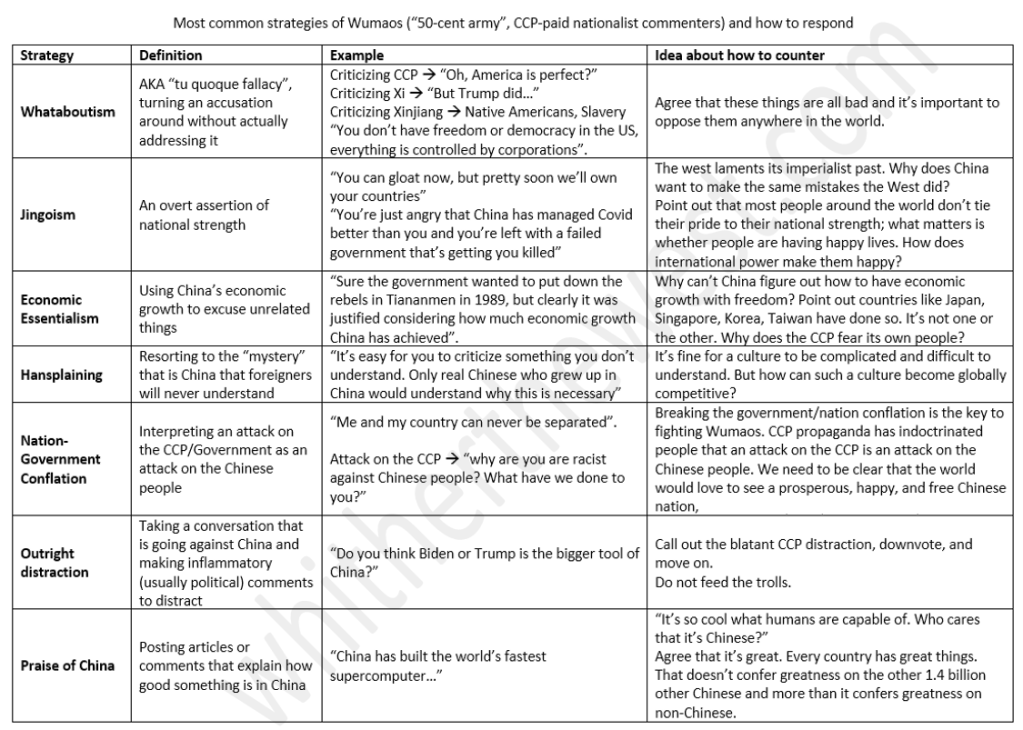
    I compiled a handy guide to some of the most common strategies and talking points by Chinese nationalists online (on forums like twitter and reddit). [Sharable image first, copy-able text follows.] This list is far from exhaustive, but should be a good base for combating most arguments. Please share additional talking points or strategies in the comments.

    One overriding thing to note: anyone in China has to use a VPN and violate Chinese law in order to be engaging on these forums in the first place. So don’t hesitate to draw attention to their hypocrisy and disrespect of Chinese law.

    Update: This was posted on reddit, and the discussion there generated many more arguments and responses. Consider

    These are really low hanging fruit. What about the more difficult points to combat that nationalists often make? How do we counter misinformation like this:

    “It’s easy to criticize the CCP, but don’t the people have a right to say they want a government and society that is different from what Americans have? How do you promote freedom and human rights without also weakening the institutions that maintain China’s independence and uniqueness we value which many other countries have lost to globalization and westernization?”

    “I think that the integration of China’s economy with the US has promoted the values we all want to see adopted by our government: free trade, freedom of movement, freedom of expression, etc. But now, the US is severing ties with China by imposing tariffs (even on goods like solar panels and EVs which are desperately needed to combat climate change), sanctioning and banning Chinese companies, and regressing to unfair trade practices like subsidizing domestic industry — practices it has criticized China for. How can the CCP in its current form be opposed when the good actors on the global stage like the US can’t be relied on to help in this fight and demonstrate correct behavior? How can we pressure the CCP when the US wants to punish China rather than shape China for the better?”

    “Whenever the extremely high incarceration rate in the US is brought up, the disproportionate imprisonment of minorities there, or the forced labor practices the US and its state governments engage in, people always do whataboutism and say hush, you have no room to talk when the CCP is doing the same and worse in Xinjiang and Tibet. I think we should oppose human rights violations no matter where they happen in the world, but the conversation always gets turned to sanctions against China and opposing the CCP. In contrast, you’ve never heard someone say ‘it’s time for regime change in the US’ or ‘why not have sanctions against the US for its crimes’, and that’s because the US is still the global policeman, judge, jury, and executioner. It’s above reproach, above the law, and unaccountable to anyone. The US should be expected to be a state party to the Rome Statute; it should be expected to support and comply with the WTO; it should be a state party in the Paris Climate Accords all of the time, not just when it feels like it. If not for its military power, the US would be considered a rogue state.”

    A (self-described) Chinese commenter replied to these points (my posting them here is not an endorsement):

    As a Chinese person to answer these questions:

    The Chinese people certainly have the right to choose a government that is different from that of the United States, but the Chinese Communist Party (CCP) has not given the Chinese people the power to choose a government that is different from that of the CCP

    The CCP has frantically suppressed civil society, from rights lawyers to investigative journalists to ordinary citizens. The CCP has used every means to crack down and persecute them. More than a decade ago, an old man took the initiative to monitor the misuse of public vehicles by officials. The CCP secret police lured him into prostitution with a scam and made it public. An attempt was made to ruin his reputation.

    The CCP does not practice free trade. Take the communications industry for example. The CCP pretended to open up the communications industry when it joined the WTO, and after it joined the WTO, it opened up only a very small number of proliferating businesses. The same thing happened to the insurance industry. The CCP has formulated a series of “documents” to create a glass ceiling for foreign investment. Foreign investors are not allowed to participate in the most important insurance business at all. By contrast, it was not until the Trump era that the US government began to restrict Chinese telecoms operators from doing business in the US.

    Liberalism itself encourages independence and uniqueness. Holding independence and uniqueness against Western civilisation, Hong Kong, the most liberal city in China, retains the most traditional culture. Under the rule of the Chinese Communist Party, people had been forced to destroy countless traditional cultures. They even destroyed the tomb of the legendary “Yellow Emperor”, the ancestor of the Chinese people. The independence that the CCP tries to retain is in fact their uninterrupted rule over the Chinese people.

    Every country violates international law to a greater or lesser extent. But the United States remains the foremost defender of the international order. On the question of the US supporting Ukraine with tens of billions of dollars against the Russian invaders, China is supporting Russia on a massive scale. Including, but not limited to, massive prepaid energy orders, drones, industrial equipment.

    Without further ado, the guide:

    StrategyDefinitionExampleIdea about how to counter
    WhataboutismAKA “tu quoque fallacy”, turning an accusation around without actually addressing itCriticizing CCP ➔ “Oh, America is perfect?”
    Criticizing Xi ➔ “But Trump did…”
    Criticizing Xinjiang ➔ Native Americans, Slavery “You don’t have freedom or democracy in the US, everything is controlled by corporations”.
    Agree that these things are all bad and it’s important to oppose them anywhere in the world.
    JingoismAn overt assertion of national strength“You can gloat now, but pretty soon we’ll own your countries”
    “You’re just angry that China has managed Covid better than you and you’re left with a failed government that’s getting you killed”
    The west laments its imperialist past. Why does China want to make the same mistakes the West did? Point out that most people around the world don’t tie their pride to their national strength; what matters is whether people are having happy lives. How does international power make them happy?
    Economic EssentialismUsing China’s economic growth to excuse unrelated things“Sure the government wanted to put down the rebels in Tiananmen in 1989, but clearly it was justified considering how much economic growth China has achieved”.Why can’t China figure out how to have economic growth with freedom? Point out countries like Japan, Singapore, Korea, Taiwan have done so. It’s not one or the other. Why does the CCP fear its own people?
    HansplainingResorting to the “mystery” that is China that foreigners will never understand“It’s easy for you to criticize something you don’t understand. Only real Chinese who grew up in China would understand why this is necessary”.It’s fine for a culture to be complicated and difficult to understand. But how can such a culture become globally competitive?
    Nation-Government ConflationInterpreting an attack on the CCP/Government as an attack on the Chinese people“Me and my country can never be separated”.
    Attack on the CCP ➔ “why are you racist against Chinese people? What have we done to you?”
    Breaking the government/nation conflation is the key to fighting Wumaos. CCP propaganda has indoctrinated people that an attack on the CCP is an attack on the Chinese people. We need to be clear that the world would love to see a prosperous, happy, and free Chinese nation.
    Outright distractionTaking a conversation that is going against China and making inflammatory (usually political) comments to distract“Do you think Biden or Trump is the bigger tool of China?”Call out the blatant CCP distraction, downvote, and move on. Do not feed the trolls.
    Praise of ChinaPosting articles or comments that explain how good something is in China“China has built the world’s fastest supercomputer…”“It’s so cool what humans are capable of. Who cares that it’s Chinese?”
    Agree that it’s great. Every country has great things. That doesn’t confer greatness on the other 1.4 billion Chinese and more than it confers greatness on non-Chinese.