Tag: modernism

  • How Important is the “Scientific Method”?

    How Important is the “Scientific Method”?

    Tyler Cowen recently posted on Marginal Revolution the question “How Important is the ‘scientific method’?” This called to mind the following paper I wrote several years ago in which I analyzed how many of the most important scientific discoveries of all time had come about from scientists who eschew “good science” and follow their hearts, biases, convictions – whatever you want to call them. Since writing this analysis, my opinion on the matter has ebbed and flowed – I think increasingly we need to turn to established institutions and procedures to help navigate the rising tide of disinformation, fake news, and fake science, but at the same time I think we must be more skeptical and critical of such institutions as they do maintain the ability to shut down dissenting voices or heterodox research. The recent Washington Post article on heterodox research in anthropology/archaeology is a great case in point. Open sourcing the publication and peer review of research, as the article illustrates, is one possible avenue, but does that solution prevent or facilitate the capture of those review processes by bad actors (botnets, special interests, internet vigilantes)? Without question the world is heading toward a fundamental restructuring of core processes and institutions that have served us well for centuries, and Western Civilization is facing its greatest epistemic upheaval since the Protestant Reformation. For those of you seeing this blog for the first time, that is a core theme of my writings. For other articles touching on this theme, check out this, this, or this.


    Without further ado, my paper to the point:

                Scientific progress comes in a variety of forms, be it via flashes of inspiration, methodical research and investigation, or simply the products of fortunate accidents. Nevertheless, through the history of western science, certain standards have arisen regarding the way in which “true” science should be done. The scientific method remains the centerpiece of these standards, stressing repeated observation, testing of hypotheses both new and old, and checking our assumptions against the realities of the physical world. In general, it is also considered standard to report all findings, whether they support current theories or not, and thus manipulation and selection of data to support preconceived notions is frowned upon, and generally considered unscientific. This stance, however, is the ideal; in reality, manipulation and staging of data has given us some of the greatest scientific breakthroughs in history – and perpetuated some of the worst misconceptions. The question, therefore, is not whether manipulation takes place in good science, but why it takes place and how science can be good despite it. Ultimately, we find that selection and staging of data has occurred throughout modern science, and that the reasons for it are based not on failures of the methods and standards of scientific practice, but rather on external social and personal influences which take advantage of the fact that science is, at its core, a human endeavor.

                In their critical analysis of the history of modern science, The Golem, authors Collins and Pinch discuss at length the 19th century debate over spontaneous generation versus biogenesis, and the role that Louis Pasteur played in the battle of scientific viewpoints. The account provides an excellent illustration of how good science can still be wrong, while “impure” practices can still illustrate the truth. Pasteur’s rival, Felix Pouchet, a staunch proponent of spontaneous generation, conducted a series of experiments to prove that life could arise from non-living material. His results were fully documented, and his experiments always showed the rise of life from his supposedly sterilized materials (Collins and Pinch 84-86). On the other hand, Pasteur conducted many experiments, of which some also seemed to show abiogenesis. Pasteur conveniently disregarded those experiments, only publicly reporting those outcomes which supported his hypothesis; “he did not accept these results as evidence of the spontaneous generation hypothesis” (C&P 85). Ultimately, Pasteur was able to align the scientific community in his favor, and biogenesis became the accepted theory of the propagation of life (C&P 87-88). The question this requires us to ask, though, is how selected and staged data ultimately came to be proven correct. Clearly, Pasteur’s methods broke with “standard” scientific practice even in the 19th century and even more so today, so there appears to be no direct connection between factual accuracy and adherence to the scientific method. Yet the scientific method remains the cornerstone of scientific research and investigation, so perhaps there is more to the nature of science than the example of Pasteur can adequately illuminate.

                Perhaps a more blatant example of staging and manipulation is that of Arthur Stanley Eddington and his astronomical expeditions in 1919. Determined to prove Einstein’s theory of relativity correct, Eddington and his fellow researchers set sail for the equator to make observations of a solar eclipse, a unique opportunity to test relativity’s predictions of gravitational lensing. The expedition’s observations, however, seemed vague, with some observations supported Einstein’s predictions, others Newton’s (C&P 48-49). Eddington chose only to publicize those data which supported Einstein. His reasons for this are mixed, and both The Golem and Matthew Stanley’s article explain his staging in different ways. The account from The Golem portrays Eddington’s thought process as simply ignoring systematic errors and focusing on those results which seemed devoid of irregularities; as a result he was conveniently left with those results which confirmed relativity. By that account, Eddington was doing “good” science, because he knew well the objective realities of his work, and was able to determine what data should and should not have been taken into consideration.

                The Stanley article, on the other hand, paints a very different picture of Eddington and his motives. The article notes that prior to the time of Eddington’s observations, international science had grown petty and nationalistic, in many ways tied to the bellicose technological advances during the First World War. The horrors which destructive technologies such as the battle tank, advanced artillery, and poisonous gasses had wrought by the end of the war led to public apprehension and disdain toward scientific achievement (Dr. Ralph Hamerla, Lecture). According to Stanley, Eddington sought to change that sentiment. Raised a Quaker, and thus with a more humanistic and anationalistic outlook, Eddington sought a transnational approach to solve the problems of mankind (Stanley 59). He believed that a British expedition into Africa and South America to confirm a German’s theory would speak volumes for the international approach necessary for beneficial scientific advancement (Stanley 59). In light of Stanley’s article, then, Eddington maintained a personal motive and religious background which may have biased his observations and decisions regarding the staging of his data.

    This brings us to an important question about not only Eddington, but manipulation and staging of data in general. Are data and observations manipulated intentionally and consciously by those who present them, staged because of subconscious influences, or is there more to the matter than that?  Returning to the example of Pasteur, The Golem reveals that “Pasteur was so committed in his opposition to spontaneous generation that he preferred to believe there was some unknown flaw in his work than to publish the results…He defined experiments that seemed to confirm spontaneous generation as unsuccessful, and vice versa” (C&P 85). Here, then, is another example of a scientist who does manipulate and disregard data in a conscious way, but not for any conscious reasons.  Rather, his preconceived notions about what was to be expected influenced his interpretation of the data. Eddington’s actions likely followed a similar path.  His Quaker, internationalist attitudes and desires may have subconsciously caused him to see systematic error in the observations he made, and those observations which confirmed relativity appeared relatively flawless to him. It is always possible, however, that he made his interpretation purely out of scientific objectivity, but Pasteur’s example seems to make the first possibility more likely.

    These examples cannot be taken to imply that manipulation is always done without conscious intent, however, nor that such staging of data always contributes to a better understanding of natural realities – quite the contrary on both counts.

    Though one could imagine that a conscious manipulation of data and figures would be intended to change the perceived outcome of the experiment, Charles Darwin used staging to the opposite effect: to better explain the argument he was already making, from the conclusions he had already drawn. Philip Prodger’s “Inscribing Science” addresses the idea that Darwin’s intentions behind the manipulation of photography. In his The Expression of the Emotions in Man and Animals (heretofore “Emotions”), Darwin makes great use of the then-fairly-new medium of photography to provide actual images of expressed emotions in people. As Prodger asserts, “His photographic illustrations were carefully contrived to present evidence Darwin considered important to his work” (Prodger 144). Given that the medium was relatively new at the time, it had its limits in terms of both detail and exposure time, “in the order of tens of seconds” (Prodger 156). As a result, some tweaking, staging, and manipulation were necessary to accurately convey Darwin’s selected evidence. He collaborated with both Oscar Rejlander and Duchenne de Boulogne in generating images for Emotions, with the former providing photographs of posed emotions, and the latter, photos of electrode-induced facial expressions. Darwin manipulated both for his book. In the case of Rejlander, Darwin removed electrodes and scientific equipment from the photos, leaving only the induced emotion visible in the book (Prodger 166-169). One of Rejlander’s photographs, known as Ginx’s Baby, was so important for the book that Darwin created a photograph of a drawing of the photo, so as to ensure that all details of the image were captured perfectly (Prodger 173-5). At the same time, for the photographs produced by both men, Darwin changed the settings of the subjects, going so far as to place Ginx’s Baby into a comfortable chair.

    Ginx’s Baby:

    Darwin’s reasons for his manipulations seem obvious enough. The photography of the day, with its long exposure times and imperfect detail, was incapable of distilling the split-second nuances of human emotional expression. It was thus difficult to communicate, via photography, the scientifically important intricacies which Darwin needed to support his claim. However, he could observe these emotions and draw his conclusions from them as they happened. Thus, Darwin was not truly manipulating his data, merely the means by which he passed it on to others, casting serious doubt on the idea that he may have had coercive motives behind his alterations.

    Innocence may be questionable, however, in the case of the alteration and manipulation of data relating to racism and biological determinism during the 19th and early 20th centuries. In The Mismeasure of Man, Stephen Jay Gould analyzes the manipulative means – intentional or otherwise – that racial scientists and craniologists employed in the dissemination of data relating to innate racial differences and phylogeny. His analysis of Samuel George Morton gives keen insight into the thought process of a blatant manipulator of data. In Morton’s presentation of data about average brain size among races, Gould states that he “often chose to include or delete large subsamples in order to match group averages with prior expectations,” that in his reports “degrees of discrepancy  match a priori assumptions,” and that “he never considered alternate hypotheses, though his own data cried out for a different interpretation” (Gould 100). All of these cases seem to demand the inference that Morton was consciously and actively manipulating data to match his own preconceived notions about racial characteristics. Yet Gould himself takes the other side, stating that he “detect[s] no sign of fraud or conscious manipulation…Morton made no attempt to cover his tracks…he explained all of his procedures and published all of his data” (Gould 101). He comes to the conclusion that the only motivation behind Morton’s warping of data was “an a priori conviction about racial ranking” (Gould 101). Yet despite such flawed data, “Morton was widely hailed as the objectivist of his day” (Gould 101).  The fact that he was hailed as such clearly demonstrates the degree to which bias and misconceptions permeated society. Based on his and others’ studies, craniometry and racial sciences perpetuated the ideas of white racial superiority well into the twentieth century.

    We are therefore left with an indecipherable mixture of outcomes based upon the manipulation of scientific data that is generated in departing from the purity of the scientific method. With Pasteur and Eddington their assumptions about the “correct” outcome of their experiments allowed them to “know” which data to exclude and which to accept.  Both were ultimately proven correct, but whether their correctness was due to their superior scientific understanding or pure luck is not an answerable question . With Darwin, his choice of manipulation was clearly intentional, but the purpose benign: to better communicate technologically limited evidence and proof.  His conclusions regarding the related emotions in humans and other animals are now supported by overwhelming scientific evidence – thus his case was one of superior scientific understanding. In the case of Morton and the racial scientists of the 19th and 20th centuries, it is clearly visible that preconceived notions can lead science down the wrong path as well as the right path. In the scientists’ quest to prove assumed facts, they ignored alternate interpretations and, instead, caused the stagnation of “objective” scientific perspective in the area of human physiology and evolution, while perpetuating social ills for a century or more.

    It can be seen that assumptions and a priori conceptions about an area of science can utterly change the scientist’s perception of the outcome. However, our initial investigation into the cause of these preconceptions has many possible solutions. Social and religious goals are possible answers, from the example of both Morton and Eddington respectively, but pride, arrogance, or simple variances in scientific understanding are equally valid conclusions. It seems foolish, however to assume that humans, who carry opinions and preconceptions in every area of their personal lives, could be capable of completely ridding themselves of those same opinions when it comes to the pursuit of science. One can conclude that as long as humans engage in the endeavor of scientific inquiry, they shall bring with them their imaginations, opinions, and cultural biases, but whether bringing those variables into scientific pursuits ultimately adds or detracts from the quality of human scientific achievement is a purely subjective matter that we cannot hope to settle through prattling verbosity.

  • Why Tolkien Hated Dune

    A short intro to the philosophy of ethics

    J.R.R. Tolkien maintained a very private, but very negative opinion of Frank Herbert’s Dune. In Tolkien’s Library, entry 964, Tolkien is quoted as having written in an unpublished letter to John Bush, on March 12 1966, “It is impossible for an author still writing to be fair to another author working along the same lines. At least I find it so. In fact I dislike Dune with some intensity, and in that unfortunate case it is much the best and fairest to another author to keep silent and refuse to comment”. [EDIT 21 March: A comment noted that “hated” is too strong a word – see my comments at the end for a defense of my word choice.] Tolkien does not elaborate, leaving the reasons for his intense dislike as an exercise for the reader. However, when one peers under the hood into the underlying philosophies of the two authors, one can easily imagine the answer: Herbert and Tolkien are exact moral opposites. Tolkien was an avid Deontologist and Dune is pure Consequentialism.

    Deontology and Consequentialism are two of the biggest rival camps in ethics. Deontology (from Greek: δέον, ‘obligation, duty’ + λόγος, ‘study’) says “acts are in themselves either good or bad”, whereas Consequentialism says “whether an act is good or bad depends on the consequences”. The central message of Tolkien’s work, hammered again and again and again, is that one should be a deontologist, a simple, good person who does charitable and good things, and that where evil arises in the world it is not the result of being inherently “bad” but rather by being convinced that one can commit small acts of selfishness and vainglory that one is convinced work toward a greater good. As Gandalf, speaking with the author’s voice, no doubt, says, “Many that live deserve death. Some that die deserve life. Can you give it to them, Frodo? Do not be too eager to deal out death in judgment. Even the very wise cannot see all ends.”

    Dune is much the opposite. The Dune saga focuses on the morality of consequence, the tradeoffs of rule, the interactions of large and often amoral systems, the ways in which a man wields these powers to achieve his goals, and the way in which the long-term consequences of his actions determine his ultimate moral worth. Herbert writes, “Greatness is a transitory experience. It is never consistent. It depends in part upon the myth-making imagination of humankind.” That is to say, greatness depends on human perspectives; if people perceive something as great, it is great, and that opinion can change over time as morality evolves.

    We can see already that this morality diverges from Tolkien’s simple, deontological “slave morality“, in which greatness does not depend upon the spirit of the times, but rather embodies a spirit that stands the test of time, a prototype of Captain America’s famous “no, you move” monologue. To wit, consider Aragorn’s rather direct opposing quote, “Deeds will not be less valiant because they are unpraised” (RotK). One might argue that Herbert explicitly deconstructs the Tolkeinesque hero embodied in Leto (I) Atreides, whose valiance and refusal to embrace Machiavellian calculus, his staunch clinging to his personal and family honor, ultimately cost him his life. But the moral disagreement between Herbert and Tolkien goes much deeper.

    Though there is no evidence that Tolkien continued to read on in the series (indeed he passed away in 1973, so could not have read beyond the second book, Dune Messiah, though since he disliked the original it would be odd for him to read on), those who have read past the introductory books up to God Emperor of Dune (it was introduced in Dune Messiah, but its full elaboration was only given in GEoD) know about the so-called Golden Path. The Path is, in short, a path to avoid humanity’s extinction. Leto II views the eventual extinction of humanity as something to be avoided at all costs, worthy of all sacrifices, and as such the Golden Path – his plan to so brutally oppress humanity that future humans would go their separate ways and refuse to ever submit themselves again to centralized rule -is pure, unadulterated consequentialism – the ultimate, millennia-long evil, countless acts of barbarity and oppression, to achieve a possible good. As Leto II extols, “I have been called many things: Usurper, Tyrant, Despot. Some even call me the greatest mass murderer in history. They are not entirely wrong. My actions have caused great suffering, and I bear that burden willingly, for I know that the future of humanity depends on it.” In other words, the ends justify the means. And thus the zenith of necessary ends justifies the nadir of abhorrent means. We need not even imagine what Tolkien thought of this: Gandalf (as we mentioned earlier, Tolkien’s surrogate), addresses it: “It is not our part to master all the tides of the world, but to do what is in us for the succor of those years wherein we are set, uprooting the evil in the fields that we know, so that those who live after may have clean earth to till.”

    The philosophical disagreement between Tolkien and Herbert touches on many more subjects, of course, and another prominent disagreement was that Tolkien was a very devout Catholic and Herbert was not exactly friendly towards religion. Herbert saw religion as an inherently mutable, utilitarian institution, and Herbert was dismissive or even openly antagonistic toward religious truths. In the world of “Dune,” religion serves as a powerful tool for control and manipulation, with institutions like the Bene Gesserit using it to shape political and social outcomes – indeed the central prophecy (that of the Lisan al Gaib) of the original book was a completely artificial contrivance for political machinations of the Bene Gesserit. In contrast, of course, Tolkien saw Christianity as channeling eternal moral truths about kindness and redemption, and his world-building reflects his belief in a higher power and cosmic order, with themes like mercy, sacrifice, and the triumph of hope over despair mirroring his theological perspective.

    Religious differences aside, the central argument between the two authors is the moral one. Tolkien is a modernist (or even pre-modernist); Herbert is a post-modernist: Tolkien encourages everyone to follow a single template of goodness; Herbert encourages cynicism and doubt of the institutions that produce templates, and shows the anguish experienced by Paul when he is forced into a template to survive. If one had to summarize these different perspectives in one sentence, Tolkien argues “Strive for goodness, and people will come to call it great”, whereas Herbert argues “strive for greatness, and people will come to call it good”.


    Edit 21 March: A Defense of the term “hated”

    As mentioned above, a post on https://potbanks.wordpress.com/category/tolkien-gleanings/ took issue with the term “hated”, finding it mischaracterized Tolkien’s feelings, which, as he himself wrote, were “strong dislike” not “hate”. However, I do believe that the word “hate” does not have nearly the same meaning as it did in the 1960s when Tolkien penned his comments, and certainly not the same as it did earlier in the century when Tolkien was developing his own ideolect and semantic impressions. It is a word that has undergone a great deal of semantic inflation, and is thus much weaker than it used to be – according to Google Ngram viewer it took on a new life after 1980 and is is more than three times more present in common usage today than it was in 1920. Someone born since 1980 – most blog readers – would likely use “hate” to express the same intensity of emotion for which someone born in 1892 would use “dislike”, let alone “strongly dislike”.

    The commenter mentioned that the title is “clickbait-y”, and this is not entirely wrong, because the era of clickbait is both a contributor to, but also a result of, the aforementioned semantic inflation. On the one hand it is true that an article titled “Why Tolkien Disliked Dune” would bait fewer clicks than one that uses the term “hated”, on the other hand as mentioned above the choice of words is merely keeping step with what is a living and evolving language. Phrasing the title as “Hwætforð Tolkien āsċūnode Dune” would be even less clickbait-y.

  • The Future Is Ours: A Short Dissection of Accelerationisms, Left, Right, and Center

    In modern usage, the term “accelerationism” is claimed by far-right groups as a philosophy of destabilizing society to bring about a more authoritarian and conservative future. However, soi-disant accelerationists have no monopoly on accelerationist ideas. That is to say that the perspective of “acceleration” of society through stages is neither new nor confined to the political right; accelerationist mindsets are espoused by various groups aspiring to “accelerate” society toward some predicted end and effect a transformation to a more “ideal” version of society. Though the nominal idea of accelerationism is widely conceived as radical and dangerous in most interpretations, the general concept of “accelerating” society toward a predefined end has a long history on many points on the political spectrum and has through its real-world political effects substantially influenced the modern world. To understand where accelerationist ideas come from, it is worthwhile to investigate, in brief, their history and legacy. It is also worthwhile to investigate their fundamental flaws.

    The Philosophical Underpinnings

    The concept of society moving toward an inexorable end is not new, but neither is it universal; many ancient peoples kept time with respect to dynasties or the founding of cities, commencing cycles that were inevitably reset every time a dynasty or city fell – for a modern relic of this system, we can see the Japanese imperial calendar or gengō system, in which the current year is Reiwa 2, second year of the reign of the new emperor. Ancient Romans kept time with relation to the founding of the city or by reference to the consuls who were in power in a particular year.[i] With the rise of monotheistic religion, however, societies began keeping time with respect to immutable events, such as the birth of Jesus or the Hijra of Mohammed – fixed dates that allowed a linear outlook on time irrespective of the city or ruling family one happened to live near. These societies also prophesied the eventual arrival at some future event, be it the end of the world or the coming of the Messiah, and even into the early modern era it was common to think that human actions could help bring it about – for example, in the 1500s, Jews began settling in the holy land, not to create a Jewish state like the modern Israel, but rather, they “hoped to accelerate the coming of the Messiah”[ii].  In the late 18th century, the German philosopher Friederich Hegel gave rise to a conception of history moving through a set of defined stages. For Hegel, this progress was most clearly visualized in the form of European civilization passing from pre-civilized barbarism, to slavery under classical societies, to the theological thought during the middle ages and culminating (for him) in the humanism and enlightenment philosophy of his time. For Hegel, this furthering of civilization was in turn furthering the evolution of the Weltgeist, or the Worldspirit, the collective mental and spiritual progress of humanity that developed inexorably toward greater liberation.

    “[…]The world spirit, has possessed the patience to pass through these forms over a long stretch of time and to take upon itself the prodigious labor of world history, and because it could not have reached consciousness about itself in any lesser way, the individual spirit itself cannot comprehend its own substance with anything less.” – Hegel, Preface, Paragraph 29[iii]

    Left-Accelerationism

    Without question the most famous application of Hegelian history was made by Karl Marx, who took the idea of historical stages and wedded them to another (and more long-lived) Hegelian philosophical invention of “dialectics” – the idea that a prevailing and dominant idea (a “thesis”) is at some point confronted with a contrary or opposite idea (the “antithesis”), and the result of this conflict of ideas is that one of the ideas would win out but be altered in the process, producing a new idea (the “synthesis”), which in being dominant would be the new thesis, continuing the cycle. Marx took this Hegelian dialectic formula and famously applied it to social classes, seeing one dominant class as the thesis, a rival class as the antithesis, and the result of their inevitable conflict would be a new synthesis and new social order, which would inevitably be challenged by a new class. Thus society progressed from slavery to feudalism to capitalism to communism.

    What does this have to do with Accelerationism? Well, the first real example of Accelerationism is tied to Marxist thought. Communism, according to Marx, could only come about once the philosophical infrastructure of Capitalism was in place, for only the underclass of capitalism, the proletariat, could overthrow the oppressive bourgeoisie and institute Communism. Marx was wedded to the inevitability of the entire endeavor:

    “The advance of industry, whose involuntary promoter is the bourgeoisie, replaces the isolation of the labourers, due to competition, by the revolutionary combination, due to association. The development of Modern Industry, therefore, cuts from under its feet the very foundation on which the bourgeoisie produces and appropriates products. What the bourgeoisie therefore produces, above all, are its own grave-diggers. Its fall and the victory of the proletariat are equally inevitable.” – Marx and Engels, 1848[iv]

    But to Marxists such as Lenin and the Bolsheviks in Russia during the late 19th and early 20th centuries, the ideal socialist society they longed for was decades or centuries away: according to most observers at the time, Russia was not yet even capitalist – rather, with the ascendancy of the church, the czar, and the nobility, (Orthodoxy, Autocracy, Nationality, went the triune slogan of Russian conservatism) Russia was still trapped, economically and socially, in a kind of feudalist proto-capitalism. Thus, in the years leading up to the Bolshevik Revolution in Russia, would-be Communists were deeply conflicted over the question of Marxists stages of history. The communists wanted Communism now, but according to Marx they would first have to usher in an era of capitalism to create the necessary foundations for their long-awaited Communist system. As a result, many Russian socialists and communists in the early 20th century embraced the possibility that Russia might have to undergo a capitalist, liberal revolution before the infrastructure could be laid for a second, socialist revolution. In the 1920s, after the Russian Civil War had been put to rest, The Communist Party of the Soviet Union embraced the “New Economic Plan” which was (relative to the “war socialism” the Bolsheviks emplaced during the late teens) a market-based system of exports and investment that would aim to get the USSR’s productive capacity on par with the capitalism they sought to surpass. Mao Zedong would embrace the same kind of stepwise thinking at times, not between capitalism and communism, but rather socialism and communism, in the lead-up to the infamous “great leap forward”[v].Should the communists, therefore, support the rise of capitalism? An idea that arose to deal with this problem is an early formulation of accelerationism. If a society has to go through stages to reach a desired end-goal, then those who want the desired end-goal should do their best to speed up the natural processes.

    Accelerationism is, then, in its fundamental form, a belief in some kind of set of stages that society needs to be walked through—and support for attempts to destabilize the current system or otherwise put in place the necessary conditions to see the change transpire organically

    In the 1970s, Marxist political philosophers Hardt and Negri published an unexpectedly popular book, “Empire”, examining the way in which American Capitalism pervaded the world, but also looking (in a devil’s advocate manner) at ways in which Capitalism was setting in motion global progress toward what would come next. For example, they noted the ways in which corporations were astutely indexing and integrating all world resources and productive capacities into a networked global market. Socialists and communist grappled onto these ideas, contending, as Bolsheviks had done decades before, with the possibility that the best way to arrive at a global transition to socialism was actually to support the growth of these capitalist global structures:

    “The huge transnational corporations construct the fundamental connective fabric of the biopolitical world in certain important respects. […] Some claim that these corporations have merely come to occupy the place that was held by the various national colonialist and imperialist systems in earlier phases of capitalist development, from nineteenth-century European imperialism to the Fordist phase of development in the twentieth century. This is in part true, but that place itself has been substantially transformed by the new reality of capitalism. The activities of corporations are no longer defined by the imposition of abstract command and the organization of simple theft and unequal exchange. Rather, they directly structure and articulate territories and populations. They tend to make nation-states merely instruments to record the flows of the commodities, monies, and populations that they set in motion. The transnational corporations directly distribute labor power over various markets, functionally allocate resources, and organize hierarchically the various sectors of world production. The complex apparatus that selects investments and directs financial and monetary maneuvers determines the new geography of the world market, or really the new biopolitical structuring of the world. The most complete figure of this world is presented from the monetary perspective. From here we can see a horizon of values and a machine of distribution, a mechanism of accumulation and a means of circulation, a power and a language.”

    – Hardt and Negri, Empire, pp 32-33.[vi]

    In other words, corporations are not merely exploitative, extractive engines serving the interests of the bourgeoisie in the global north, but are rather organizing forces that mobilize resources (notably labor power) into a global connected system. Thus, Hardt and Negri argue, the modern corporation may be moving some people toward the proletarian organization that early Marxists sought to effect through cadres and labor unions. Echoing Hardt and Negri’s work, it is common these days in some corners of the internet to talk about “late-stage capitalism”, an overt assumption that society progresses in stages and that capitalism’s stage is on the way out, laying the foundation for a transition to socialism[vii]. These communists pay heed to the inevitability in Marx’s work, the teleological inexorability, which classes would find their way to conflict without need of the cadre-driven insurrection embraced by Bolsheviks and Maoists, who truly believed that they could “accelerate” the stages of history, rather than simply letting them unfold naturally.

    Technological Accelerationism

    Another form of accelerationism that had a short-lived but influential moment in the late 20th and early 21st centuries is that of a pseudo-apolitical techno-futurist accelerationism. In this conception of futurism, which held precedence just before the far-right swing in nominal futurism mentioned above, acceleration is viewed in a technological sense: society must invest in technological progress to speed us through this era of directionless sociopolitical uncertainty. In a 2017 conception,

    This accelerationism has a conservative flair (at least in the American sense): government should get out of the way and allow technology leaders to chart the path to the utopian post-scarcity future. This is a vision of acceleration, and a known future state, strongly influenced by trends of Science Fiction. “In an era where left-of-center voices increasingly paint a dark vision of the future as fraught with ecological dangers, science fiction conservatives have a near monopoly on utopian dreams of a tomorrow of abundance and technological wonders.”[viii] A prominent proponent of this conservative techno-utopian ideal was former Speaker of the House Newt Gingrich, a self-described pursuer of Star Trek-like visions of the future, who advocated a libertarian approach to scientific advancement: “If you take all the money we’ve spent at NASA since we landed on the moon and you had applied that money for incentives to the private sector, we would today probably have a permanent station on the moon, three or four permanent stations in space, a new generation of lift vehicles. And instead what we’ve had is bureaucracy after bureaucracy after bureaucracy, and failure after failure”.[ix] This same techno-libertarian futurism was on full display as late as the 2016 Republican National convention, in which billionaire tech investor Peter Thiel declared that “today our government is broken. Our nuclear bases still use floppy disks. Our newest fighter jets can’t even fly in the rain […] Instead of going to Mars, we have invaded the Middle East […] When Donald Trump asks us to Make America Great Again, he’s not suggesting a return to the past. He’s running to lead us back to that bright future.”[x]

    It was as an outgrowth of this culture – conservative, sci-fi influenced techno-utopianism, that in the late 2010s observers characterized “accelerationism” in the following way:

    “Accelerationists argue that technology, particularly computer technology, and capitalism, particularly the most aggressive, global variety, should be massively sped up and intensified – either because this is the best way forward for humanity, or because there is no alternative. Accelerationists favour automation. They favour the further merging of the digital and the human. They often favour the deregulation of business, and drastically scaled-back government. They believe that people should stop deluding themselves that economic and technological progress can be controlled. They often believe that social and political upheaval has a value in itself. Accelerationism, therefore, goes against conservatism, traditional socialism, social democracy, environmentalism, protectionism, populism, nationalism, localism and all the other ideologies that have sought to moderate or reverse the already hugely disruptive, seemingly runaway pace of change in the modern world.”[xi]

    Right-accelerationism

    Today, however, “accelerationism” is nominally more of a right-wing ideology. How did it make this transition? Communists did not maintain a monopoly on the concept of accelerating society through stages. In the 1920s, the German Nationalist (and proto-Nazi) philosopher Carl Schmitt embraced accelerationist attitudes in his belief in the need for a strong authoritarian center for modern society. Given that “the sovereign power of the king has been dissolved, disembodied, and dispersed in the communication flows of civil society, and it has at the same time assumed the shape of procedures, be it for general elections or the numerous deliberations and decisions of various political bodies,” Schmitt believed that it would be necessary for people to develop a new kind of sacred reverence for a new source of authority and legitimacy. Schmitt believed that even supposedly liberal democracies were authoritarian at the core, and that when real and consequential decisions had to be made (e.g. to fight against terrorism or a global pandemic), the pretense of procedural democracy would always be shunted aside. More specifically, he conceptualized that even a liberal democracy would encounter moments—crises—in which “exceptions” had to be made, and as Schmitt put it, “Sovereign is he who decides on the exception.”[xii] To that end, right-accelerationism attempts to bring about precisely that destabilization of society in order to reach the exception, with a kind of conservative authoritarianism able to check the undesirable aspects of liberal democracy. His answer was to call for a mythologizable and revered leader, very much like what Nazi ideology embraced regarding Hitler.

    Ever since the chaos of the 1930s and resulting ascension of fascism, political observers have noted the relationship between a breakdown in the normal fabric of society and the resulting popular support for authoritarianism. For example, economic shocks such as market collapse are often associated with increased support for tougher, roughshod measures to get things back on track.[xiii]

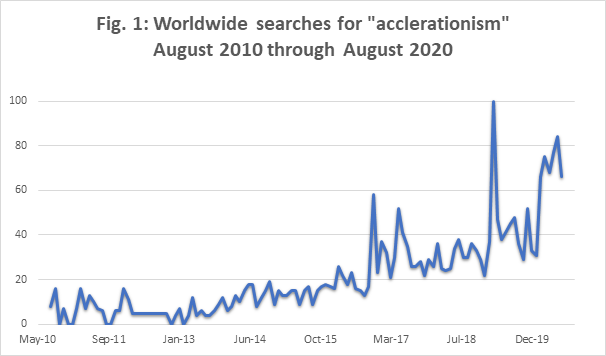
    This brings us to the typical modern instantiation of accelerationism: the white supremacist and far-right accelerationism embraced by, among others, the shooter who murdered 49 mosque-attendees in New Zealand in March 2019. The terrorist attack, committed in the explicit name of “accelerationism”, has set the standard for the popularity and use of the term (see: fig. 1)[xiv]. These accelerationists believe that western liberal democracies must embrace authoritarianism to rid themselves of weak and detracting elements – namely non-white people, feminists, and other components of what they consider to be “others” and part of the cultural left. Further, they feel that this sort of society will naturally come about when society is destabilized enough that the majority demands stronger security and policing. As such, they advocate chaos and anarchical behavior to shock and terrorize society in radical lockdowns and internal transformation.

    The Fundamental Error

    Accelerationist ideas across all political ideologies stem inexorably from a preconception about two things: first, a prescience about the future trajectory of the sociopolitical; second, a belief in the ability to bring about that future trajectory. From Leninists who believed that a campaign of Bolshevistic force could bring about the necessary transition to sustainable socialism to the New Zealand shooter who believed that his actions would contribute to a destabilization of society sufficient that a critical mass would call for a revocation of liberal and multicultural values, the fundamental assumption of accelerationists is an ability to tell the future. Accelerationists of all political stripes believe that the future is inherently more in line with their political goals and preconceptions, and that certain institutions of the status quo must be overcome or changed in order to arrive at that utopian end.

    Indeed, many observers, even those of us who do not believe ourselves to be “accelerationists” of any stripe are guilty of some form of this. A common instantiation of this error is that of the so-called “Whiggish” view of history, that is, that “the arc of history is long and it bends toward justice”. Though this may have been the general trajectory for the past few hundred years, to extrapolate this out a few centuries hence and to assume that society can go in no direction other than the maximization of justice is somewhat presumptive. Believing that the future is inherently on one’s side, and that all one must do to bring about one’s ideal future is clear away certain blockers in the present (e.g. removing certain injustices to accelerate the arrival of an inexorably just future) is certainly a form of accelerationist mindset, albeit a relatively dilute one.

    But such an assumption is not unique to those who view inexorable progress only in sociocultural terms – indeed, those who view progress in technological terms are equally fallible, for as desirable as the post-scarcity utopias of Star Trek and related visions of the future may be, they hinge as much on a fixed interpretation of the arc of human progress: indeed technological progress could allow humanity to escape the Malthusian trap and create a prosperous world free of competition, but it could just as likely lead to a world of Orwellian or Huxleyan social control.[xv]

    To that end, the way to avoid making the errors and assumptions of accelerationism is as follows: one must forget one’s idea of what the future will be like. Working towards a particular end will not necessarily bring it about, and may, through the invocation of opposition, bring about a countervailing reaction that undoes the entirety of one’s progress. The vicissitudes of history are fierce and many, and few institutions have the capacity to see through plans and goals through more than a few decades before “today’s problems [become] the result of yesterday’s solutions”.


    [i] Day, Abby. “Sacred Time”. The International Encyclopedia of Anthropology, 1-8. 2018. doi:10.1002/9781118924396.wbiea1919 

    [ii] Abulafia, David. The Great Sea. 2012. Ebook version, Section 4, Chapter III, Paragraph 5.

    [iii] Hegel, Friedrich. The Phenomenology of Spirit. 1807.

    [iv] Marx, Karl and Friedrich Engels. “Manifesto of the Communist Party”. 1848

    [v] Meisner, Maurice. “Mao’s China and After: A History of the People’s Republic”. Simon and Schuster, 1999.

    [vi] Hardt, Michael and Antonio Negri. Empire. Harvard University Press, 2001.

    [vii] Reddit. “/r/latestagecapitalism”. www.reddit.com/r/latestagecapitalism. Retrieved June 11, 2020. At the time of retrieval, the community had 538,889 subscribers.

    [viii] Kill Screen Staff. “How Much of a Sci-fi buff is Newt Gingrich, and what does science fiction tell us about the GOP?”. Kill Screen, February 29, 2012. https://killscreen.com/previously/articles/how-much-of-a-sci-fi-buff-is-newt-gingrich-and-what-does/. Retrieved June 2020.

    [ix] Malik, Tariq. “Newt Gingrich on Space Exploration: ‘NASA Is Standing in the Way’”. Space.com, June 14, 2011. https://www.space.com/11959-gop-presidential-debate-nasa-future-republicans.html. Accessed June 2020.

    [x] Thiel, Peter, as reported by Will Drabold. “Read Peter Thiel’s Speech at the Republican National Convention”. Time, July 21, 2016. https://time.com/4417679/republican-convention-peter-thiel-transcript/

    [xi] Beckett, Andy. Accelerationism: how a fringe philosophy predicted the future we live in”. The Guardian, May 11 2017. https://www.theguardian.com/world/2017/may/11/accelerationism-how-a-fringe-philosophy-predicted-the-future-we-live-in

    [xii] Schmitt, Carl. Political Theology: Four Chapters on the Concept of Sovereignty. George D. Schwab, trans. (MIT Press, 1985 / University of Chicago Press; University of Chicago edition, 2004 with an Introduction by Tracy B. Strong. Original publication: 1922, 2nd edn. 1934.

    [xiii] Haggard, Stephan and Robert Kaufman

    [xiv] Figure 1: Source: Google Trends. https://trends.google.com/trends/explore?date=2010-07-31%202020-07-31&q=accelerationism. Retrieved July 31, 2020. DOI: 10.6084/m9.figshare.12745526

    [xv] A particularly insightful comparison can be drawn from McMillen Stuart, “Amusing Ourselves to Death”, Recombinantrecords.com, May 2009. However, McMillen deleted his claim to this comic given claims by copyright holders of Postman, Neil. “Amusing Ourselves to Death”. Viking Penguin, Methuen, UK, 1985.

  • If you’re eating locally for environmental reasons, you’re doing it wrong

    If you’re eating locally for environmental reasons, you’re doing it wrong

    If you’re eating locally for ecological reasons, you’re doing it wrong. If we’re talking about the economic and cultural benefit to local producers and sellers, that is another story. But ecologically, since transport makes up a negligible part of the ecological impact of food (see the chart below), it is better to make use of an idea I call comparative ecological advantage (defined after the chart).

    https://ourworldindata.org/food-choice-vs-eating-local

    What is comparative ecological advantage?

    It should be clear that not every region, state, or country can easily produce every kind of food. Kansas may be perfect for growing grain, Wyoming is ideal for grazing cattle, and Southern California is excellent for growing fruits and vegetables. Similarly, avocados grow relatively better in Mexico and oats grow better in Scotland. None of these natural advantages are insurmountable – we can always create greenhouses, hydroponic systems, and microclimates to grow everything anywhere, even in space. But at what cost? Bringing water to the desert, heating winter greenhouses, and replacing tropical soils come at an immense environmental cost that defeats the point of eating in environmentally responsible ways. We can think of eating locally at any cost and refusing to transport food long distance as a form of ecological mercantilism.

    In the 1800s, David Ricardo helped to deconstruct the accepted wisdom that countries should strive to produce everything they need internally and import as little as possible (mercantilism). He showed mathematically that it produced more prosperity for everyone if countries specialized in what they could produce most efficiently, and then freely traded internationally. This idea was called “comparative advantage” – the thing that a country was best equipped to produce, relative to the other things that they could choose to produce. This destruction of the prevailing logic of mercantilism unlocked the first era of globalization and created the trading system that we still use today, two centuries later. The exact same logic – the faulty logic of ecological mercantilism and the economic logic of ecological comparative advantage – is at work today. Specialize, trade, and reap the fruits of global integrated markets for the benefit of all mankind.

    Less desirable alternatives

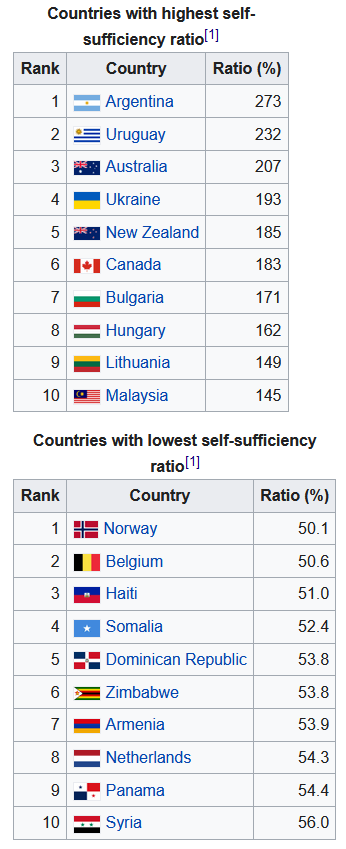
    Of course, we could also go another route: maybe each country or region should only eat the things that it can grow well in the vicinity. But we need to think this through a bit. Self-sufficiency in food is an unreachable dream for many regions of the world (see the chart below). Some countries like Argentina or Australia are lucky exceptions – they are sparsely populated with lots of arable land, and thus able to feed themselves many times over. However, countries like The Netherlands, Belgium, and Norway, for example, can only produce 50% of the food they consume. When we consider that countries like Australia or Canada are overwhelmingly producing things like meat and grain, it means these areas would be faced with rather poor diets were they to eat only locally produced foods. To implement local-only consumption globally in nutritionally and culturally acceptable ways, there would need a restructuring of the entire population of the world into high-fertility areas (which would necessitate converting the land of these high-fertility areas into buildings, the most ecologically destructive thing we can do). But why would it be better than a system of production and exchange according to comparative ecological advantage?

    https://en.wikipedia.org/wiki/List_of_countries_by_food_self-sufficiency_rate

  • Stories and Truth – a Rivalry?

    I recently engaged in the following conversation about the nature of stories and truth. Others’ comments in quotes, mine unquoted. All have been edited for readability and style.

    “Never let the truth get in the way of a good story”

    I strongly dislike this idea. Reality is enchanting and amazing. Things happen in history and real life that would seem utterly contrived and  unbelievable if written down. If one can’t tell a good story without bending the truth, then maybe one is just bad at telling stories.

    Facts happen once and are gone. Sharing it or writing it down completely changes what happened. The storyteller or writer chooses what to convey. So reality may be amazing, but cannot be shared in its full splendor.

    I do not agree that just because reality may be ephemeral that we should not attempt to hold ourselves to it as much as possible. Of course our forms of communication limit how much of reality or of lived events can be conveyed, but I eschew the notion that since absolute truth is not possible that we should fully abandon its pursuit.

    Adherence to facts and truth is the goal in serious journalism, but even there the journalist is limited by their subjectivity. And when the facts don’t fit the narrative it’s usually a lot more common to change the facts to fit the narrative. But the same is true of readers, who bring their own subjectivity to the reading experience. In other words, since words carry meaning, we can never have an objective recounting of the truth.

    I agree and I take these points seriously. However, there’s a postmodern idea that says that since we can never truly reach truth and objectivity, it’s pointless to try and we should indulge in subjectivity, letting one person’s biased and subjective views counter another person’s biased and subjective views. I find this unworkable and self-defeating, because why would we engage in the process of meaning-making at all if it’s ultimately impossible to arrive at an understanding of another person’s thoughts and experiences?

    I propose, rather, a neomodernist framework: we take in stride the postmodernist criticism that objective truth is an unreachable ideal, but as with any ideal we follow it as best we can. We also elevate other interpretations that aim for the same ideal and strive for critical awareness of our own biases and preconceptions, and from those triangulate what the ideal “objective truth” might be, even if it is unattainable.

    And more consequentially, we must have a shared epistemological system in order to maintain or construct a shared global culture and civilization. If every person has their own epistemological system, then the world contains more than 7 billion different cultures and civilizations, rendering a true shared human community an impossible dream. It should not be an impossible dream. It should be the goal we work toward every day.

  • Not Postmodern

    What is the West?

    Not Postmodern.

    Now, a lot of people like to use these terms like “modern”, “postmodern” and even “anti-postmodern” without knowing exactly what they mean. So for the sake of having some common vocabulary for once, let’s define our terms.

    Modernism – the philosophical outlook that defined the West through the late 19th and early 20th century. Essentially, a belief in progress, a belief in objective success in human development, and a belief that a better and more prosperous and free world could be achieved through the right combination of technologies and institutions. Modernism requires a belief in an objective truth, a belief in some sort of scale upon which human societies can be judged, and a belief in the power of human intellect and spirit.

    The Nobel Prize, the World Health Organization, and the Kellogg-Briand pact were examples of applied Modernism.

    So were Colonialism, Communism, and Nazism.

    Gulags, concentration camps, and apartheid were seen as necessary means for these grand visions of social progress. In the eyes of many “moderns”, force and death were unfortunate but necessary means of making way for humanity’s future, of eliminating the unwanted vestiges of the old to make way for the new.

    It is no surprise, then, that in the wake of the Second World War, some people began to question the tenets of Modernism. “Who are you,” the first post-modernists might ask, “to determine what a better society should be? What does ‘better’ even mean? How is it defined? These are socially constructed terms that don’t mean anything. I am entitled to an opinion about social progress as much as you are”.

    In the past few decades, this postmodern discourse has proven startlingly successful. Though initially postmodernists scored excellent political points against racist, sexist, and other repressive ideals, these memetic ideas, having run out of monsters to slay, have been turned in praetorian fashion against some of the core pillars of Western civilization. The attitude that “everything is opinion, and everyone is entitled to their own” and “there are no objective facts, only narratives” have taken the West by storm. This cynical weaponized postmodernism has propelled Brexit supporters to grow “tired of experts”, have propelled Trump supporters to create their own “alternative facts”, and the impulse to “question everything and think for yourself” has subsidized the rise of Flat Earthers, Intelligent Design subscribers, creationists, anti-vaccine advocates, and birthers, content to believe that “what they feel to be true” is just as valid as empirical evidence, for, after all, we are all entitled to our opinions. The pendulum of philosophical dialectic has swung far too far.

    To put it squarely – albeit perhaps too on-the-nose – postmodernism is anti-Western, for it is against the large group identities such as those of civilizations. Post-modernism is a critique of all collective values, a critique of shared assumptions, even if those values are freedoms of inquiry and debate, and those assumptions are rational and scientific ones.

    Post-modernism says “why should we privilege traditional western freedoms over other kinds of values? Why should we privilege scientific mindsets over other kinds of mindsets?”

    The Neomodernist West must respond: “because they make everything better”.


  • To Explain is Not to Excuse

    Scott Alexander recently posted his thoughts on the merits of social shaming of explainable sociopsychological phenomena. Beginning his discourse with the new hyperprogressive idea that “lazy-shaming” should be ended, Alexander counters that

    I imagine [an anti-Lazy shamer] believing he has a fundamental value difference with people who use the term “lazy”. They think that some people are just bad and should be condemned, whereas he wisely believes that everything has a cause and people who have issues with motivation should be helped. But it’s not clear to me that this is a real difference.

    Alexander’s dialogue goes in a more semiotic and semantic direction than I would think about this subject from, but nonetheless touches on an important idea that should perhaps be one of the cores of neomodernism: being able to explain the origins or nature of problem does not necessarily excuse it. We should strive to explain and understand as much as possible. But once explained and understood, we must then strive to decide which things are good or bad, and encourage those things which are good and reduce those things which are bad. Body image/weight/fat-shaming discourses fall into the same category as the Lazy-shaming discourse above. There are many reasons that people gain excess weight — social, psychological, emotional, genetic, habitual, economic — the list goes on. No one should ever be bullied or abused for their physical condition. Yet at the end of the day, obesity is an extremely deleterious condition that is for the most part correctable — and to the end that it is correctable, social carrots and sticks must continue to demonstrate that obesity is condition to be escaped and avoided.

    To some extent, I am a supporter of the to explain is to excuse mindset with regard to socioeconomic conditions. A person who grew up and lives in a “poor” community may be subject to many socioeconomic memes that influence his or her behaviors in ways that are not conducive to his or her socioeconomic advancement. This is not that person’s fault, and thus, to some extent, we should not poor-shame on the personal level. On the one hand, it is simply, unarguably, better not to be “poor”, and in some aspects this is a correctable condition based on some changes such as saving (do more), spending (fewer depreciable and consumable assets), and behavioral (don’t smoke or drink too much alcohol) habits. And then on the other hand, in other aspects (the majority of aspects, likely), there are areas of this that are completely uncorrectable by individual means (educational background, job availability, level of income).

    With laziness as discussed by Alexander, there are many similarities — often, laziness is simply the result of bad memetic input: people have learned the wrong habits, have not learned the right habits, etc. But there is a difference between explaining how or why someone becomes lazy and condoning or accepting it as a should.

    Neomodernism must avoid the pitfalls of modernism: the anti-human, unexplaining, undeterred drive to some form of grand betterment. But it must too avoid the excesses of postmodernism: the all-accepting particularism that sees no difference between the is and the should be. It’s important to break the perception that explanation and condemnation are some kind of substitutes for one another and that they exist on the same spectrum. Rather, one can ideally strive to explain everything and then figure out what to condemn after the fact, and not let the status quo become synonymous with the should.

    Applicability to Academic Freedom/Freedom of Inquiry

    There is another aspect to this Explain/Excuse relationship: often, seeking to academically explain or research a topic, or to publish information on a topic, is seen as apologetics or excuse for heinous things. People who interview or research terrorists, KKK members, pedophiles, etc., may all be shamed for even engaging in such practices. “How can you even listen to what this person has to say? You’re giving them a platform! You’re validating them!” This was often the case with Trump supporters, for example, in the lead up to the 2016 election.

    This enters into murky waters. On the one hand, freedom of inquiry and expression means very little if it does not grant the ability to research topics that offend and disgust us. On the other hand, there are some highly offensive fringe views or objective behaviors that do get amplified and normalized by their publication and repetition.

    What do we say to this dilemma?

    The answer, I think, is to research and publish these ideas, but to do so from an objective, neomodern lens (“these people have their own reasons to believe these things, but they are factually wrong”), and never from a relativist postmodern perspective (“these people believe these things, and how do we really know that their truths are less valid than our own?”). I contend that a core problem with modern academia, journalism, and other sorts of “publicative/promotional” media is not bias, but rather the fact that in attempting to avoid bias, journalism has cultivated a relativism and apathy toward objective fact. There is a difference between apathy to valid opinion based on objective fact (whether, given racial socioeconomic discrepancies, there should be affirmative action programs, for example), and apathy toward the basic facts themselves (whether or not significant portions of welfare recipients are lying and manipulating the system to receive free money).

    This is what a neomodern research and journalism should be about: understanding the perspective of others, understanding that different interpretations exist, but being firm and unyielding in the face of abuse or falsification of objective fact. To Explain is not to Excuse.