Tag: liberalism

  • Culture as a Trade Barrier

    Or one way illiberal states get the better deal on trade agreements

    A concept that I would have imagined was thoroughly discussed, but which I somehow cannot find discussed anywhere, is the concept of culture as a trade barrier. Now the idea that culture affects trade is nothing new – no one ever claimed that every country should buy equally all the products of the world; culture is a normal and expected part of the global marketing and trade landscape. But what I have never seen discussed is the extent to which culture can act as a hard barrier which can act one way more strongly than the other, or as one that is malleable for the purposes of statecraft – particularly in the hands of totalitarian societies that can shape public opinion and craft cultural trade preferences more easily than democracies.

    What I mean when I say that culture can be a trade barrier, and often should be studied and analyzed as one, is this: different peoples in different countries tend to buy different things. Sounds simple, right? But it’s not simple. Some cultures can be very fussy about the products they consume coming in particular forms or from particular places, and these preferences can make foreign producers of ostensibly similar products (replacement goods, to use the formal term) have to fight uphill battles to get their products into those markets, even if there’s not an equivalent in the other direction (I list several examples below). These preferences can take many different forms: sometimes people tend to buy things that are from their own country, or tend not to buy things that are from a specific country, for completely irrational reasons or even without any particular reason, just by background cultural “by-default” programming. Or sometimes, because of the cultural traditions and preferences of the country, there may be an extreme difficulty getting the citizens of the country to buy things from somewhere else. Critically, these preferences are not fixed, and are susceptible to marketing campaigns, but are equally susceptible to state programs of marketing or propaganda (depending on your perspective).

    Nationalized Preferences

    For an example of “national preference” trade barriers, we need only think of “buy American” campaigns. In the context of World Trade Organization or other free trade agreement (e.g. the European Union or USMCA), national governments have their hands tied on providing direct subsidies, protections, and benefits to the industries covered by the agreement. For example, if it is agreed that countries should trade bicycles without trade barriers, it would be a violation if a party to the agreement were giving government subsidies to their domestic bicycle industry, or doing something to restrict the imports of bicycles, causing an unfair advantage in their competition with trade partners; the WTO has mechanisms for levying punishments on violations by members. However, countries have the possible workaround of trying to shift national preferences. A campaign encouraging people to “buy American” can potentially have small effects that shift buying preferences and result in some difficulty in non-American products competing in certain contexts – a slight raising of the cultural trade barrier. Though in practice these campaigns don’t have much effect in the US, in other countries waves of national sentiment can constitute huge trade barriers: the Chinese government has long fanned the flames of anti-Japanese sentiment, causing Japanese shops and factories to be damaged and close due to Chinese protests, and even causing rebranding of Chinese brands accused of being “too Japanese”; when this happens, Japanese sales to China of many goods predictably fall. Critics may argue that preferences of national origins are often “signals” of quality (i.e. with no further information about products that appear identical, most western consumers would likely judge “made in China” to be lower quality than “made in Germany”), this is not a 1:1 correlation with preferences for buying things from a specific country – people may choose to buy from one’s own country even if it doesn’t mean cheaper or better quality, or buy from “friendly” countries over “unfriendly ones” as seen by American boycotts of French-sounding products at the outset of the Iraq War. So clearly there is something else going on aside from signaling.

    Denationalized Preferences

    For the denationalized “cultural preference” barrier, take milk for example. In country A people may be perfectly willing to buy and use UHT (Ultra-High Temperature pasteurized, i.e. shelf-stable) milk as any other milk. And in a neighboring country B people may overwhelmingly prefer to use fresh, refrigerated milk. As a result, country B can UHT-pasteurize and export all of its excess milk production into country A, but country A will have a much harder time shipping fresh milk to country B at affordable prices, since such shipments would require refrigerated trucks and much more efficient logistical planning to ship the milk larger distances over international borders. Thus, the culture of country B constitutes a form of trade barrier relative to that of country A. For a data-backed real-world example, consider the preferences in bread consumption of France versus the UK. In the UK, bread is often consumed, as in the US, in a soft, pre-sliced form, easy to pop in the toaster for breakfast, and just as easy to keep fresh on the shelves for days on end; in France, bread is by and large consumed fresh, with a crackly-crusty exterior while still being soft on the interior, a juxtaposition that breaks down within hours if wrapped in plastic, or becomes too dry and hard if left unwrapped – in short, impossible to pack and ship internationally. As a result, we got the following (before Brexit):
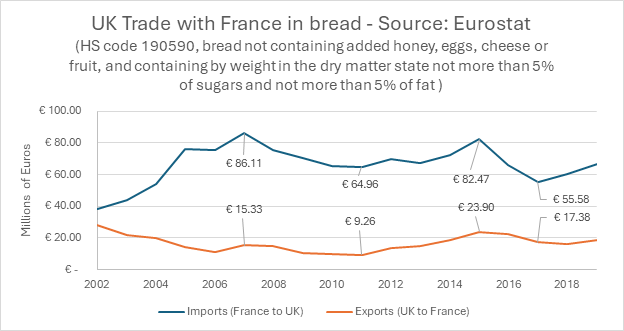
    French exports of bread to the UK dwarfed the inverse – France could produce and ship the kind of bread that Britons wanted to eat, but the UK couldn’t produce and ship the kind of bread that French wanted to eat. Thus French exports to the UK were, since 2005 or so, 3-6x UK bread exports to France. There are certainly other possible explanations for this phenomenon, but I imagine that the cultural barrier is a significant one.

    Another notable real-world example, though slightly more abstract, was salmon. Prior to the 1990s, Japan consumed very little salmon and almost exclusively in a cooked form, viewing salmon as a fish prone to parasites that should not ever be consumed raw, whereas in Norway raw or lightly smoked salmon is a staple of the national cuisine. In the late 1980s, Norwegian fishermen found themselves with a surplus of Salmon and insufficient markets to offload it into, and thus they sought to change the culture of Japan through a fierce marketing campaign that transformed the culinary culture of the land of the rising sun – salmon sushi is now arguably one of the most iconic emblems of Japanese cuisine. The culture of Japan constituted a trade barrier, and clever Norwegian marketing lowered, or even reversed, the cultural trade barrier.

    The Illiberal Advantage

    As I mentioned, one aspect of this discussion – the impacts of culture on trade – are nothing new. But what is often missed from these analyses is that it does not operate equally for all countries – some countries have much stronger cultural “walls” than others. It stands to reason that authoritarian regimes with tight media controls (e.g. China) have much more power to shift culture in a direction that  brings economic benefit – for example, encouraging Traditional Chinese Medicine as a way of stimulating the domestic market and raising a trade barrier to foreign pharmaceuticals, or perhaps doing behind-the-scenes manipulation to discourage state-affiliated firms (increasingly all major Chinese firms) from buying from geostrategic competitors. As such, liberal democracies have a strong incentive to understand this greater power of their non-democratic rivals and trade competitors to shape tradeflows and effectively circumvent and nullify aspects of free trade agreements. A solution would be to create monitoring offices at the WTO or embedded in trade agreement arbitration mechanisms to set limits on the scale or intensity of marketing campaigns or state manipulation of cultural preferences that affect trade.

  • Free Trade – the American Past and Future

    Aside from human decency, several minorities, and general faith in the American political system, one of the lesser-lamented victims of the post-2016 turn in American politics was Free Trade. Strangely, from it being one of few things that most American politicians agreed upon in 2012, free trade has fallen to the wayside as a cornerstone of American economic policy. Before we so lightly abandon it, let us consider what it has done for us, and what it can still do.

    In the wake of the second world war, the united states stood alone as a colossus of industry. Western Europe and the Japanese Empire, the most industrialized places outside the Americas, as well as secondary centers like the Soviet Union and the Middle East, had been devastated by years, in some places nearly a decade, of total war. In 1945, the United States possessed nearly half of the world’s industrial capacity (estimates vary but over 40%) – literally all of rest of the world combined could barely equal the combined industrial output of the United States.

    During this period, it made complete and total logical sense for the United States to pursue policies of free trade, and to get others to do the same. But let us dig a little bit into the why of the thing. To some, this idea is intuitively obvious; to others, free trade means hemorrhaging jobs overseas and impoverishing workers and undercutting the power of unions. But in the postwar years, the United States with its unrivaled industrial capacity was doing two things that benefitted from free trade: 1, exporting these manufactured goods like cars, radios, and the nascently popular television, and 2, importing the raw materials like wood, agricultural products, and metals to be turned into these manufactured goods. For a country in these situations, it was beneficial to go knock on the doors of trade partners, and propose an exchange: the US would allow their exporters to sell without tariffs into the US, and in return they would allow US exporters to sell without tariffs into their markets. For many of these countries like Latin America, East Asia, and the Middle East, who were major exporters of these raw materials and importers of finished goods, these free trade deals made intuitive sense as well; there was little need for coercion and strong-arming or massive expense of diplomatic capital to see most of the world embrace a regime of free trade and open borders, especially considering that a major cause for the great depression and ensuing Second World War was the imposition of punitive, beggar-thy-neighbor trade barriers and the ensuing collapse of global commerce (global trade in 1933 collapsed to 1/3 of its value in 1929).

    Now back in the United States, surely this embrace of free trade in the immediate postwar era meant that these foresters and coal miners and farmers were being outcompeted by these cheap imports and leaving their communities impoverished, and the CEOs were getting fat off the profits, like many people allege is happening today with deals like NAFTA, right? Quite the contrary. There are many different contributing factors to why this didn’t turn out poorly (and in fact turned out so well) and intense political debates and entire academic careers surround the relative importance of each one, but amongst the most important (in no particular order) are these:

    • American (and indeed global) industry in this period was still highly labor intensive and much of it did not require many special skills; those unemployed miners, farmers, etc. did not have very much trouble finding work, preventing mass layoffs and unemployment
    • The 1944 GI Bill provided funding for returning military personnel who had served in WWII to get training and educations, allowing immense mobility into the growing and expanding higher-skilled post-industrial sectors of the American Economy. Between 1944 and 1956, nearly 10 million veterans received these education and training provisions (considering the US population in 1950 was only about 150 million people, this is an enormous swath of the American workforce receiving post-secondary education assistance).
    • The top marginal tax rate in much of the 1950s was nearly 90%. Economic inequality remained very low and social mobility remained very high. The increased government revenues resulting from these tax rates funded the infamous Military Industrial Complex as well as such far-reaching investments as the Interstate Highway System which circulated massive amounts of money throughout the economy.

    As a result of these and other factors, what happened was that American companies had massive demand for their increasingly advanced manufactured goods as the economies of Western Europe and East Asia rebuilt, and sold easily as a result of lowered or absent tariffs and barriers to trade; additionally, their access to cheap tariff-free raw materials from Latin America and elsewhere meant that they stayed profitable, were able to grow and soak up massive amounts of excess labor in the US labor market, preventing mass unemployment and contributing to a growing middle class and the halcyon prosperity of the 50s and early 60s. High marginal tax rates and high investments in social programs, education, and infrastructure ensured unparalleled levels of socioeconomic mobility. And many developing countries, many of them still under the yoke of European empire, were either struggling with fundamental problems of internal development and wartime devastation (e.g. Korea) or finding their own path to prosperity via more efficient and productive exploitation and export of basic agricultural goods and natural resources such as via the route that Argentina followed in the late 1800s when it briefly surpassed France, Sweden, or Italy in economic output. Eager for access to US markets in exchange for lowered tariffs on imported manufactured goods, much of the world climbed aboard the trade bandwagon.

    In this new regime of free trade, between 1945 and 1970 the volume and value global exchange skyrocketed, and American prosperity along with it.

    The current state of world affairs could not be more different. Countries like China and Mexico are not content to sell agricultural products and ores and buy American cars and televisions; they produce televisions, cars, and durable goods of their own, and often more cheaply and innovatively than those produced in the US. What began in the late 60s as Volkswagens and later Hondas began outcompeting GM and Ford in the US market has become the new global status quo – the United States holds no monopolies on manufactured goods, electronics, or post-industrial services.

    Politicians like Bernie Sanders and Donald Trump are in one respect right when they assert that the United States cannot maintain prosperity by doing exactly what it has been doing with regards to free trade, and that continue going down that path will lead to the end of the American working class and the continuing hemorrhaging of jobs and wealth to developing countries. If one defines the working class as the class that can make a decent living off of relatively unskilled labor, particularly in manufacturing, those are some of the jobs that are inherently likely to relocate to areas with cheaper labor, like the Chinas or Mexicos of the world.

    However, the politicians like Sanders and Trump are completely wrong in the assertion that the response to this loss of jobs and massive trade deficits should be protectionism and a retreat from neoliberalism and free trade. Rather, an advanced post-industrial economy like the United States has no business trying to compete with developing and industrial economies in unskilled manufacturing; the Chinese manufacturer of bicycles or computer monitors will always be able to outcompete the American manufacturer in such products, because the Chinese factory worker only requires the wages to sustain a Chinese factory worker standard of living. Unless the United States is willing to sacrifice all of the advances in comfort and standards of living for the last 50 years, we will never be able to compete with China in basic manufacturing. Instead we should strive to be competing with Japan and Germany in advanced electronics and engineering, energizing our Infotech sectors on the West coast and biochemical clusters in the Northeast, and investing in clean and renewable energies in the Midwest, not striving to protect the dying industries of the Rust Belt.

    The only obstacle is that the US will have to rebuild much of the institutional foundation of 1950s prosperity in order to accomplish this transition. The US should be investing in trade and technical schools and public universities to make sure that those previously unskilled manufacturers have the skills and talents necessary to work on advanced manufacturing, in the way that was done with the GI Bill in the 40s and 50s. We must invest in new infrastructure; in a 21st century analog to the Interstate Highway System, the US must craft nationwide broadband and smart grids for all, allowing underprivileged students access to the socioeducational benefits of resources like Wikipedia, Khanacademy, and Youtube as well as for Midwest energy production in wind, natural gas, biofuel, and solar energy to power the major coastal cities. We must strive for the future, not the past; we must strive to compete with countries whose standard of living we envy, not those whose standards of living we have surpassed long ago. A brighter future is possible. But we must fight for it.