Natalism, the belief in the need for higher birthrates, is increasingly a topic of concern for various thinkers and prognosticators (Robin Hanson, Tyler Cowen, Zvi Moskowitz, and Elon Musk among many others). However, the calls for natalist policies are almost unanimously from the political right. I would like to argue that it would behoove the political left to take on this banner as well.
The reason that the left has been reluctant to promote natalism are somewhat obvious. One of the core ideological constituencies of the political Left in many developed countries is young educated professionals, many of whom are child-free: some simply by the vicissitudes of professional life, and some of whom by ecological or personal choice. For the child-free members of this group, to embrace natalism would be hypocrisy. And for a leftist group or party to embrace natalism would be to risk alienating this important source of votes, funds, and political energy. Natalism is closely associated with the “traditional family” and “family values”, typically conservative calling cards.
That said, there are a two strong arguments to make for the left embracing natalism, one of them Machiavellian and the other Darwinian.
The Machiavellian argument is simply that natalism could be a powerful argument and political tool for advancing many leftist causes. I will take the American example here, even though the US is out of step with most western countries on these issues, but the example should be illustrative to other political systems nonetheless. Some of the dreams of the American left include expanding public healthcare, instating paid medical and parental leave policies, and funding public schooling, including higher education. A powerful political argument from the natalist perspective is that the cost and burden of having, raising, and educating a child is too prohibitive and that this is a significant reason for the choice of many adults in developed countries not to have children. By putting in place these policies, the cost of having, raising, and educating a child is distributed to society as a whole, just as the benefit of having that additional participant in the economy is distributed – public goods should have public funding. Should the American political left embrace natalism, it could seek common cause with natalists on the right to find compromises on these policies for the benefit of boosting the birthrate.
On the Darwinian side, Leftists should consider embracing natalism to ensure their ideological and demographic sustainability. In the short-term national scale, if left-leaning individuals and groups continue to have lower birth rates compared to their right-leaning counterparts, the political landscape could shift significantly over a few decades; higher birth rates on the right could lead to a future where conservative values and policies dominate simply due to numerical superiority and intra-familial transmission. As Robin Hanson argues, over time this could mean a far future that is populated by the descendants of high-fertility subcultures like Amish and Ultra-Orthodox Jews, who are of course very religious and conservative. When Hanson first promulgated this idea, I was resistant and argued that
“The idea that society will be dominated by the high-fertility subcultures is reductionist and assumes that the part of society one is born into is nearly perfectly correlated with the part of society one affiliates with as an adult, which is not the case. Conservative religious groups have higher fertility, but many people raised in those environments convert to more secular or liberal worldviews as adults. Parts of society that don’t have high fertility compete with high-fertility parts by being more alluring. Equilibrium can continue indefinitely.”
However, I did the math, and posited a scenario in which there is a dominant culture D with fertility rate 1.5, and subculture S which is only 5% of the population but has a fertility rate of 4. To ensure that S never becomes dominant, the conversion rate from S to D needs to be approximately 29.33% per generation. This means that for every 100 S individuals, at least 29.33 need to convert to D each generation to prevent S from ever becoming the majority. 29% is a high barrier, considering that fewer than 10% of Amish leave their communities. It would be much easier to simply increase the fertility rate of mainstream society.[1] By promoting and supporting family-friendly policies that encourage higher birth rates within their communities, leftists can help ensure the populational vitality of the coalition.
In the long term global perspective, falling birth rates in secular, developed countries can lead to a significant population imbalance compared to developing countries, which, without stereotyping, are on average less secular and egalitarian than western countries. This will put secular liberal values at a disadvantage globally in bodies such as the UN or its successors. Further, countries experiencing starkly declining populations may increasingly rely on immigration to sustain their economies and address labor shortages (NB: I am pro-immigration and this is overall a good thing!). However, as shown in the previous link, this immigration will increasingly have to come from nations with more conservative cultures, posing increasingly difficult demands on systems of integration/assimilation, which may over time threaten the influence of liberal and secular ideals (we don’t have to go full Houellebecq and see some abrupt takeover). This process can be slowed and eased by boosting domestic fertility.
[1] Note that this sort of scenario only really plays out in a peaceful world; in a more belligerent time like in most of human history, dynamism in social organization and scientific and technological advance allowed the dominance of countries with small populations over larger ones; see, for example, the Mongol, British or Japanese victories over China, or Prusso-German successes over Russia, or for the most extreme examples the incursions of Pizarro and Cortez in the Americas.
In modern usage, the term “accelerationism” is claimed by far-right groups as a philosophy of destabilizing society to bring about a more authoritarian and conservative future. However, soi-disant accelerationists have no monopoly on accelerationist ideas. That is to say that the perspective of “acceleration” of society through stages is neither new nor confined to the political right; accelerationist mindsets are espoused by various groups aspiring to “accelerate” society toward some predicted end and effect a transformation to a more “ideal” version of society. Though the nominal idea of accelerationism is widely conceived as radical and dangerous in most interpretations, the general concept of “accelerating” society toward a predefined end has a long history on many points on the political spectrum and has through its real-world political effects substantially influenced the modern world. To understand where accelerationist ideas come from, it is worthwhile to investigate, in brief, their history and legacy. It is also worthwhile to investigate their fundamental flaws.
The Philosophical Underpinnings
The concept of society moving toward an inexorable end is not new, but neither is it universal; many ancient peoples kept time with respect to dynasties or the founding of cities, commencing cycles that were inevitably reset every time a dynasty or city fell – for a modern relic of this system, we can see the Japanese imperial calendar or gengō system, in which the current year is Reiwa 2, second year of the reign of the new emperor. Ancient Romans kept time with relation to the founding of the city or by reference to the consuls who were in power in a particular year.[i] With the rise of monotheistic religion, however, societies began keeping time with respect to immutable events, such as the birth of Jesus or the Hijra of Mohammed – fixed dates that allowed a linear outlook on time irrespective of the city or ruling family one happened to live near. These societies also prophesied the eventual arrival at some future event, be it the end of the world or the coming of the Messiah, and even into the early modern era it was common to think that human actions could help bring it about – for example, in the 1500s, Jews began settling in the holy land, not to create a Jewish state like the modern Israel, but rather, they “hoped to accelerate the coming of the Messiah”[ii]. In the late 18th century, the German philosopher Friederich Hegel gave rise to a conception of history moving through a set of defined stages. For Hegel, this progress was most clearly visualized in the form of European civilization passing from pre-civilized barbarism, to slavery under classical societies, to the theological thought during the middle ages and culminating (for him) in the humanism and enlightenment philosophy of his time. For Hegel, this furthering of civilization was in turn furthering the evolution of the Weltgeist, or the Worldspirit, the collective mental and spiritual progress of humanity that developed inexorably toward greater liberation.
“[…]The world spirit, has possessed the patience to pass through these forms over a long stretch of time and to take upon itself the prodigious labor of world history, and because it could not have reached consciousness about itself in any lesser way, the individual spirit itself cannot comprehend its own substance with anything less.” – Hegel, Preface, Paragraph 29[iii]
Left-Accelerationism
Without question the most famous application of Hegelian history was made by Karl Marx, who took the idea of historical stages and wedded them to another (and more long-lived) Hegelian philosophical invention of “dialectics” – the idea that a prevailing and dominant idea (a “thesis”) is at some point confronted with a contrary or opposite idea (the “antithesis”), and the result of this conflict of ideas is that one of the ideas would win out but be altered in the process, producing a new idea (the “synthesis”), which in being dominant would be the new thesis, continuing the cycle. Marx took this Hegelian dialectic formula and famously applied it to social classes, seeing one dominant class as the thesis, a rival class as the antithesis, and the result of their inevitable conflict would be a new synthesis and new social order, which would inevitably be challenged by a new class. Thus society progressed from slavery to feudalism to capitalism to communism.
What does this have to do with Accelerationism? Well, the first real example of Accelerationism is tied to Marxist thought. Communism, according to Marx, could only come about once the philosophical infrastructure of Capitalism was in place, for only the underclass of capitalism, the proletariat, could overthrow the oppressive bourgeoisie and institute Communism. Marx was wedded to the inevitability of the entire endeavor:
“The advance of industry, whose involuntary promoter is the bourgeoisie, replaces the isolation of the labourers, due to competition, by the revolutionary combination, due to association. The development of Modern Industry, therefore, cuts from under its feet the very foundation on which the bourgeoisie produces and appropriates products. What the bourgeoisie therefore produces, above all, are its own grave-diggers. Its fall and the victory of the proletariat are equally inevitable.” – Marx and Engels, 1848[iv]
But to Marxists such as Lenin and the Bolsheviks in Russia during the late 19th and early 20th centuries, the ideal socialist society they longed for was decades or centuries away: according to most observers at the time, Russia was not yet even capitalist – rather, with the ascendancy of the church, the czar, and the nobility, (Orthodoxy, Autocracy, Nationality, went the triune slogan of Russian conservatism) Russia was still trapped, economically and socially, in a kind of feudalist proto-capitalism. Thus, in the years leading up to the Bolshevik Revolution in Russia, would-be Communists were deeply conflicted over the question of Marxists stages of history. The communists wanted Communism now, but according to Marx they would first have to usher in an era of capitalism to create the necessary foundations for their long-awaited Communist system. As a result, many Russian socialists and communists in the early 20th century embraced the possibility that Russia might have to undergo a capitalist, liberal revolution before the infrastructure could be laid for a second, socialist revolution. In the 1920s, after the Russian Civil War had been put to rest, The Communist Party of the Soviet Union embraced the “New Economic Plan” which was (relative to the “war socialism” the Bolsheviks emplaced during the late teens) a market-based system of exports and investment that would aim to get the USSR’s productive capacity on par with the capitalism they sought to surpass. Mao Zedong would embrace the same kind of stepwise thinking at times, not between capitalism and communism, but rather socialism and communism, in the lead-up to the infamous “great leap forward”[v].Should the communists, therefore, support the rise of capitalism? An idea that arose to deal with this problem is an early formulation of accelerationism. If a society has to go through stages to reach a desired end-goal, then those who want the desired end-goal should do their best to speed up the natural processes.
Accelerationism is, then, in its fundamental form, a belief in some kind of set of stages that society needs to be walked through—and support for attempts to destabilize the current system or otherwise put in place the necessary conditions to see the change transpire organically
In the 1970s, Marxist political philosophers Hardt and Negri published an unexpectedly popular book, “Empire”, examining the way in which American Capitalism pervaded the world, but also looking (in a devil’s advocate manner) at ways in which Capitalism was setting in motion global progress toward what would come next. For example, they noted the ways in which corporations were astutely indexing and integrating all world resources and productive capacities into a networked global market. Socialists and communist grappled onto these ideas, contending, as Bolsheviks had done decades before, with the possibility that the best way to arrive at a global transition to socialism was actually to support the growth of these capitalist global structures:
“The huge transnational corporations construct the fundamental connective fabric of the biopolitical world in certain important respects. […] Some claim that these corporations have merely come to occupy the place that was held by the various national colonialist and imperialist systems in earlier phases of capitalist development, from nineteenth-century European imperialism to the Fordist phase of development in the twentieth century. This is in part true, but that place itself has been substantially transformed by the new reality of capitalism. The activities of corporations are no longer defined by the imposition of abstract command and the organization of simple theft and unequal exchange. Rather, they directly structure and articulate territories and populations. They tend to make nation-states merely instruments to record the flows of the commodities, monies, and populations that they set in motion. The transnational corporations directly distribute labor power over various markets, functionally allocate resources, and organize hierarchically the various sectors of world production. The complex apparatus that selects investments and directs financial and monetary maneuvers determines the new geography of the world market, or really the new biopolitical structuring of the world. The most complete figure of this world is presented from the monetary perspective. From here we can see a horizon of values and a machine of distribution, a mechanism of accumulation and a means of circulation, a power and a language.”
In other words, corporations are not merely exploitative, extractive engines serving the interests of the bourgeoisie in the global north, but are rather organizing forces that mobilize resources (notably labor power) into a global connected system. Thus, Hardt and Negri argue, the modern corporation may be moving some people toward the proletarian organization that early Marxists sought to effect through cadres and labor unions. Echoing Hardt and Negri’s work, it is common these days in some corners of the internet to talk about “late-stage capitalism”, an overt assumption that society progresses in stages and that capitalism’s stage is on the way out, laying the foundation for a transition to socialism[vii]. These communists pay heed to the inevitability in Marx’s work, the teleological inexorability, which classes would find their way to conflict without need of the cadre-driven insurrection embraced by Bolsheviks and Maoists, who truly believed that they could “accelerate” the stages of history, rather than simply letting them unfold naturally.
Technological Accelerationism
Another form of accelerationism that had a short-lived but influential moment in the late 20th and early 21st centuries is that of a pseudo-apolitical techno-futurist accelerationism. In this conception of futurism, which held precedence just before the far-right swing in nominal futurism mentioned above, acceleration is viewed in a technological sense: society must invest in technological progress to speed us through this era of directionless sociopolitical uncertainty. In a 2017 conception,
This accelerationism has a conservative flair (at least in the American sense): government should get out of the way and allow technology leaders to chart the path to the utopian post-scarcity future. This is a vision of acceleration, and a known future state, strongly influenced by trends of Science Fiction. “In an era where left-of-center voices increasingly paint a dark vision of the future as fraught with ecological dangers, science fiction conservatives have a near monopoly on utopian dreams of a tomorrow of abundance and technological wonders.”[viii] A prominent proponent of this conservative techno-utopian ideal was former Speaker of the House Newt Gingrich, a self-described pursuer of Star Trek-like visions of the future, who advocated a libertarian approach to scientific advancement: “If you take all the money we’ve spent at NASA since we landed on the moon and you had applied that money for incentives to the private sector, we would today probably have a permanent station on the moon, three or four permanent stations in space, a new generation of lift vehicles. And instead what we’ve had is bureaucracy after bureaucracy after bureaucracy, and failure after failure”.[ix] This same techno-libertarian futurism was on full display as late as the 2016 Republican National convention, in which billionaire tech investor Peter Thiel declared that “today our government is broken. Our nuclear bases still use floppy disks. Our newest fighter jets can’t even fly in the rain […] Instead of going to Mars, we have invaded the Middle East […] When Donald Trump asks us to Make America Great Again, he’s not suggesting a return to the past. He’s running to lead us back to that bright future.”[x]
It was as an outgrowth of this culture – conservative, sci-fi influenced techno-utopianism, that in the late 2010s observers characterized “accelerationism” in the following way:
“Accelerationists argue that technology, particularly computer technology, and capitalism, particularly the most aggressive, global variety, should be massively sped up and intensified – either because this is the best way forward for humanity, or because there is no alternative. Accelerationists favour automation. They favour the further merging of the digital and the human. They often favour the deregulation of business, and drastically scaled-back government. They believe that people should stop deluding themselves that economic and technological progress can be controlled. They often believe that social and political upheaval has a value in itself. Accelerationism, therefore, goes against conservatism, traditional socialism, social democracy, environmentalism, protectionism, populism, nationalism, localism and all the other ideologies that have sought to moderate or reverse the already hugely disruptive, seemingly runaway pace of change in the modern world.”[xi]
Right-accelerationism
Today, however, “accelerationism” is nominally more of a right-wing ideology. How did it make this transition? Communists did not maintain a monopoly on the concept of accelerating society through stages. In the 1920s, the German Nationalist (and proto-Nazi) philosopher Carl Schmitt embraced accelerationist attitudes in his belief in the need for a strong authoritarian center for modern society. Given that “the sovereign power of the king has been dissolved, disembodied, and dispersed in the communication flows of civil society, and it has at the same time assumed the shape of procedures, be it for general elections or the numerous deliberations and decisions of various political bodies,” Schmitt believed that it would be necessary for people to develop a new kind of sacred reverence for a new source of authority and legitimacy. Schmitt believed that even supposedly liberal democracies were authoritarian at the core, and that when real and consequential decisions had to be made (e.g. to fight against terrorism or a global pandemic), the pretense of procedural democracy would always be shunted aside. More specifically, he conceptualized that even a liberal democracy would encounter moments—crises—in which “exceptions” had to be made, and as Schmitt put it, “Sovereign is he who decides on the exception.”[xii] To that end, right-accelerationism attempts to bring about precisely that destabilization of society in order to reach the exception, with a kind of conservative authoritarianism able to check the undesirable aspects of liberal democracy. His answer was to call for a mythologizable and revered leader, very much like what Nazi ideology embraced regarding Hitler.
Ever since the chaos of the 1930s and resulting ascension of fascism, political observers have noted the relationship between a breakdown in the normal fabric of society and the resulting popular support for authoritarianism. For example, economic shocks such as market collapse are often associated with increased support for tougher, roughshod measures to get things back on track.[xiii]
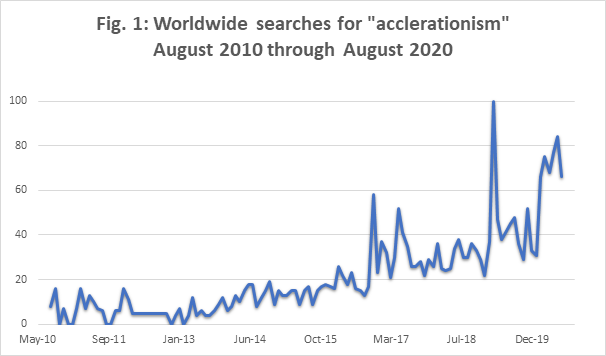
This brings us to the typical modern instantiation of accelerationism: the white supremacist and far-right accelerationism embraced by, among others, the shooter who murdered 49 mosque-attendees in New Zealand in March 2019. The terrorist attack, committed in the explicit name of “accelerationism”, has set the standard for the popularity and use of the term (see: fig. 1)[xiv]. These accelerationists believe that western liberal democracies must embrace authoritarianism to rid themselves of weak and detracting elements – namely non-white people, feminists, and other components of what they consider to be “others” and part of the cultural left. Further, they feel that this sort of society will naturally come about when society is destabilized enough that the majority demands stronger security and policing. As such, they advocate chaos and anarchical behavior to shock and terrorize society in radical lockdowns and internal transformation.
The Fundamental Error
Accelerationist ideas across all political ideologies stem inexorably from a preconception about two things: first, a prescience about the future trajectory of the sociopolitical; second, a belief in the ability to bring about that future trajectory. From Leninists who believed that a campaign of Bolshevistic force could bring about the necessary transition to sustainable socialism to the New Zealand shooter who believed that his actions would contribute to a destabilization of society sufficient that a critical mass would call for a revocation of liberal and multicultural values, the fundamental assumption of accelerationists is an ability to tell the future. Accelerationists of all political stripes believe that the future is inherently more in line with their political goals and preconceptions, and that certain institutions of the status quo must be overcome or changed in order to arrive at that utopian end.
Indeed, many observers, even those of us who do not believe ourselves to be “accelerationists” of any stripe are guilty of some form of this. A common instantiation of this error is that of the so-called “Whiggish” view of history, that is, that “the arc of history is long and it bends toward justice”. Though this may have been the general trajectory for the past few hundred years, to extrapolate this out a few centuries hence and to assume that society can go in no direction other than the maximization of justice is somewhat presumptive. Believing that the future is inherently on one’s side, and that all one must do to bring about one’s ideal future is clear away certain blockers in the present (e.g. removing certain injustices to accelerate the arrival of an inexorably just future) is certainly a form of accelerationist mindset, albeit a relatively dilute one.
But such an assumption is not unique to those who view inexorable progress only in sociocultural terms – indeed, those who view progress in technological terms are equally fallible, for as desirable as the post-scarcity utopias of Star Trek and related visions of the future may be, they hinge as much on a fixed interpretation of the arc of human progress: indeed technological progress could allow humanity to escape the Malthusian trap and create a prosperous world free of competition, but it could just as likely lead to a world of Orwellian or Huxleyan social control.[xv]
To that end, the way to avoid making the errors and assumptions of accelerationism is as follows: one must forget one’s idea of what the future will be like. Working towards a particular end will not necessarily bring it about, and may, through the invocation of opposition, bring about a countervailing reaction that undoes the entirety of one’s progress. The vicissitudes of history are fierce and many, and few institutions have the capacity to see through plans and goals through more than a few decades before “today’s problems [become] the result of yesterday’s solutions”.
[i] Day, Abby. “Sacred Time”. The International Encyclopedia of Anthropology, 1-8. 2018. doi:10.1002/9781118924396.wbiea1919
[ii] Abulafia, David. The Great Sea. 2012. Ebook version, Section 4, Chapter III, Paragraph 5.
[iii] Hegel, Friedrich. The Phenomenology of Spirit. 1807.
[iv] Marx, Karl and Friedrich Engels. “Manifesto of the Communist Party”. 1848
[v] Meisner, Maurice. “Mao’s China and After: A History of the People’s Republic”. Simon and Schuster, 1999.
[vi] Hardt, Michael and Antonio Negri. Empire. Harvard University Press, 2001.
[vii] Reddit. “/r/latestagecapitalism”. www.reddit.com/r/latestagecapitalism. Retrieved June 11, 2020. At the time of retrieval, the community had 538,889 subscribers.
[xii] Schmitt, Carl. Political Theology: Four Chapters on the Concept of Sovereignty. George D. Schwab, trans. (MIT Press, 1985 / University of Chicago Press; University of Chicago edition, 2004 with an Introduction by Tracy B. Strong. Original publication: 1922, 2nd edn. 1934.
[xv] A particularly insightful comparison can be drawn from McMillen Stuart, “Amusing Ourselves to Death”, Recombinantrecords.com, May 2009. However, McMillen deleted his claim to this comic given claims by copyright holders of Postman, Neil. “Amusing Ourselves to Death”. Viking Penguin, Methuen, UK, 1985.
There’s an idea that I’ve been tossing around in my head for quite some time, and I wanted to start laying the groundwork for putting into text. The gist of the idea is this: we’re probably too late to stop the worst of climate change. Therefore, does it not behoove us to at least consider how to make the most of the completely Anthropocene world we are creating?
Some things to consider:
As global temperatures rise, very cold and barely habitable places like Siberia, Alaska, Greenland, Northern Canada, and Antarctica are going to become habitable. Colder habitable areas, e.g. New England, the Upper Midwest US, Northern Britain, Scandinavia, Hokkaido, Manchuria, Tierra del Fuego, and New Zealand will have “better” overall temperatures. Altogether, these are enormous areas (Canada and Siberia particularly). The biodiversity of arctic and semi-arctic areas is very small compared to more temperate areas – broadly speaking, more energy in an environment means more life – and we need to investigate the possible upsides of cultivating these areas. The conversion of tundra to taiga, taiga to coniferous forest, and coniferous forest to temperate deciduous forest stands to be an enormous boon in some respects.
The opening of sea lanes is going to be monumental. For centuries, explorers sought Northwest and Northeast passages from the Atlantic to the Pacific; those passages are becoming available. Ships are now beginning to ply the waters of the Arctic ocean, and soon will be a regular occurrence, shaving as much as 40% off of current routes through either the Panama or Suez Canals.This point has already received a great deal of attention, and many skeptics point to the fact that, e.g. trade between China and Norway is extremely small, or that ports of call are nonexistent along the Arctic coast. However, these estimations are making the fatal flaw of dealing with the situation as it stands, not as it may be a century hence. As natural resources beneath the arctic are exploited and shipping expands, new settlements and ports are bound to be founded, and the Arctic Ocean will likely in future decades be dotted with lights throughout its sunless winters.To this end, the Bering Strait may well be the Bosporus of the next Century, and the United States and Russia would likely both benefit from improving infrastructure at the strait, both port entrepot facilities and rail/road/pipeline connections.
Higher atmospheric CO2 concentrations will mean faster plant growth. Already, the average color of the earth is becoming greener, and greater forestation in China and India are substantially to thank. Combined with the effects from point 1, there could end up being enormous booms of plant growth in the higher latitudes in coming decades.
The Bible begins in the Garden of Eden which has become a moral allegory for millions. Plato famously invented the continent of Atlantis to demonstrate his ideas. Thomas Moore had his Utopia. Philosophers throughout the ages have invented States of Nature, various Paradises, their fictional worlds in which they posited ideal systems and via which they constructed their worldviews.
The fictional world via which I most shaped my worldview was Star Trek.
Growing up, I was undoubtedly deeply influenced by the vision laid out in Star Trek: The Next Generation and the corresponding films, in which Humanity had reached what is known as a post-scarcity society: a level of technological productivity in which all needs can be provided for and competition – be it economic or military – was rendered unnecessary. Along with this economic abundance came a democratic-socialist system of sociopolitical organization, with sufficient welfare systems and healthcare, and in which scientific advancement was undertaken not for private profit but for the collective good.
I took this vision as my own ideal of what the future of humanity should look like. However, this was obviously a fiction, very greatly divorced from the way the world worked today. The questions that arose, therefore, were: in what ways was this vision achievable? In what ways would it have to be altered?
More specifically, this is a society in which some of the ideas of Western society are taken to an extreme: science and logic are given pride of place, religion has all but disappeared save for private affairs, all individuals are subject to rule of law, and people of all races and genders are treated as equals. Though many people may see these institutions as the logical termination of our current “scarcity” era of human history, it is important not to become trapped in a teleological fallacy. These values are not universal ideals. These ideals are the hallmark of Western Civilization.
Western ideas of liberalism, constitutionalism, human rights, equality, liberty, the rule of law, democracy, free markets, the separation of church and state, often have little resonance in Islamic, Confucian, Japanese, Hindu, Buddhist, or Orthodox culture” (Samuel Huntington, “The Clash of Civilizations”, 1993, p. 40).
As I understood it, the vision presented in Star Trek was closest to being achieved, in the early 21st century, in the European Union. In the EU, war had been all but abandoned as a tool of national policy. Religion was kept far from politics
For me, a young liberal growing up in Bush-era middle America, this idea of Europe offered me a vision of society free from everything I hated about the United States: its self-exaltation, its bellicose policies, the rampant capitalism, the overbearing influence of religion on national life.
As I grew up, however, I began to see that Europe was sleepwalking off a cliff. Western Civilization was not alone in the world, and it had no unchallenged right to lead the future of humanity. The philosophical changes that had led to a softening of military policies and an embrace of comfortable social policies in Europe had blunted any desire to carry a torch or wave the banner of a civilization. The projection of civilizational ideals abroad meant little if not backed with the ability to project civilizational force abroad. Though Europe was closest to achieving the Trekian dream, the road it had followed was a dead-end given geopolitical realities.
Aside from human decency, several minorities, and general faith in the American political system, one of the lesser-lamented victims of the post-2016 turn in American politics was Free Trade. Strangely, from it being one of few things that most American politicians agreed upon in 2012, free trade has fallen to the wayside as a cornerstone of American economic policy. Before we so lightly abandon it, let us consider what it has done for us, and what it can still do.
In the wake of the second world war, the united states stood alone as a colossus of industry. Western Europe and the Japanese Empire, the most industrialized places outside the Americas, as well as secondary centers like the Soviet Union and the Middle East, had been devastated by years, in some places nearly a decade, of total war. In 1945, the United States possessed nearly half of the world’s industrial capacity (estimates vary but over 40%) – literally all of rest of the world combined could barely equal the combined industrial output of the United States.
During this period, it made complete and total logical sense for the United States to pursue policies of free trade, and to get others to do the same. But let us dig a little bit into the why of the thing. To some, this idea is intuitively obvious; to others, free trade means hemorrhaging jobs overseas and impoverishing workers and undercutting the power of unions. But in the postwar years, the United States with its unrivaled industrial capacity was doing two things that benefitted from free trade: 1, exporting these manufactured goods like cars, radios, and the nascently popular television, and 2, importing the raw materials like wood, agricultural products, and metals to be turned into these manufactured goods. For a country in these situations, it was beneficial to go knock on the doors of trade partners, and propose an exchange: the US would allow their exporters to sell without tariffs into the US, and in return they would allow US exporters to sell without tariffs into their markets. For many of these countries like Latin America, East Asia, and the Middle East, who were major exporters of these raw materials and importers of finished goods, these free trade deals made intuitive sense as well; there was little need for coercion and strong-arming or massive expense of diplomatic capital to see most of the world embrace a regime of free trade and open borders, especially considering that a major cause for the great depression and ensuing Second World War was the imposition of punitive, beggar-thy-neighbor trade barriers and the ensuing collapse of global commerce (global trade in 1933 collapsed to 1/3 of its value in 1929).
Now back in the United States, surely this embrace of free trade in the immediate postwar era meant that these foresters and coal miners and farmers were being outcompeted by these cheap imports and leaving their communities impoverished, and the CEOs were getting fat off the profits, like many people allege is happening today with deals like NAFTA, right? Quite the contrary. There are many different contributing factors to why this didn’t turn out poorly (and in fact turned out so well) and intense political debates and entire academic careers surround the relative importance of each one, but amongst the most important (in no particular order) are these:
American (and indeed global) industry in this period was still highly labor intensive and much of it did not require many special skills; those unemployed miners, farmers, etc. did not have very much trouble finding work, preventing mass layoffs and unemployment
The 1944 GI Bill provided funding for returning military personnel who had served in WWII to get training and educations, allowing immense mobility into the growing and expanding higher-skilled post-industrial sectors of the American Economy. Between 1944 and 1956, nearly 10 million veterans received these education and training provisions (considering the US population in 1950 was only about 150 million people, this is an enormous swath of the American workforce receiving post-secondary education assistance).
The top marginal tax rate in much of the 1950s was nearly 90%. Economic inequality remained very low and social mobility remained very high. The increased government revenues resulting from these tax rates funded the infamous Military Industrial Complex as well as such far-reaching investments as the Interstate Highway System which circulated massive amounts of money throughout the economy.
As a result of these and other factors, what happened was that American companies had massive demand for their increasingly advanced manufactured goods as the economies of Western Europe and East Asia rebuilt, and sold easily as a result of lowered or absent tariffs and barriers to trade; additionally, their access to cheap tariff-free raw materials from Latin America and elsewhere meant that they stayed profitable, were able to grow and soak up massive amounts of excess labor in the US labor market, preventing mass unemployment and contributing to a growing middle class and the halcyon prosperity of the 50s and early 60s. High marginal tax rates and high investments in social programs, education, and infrastructure ensured unparalleled levels of socioeconomic mobility. And many developing countries, many of them still under the yoke of European empire, were either struggling with fundamental problems of internal development and wartime devastation (e.g. Korea) or finding their own path to prosperity via more efficient and productive exploitation and export of basic agricultural goods and natural resources such as via the route that Argentina followed in the late 1800s when it briefly surpassed France, Sweden, or Italy in economic output. Eager for access to US markets in exchange for lowered tariffs on imported manufactured goods, much of the world climbed aboard the trade bandwagon.
In this new regime of free trade, between 1945 and 1970 the volume and value global exchange skyrocketed, and American prosperity along with it.
The current state of world affairs could not be more different. Countries like China and Mexico are not content to sell agricultural products and ores and buy American cars and televisions; they produce televisions, cars, and durable goods of their own, and often more cheaply and innovatively than those produced in the US. What began in the late 60s as Volkswagens and later Hondas began outcompeting GM and Ford in the US market has become the new global status quo – the United States holds no monopolies on manufactured goods, electronics, or post-industrial services.
Politicians like Bernie Sanders and Donald Trump are in one respect right when they assert that the United States cannot maintain prosperity by doing exactly what it has been doing with regards to free trade, and that continue going down that path will lead to the end of the American working class and the continuing hemorrhaging of jobs and wealth to developing countries. If one defines the working class as the class that can make a decent living off of relatively unskilled labor, particularly in manufacturing, those are some of the jobs that are inherently likely to relocate to areas with cheaper labor, like the Chinas or Mexicos of the world.
However, the politicians like Sanders and Trump are completely wrong in the assertion that the response to this loss of jobs and massive trade deficits should be protectionism and a retreat from neoliberalism and free trade. Rather, an advanced post-industrial economy like the United States has no business trying to compete with developing and industrial economies in unskilled manufacturing; the Chinese manufacturer of bicycles or computer monitors will always be able to outcompete the American manufacturer in such products, because the Chinese factory worker only requires the wages to sustain a Chinese factory worker standard of living. Unless the United States is willing to sacrifice all of the advances in comfort and standards of living for the last 50 years, we will never be able to compete with China in basic manufacturing. Instead we should strive to be competing with Japan and Germany in advanced electronics and engineering, energizing our Infotech sectors on the West coast and biochemical clusters in the Northeast, and investing in clean and renewable energies in the Midwest, not striving to protect the dying industries of the Rust Belt.
The only obstacle is that the US will have to rebuild much of the institutional foundation of 1950s prosperity in order to accomplish this transition. The US should be investing in trade and technical schools and public universities to make sure that those previously unskilled manufacturers have the skills and talents necessary to work on advanced manufacturing, in the way that was done with the GI Bill in the 40s and 50s. We must invest in new infrastructure; in a 21st century analog to the Interstate Highway System, the US must craft nationwide broadband and smart grids for all, allowing underprivileged students access to the socioeducational benefits of resources like Wikipedia, Khanacademy, and Youtube as well as for Midwest energy production in wind, natural gas, biofuel, and solar energy to power the major coastal cities. We must strive for the future, not the past; we must strive to compete with countries whose standard of living we envy, not those whose standards of living we have surpassed long ago. A brighter future is possible. But we must fight for it.


 This point has already received a great deal of attention, and many skeptics point to the fact that, e.g. trade between China and Norway is extremely small, or that ports of call are nonexistent along the Arctic coast. However, these estimations are making the fatal flaw of dealing with the situation as it stands, not as it may be a century hence. As natural resources beneath the arctic are exploited and shipping expands, new settlements and ports are bound to be founded, and the Arctic Ocean will likely in future decades be dotted with lights throughout its sunless winters.To this end, the Bering Strait may well be the Bosporus of the next Century, and the United States and Russia would likely both benefit from improving infrastructure at the strait, both port entrepot facilities and rail/road/pipeline connections.
 Whither the West?