Tag: free trade

  • Why are European Farmers so Angry

    The Global Context of the Continental Uproar

    Farmers are special in a lot of ways. They receive enormous amounts of subsidies from governments in a way that no other industry does. In most industries, free trade agreements prevent member governments from giving government subsidies to their industries; these would be unfair advantages that defeat the purposes of trade agreements. However, agriculture is by and large exempt from these free trade agreements. Why? A lot of food is easily freezable, cannable, refrigerable, processable and shippable around the world, and if we had a world with fully free trade, imported food from Far-Eastern Europe, Latin America, Africa and South Asia would be far cheaper than domestic production, and the agricultural production of wealthy countries would go the way of the textile production of wealthy countries – i.e., it would be uncompetitively expensive except as niche and artisan purchases, and soon there would be very few farmers or agricultural production in wealthy countries.

    And this is really bad PR, and, potentially, bad policy. Why? Countries like to be able to say that they can feed themselves. If the voting public in some countries got wind that their government approved a policy that made their country completely dependent on foreign imports to get fed, they would burn down the halls of power (though many wealth countries with high populations and low arable land area, like Japan or the Netherlands, have been deeply dependent on food imports for decades – and microstates like Singapore are completely dependent on exports for basically everything, one reason why small states are historically big proponents of free trade: they just can’t aren’t big enough for self-sufficiency to be a realistic goal).

    But like I said, it’s not just bad PR, it’s also potentially bad policy. The Pandemic years were a wake-up call to many countries that it might not be a bad idea to make sure one’s supply chains were robust and that one’s stocks of essential goods were secure. The world witnessed (despite efforts at censorship) starvation in a modern wealthy city (Shanghai and other Chinese Cities) when draconian covid lockdowns strained supply chains to their breaking point. It has long been military policy of many countries like the US to ensure that their agricultural production would allow the country to feed itself in the event of a trade-destroying war, and this makes a lot of sense because the US could realistically defeat any conventional enemy in conventional war but if faced with domestic starvation would be crippled.

    There’s also the pure PR power of farmers that makes them punch far above their weight in cultural and political discourse: except for the bluest of bluebloods, we all have farmers in our very recent ancestry, and until the 19th century most people in most countries were farmers.
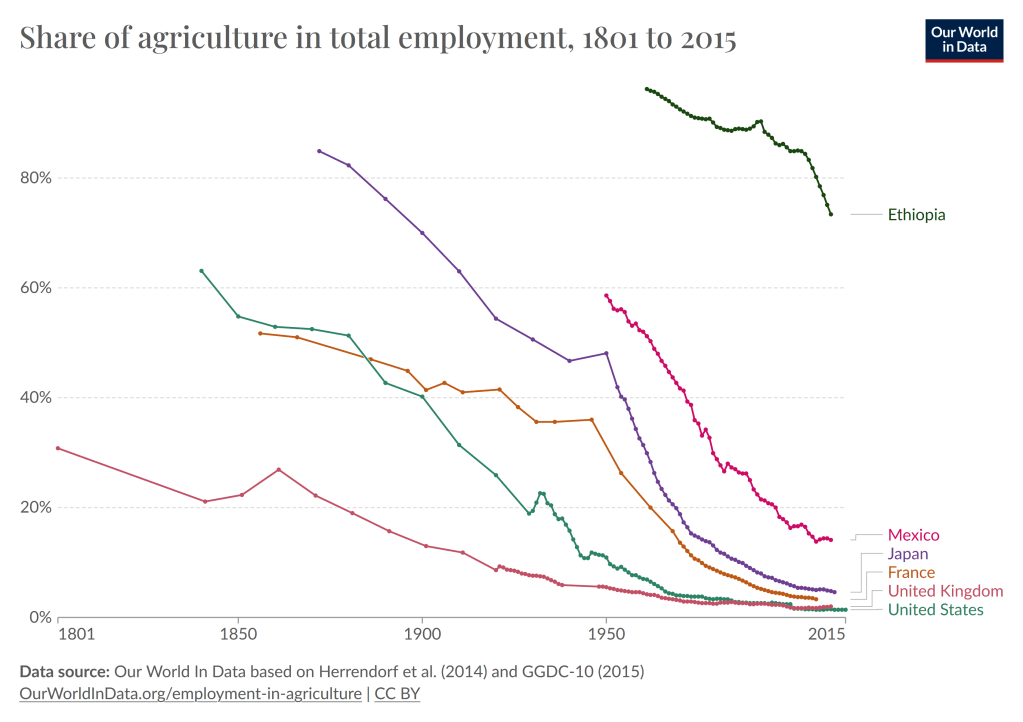
    Farmers are widely seen as embodying superhuman amounts of grit and humility, a winning personality combination in many countries. For all these reasons and more, their political clout is outsized.

    Thus, many wealthy countries have gone out of their way to subsidize their agricultural sectors and keep farming productive and competitive – and farmers quiet. However, it has become increasingly apparent to policymakers that their treatment of farmers is potentially anti-environmental (https://whitherthewest.substack.com/p/the-danger-of-eating-locally) and inegalitarian. I’ll address each of these points in turn. Regarding the environment, farming can be highly polluting – not just via fertilizers and pesticides, but by outdated farm equipment; as an aside, I once heard a French farmer’s solution to a badger on his land was to pour gasoline into its burrow.

    Regarding equality, remember how I said that wealthy countries want to keep agriculture out of free trade agreements so that they don’t get overwhelmed with cheaper products from Latin America, Africa, Far-East Europe and South Asia? Well, Latin America, Africa, Far-East Europe and South Asia are rather unhappy about that – agriculture is often their comparative advantage, and they find it deeply unfair that the things wealthy countries produce (manufactured goods) are subject to reduced tariffs, but the things they produce efficiently (agriculture and forest products) are magically kept out by tariffs for “nAtiOnAl sEcUrItY ReASons”.

    This brings us to today. Many on the left side of the political spectrum in the EU are aware of these two issues (environment and inequality) and are pushing for changes that would not benefit the EU agricultural sector but would privilege environment and global social justice – reductions in subsidies, enforced environmental protections, and ongoing free trade negotiations with Mercosur (a Latin American trade bloc). With the latest push for the Green New Deal in Europe, farmers around the continent decided to see how much heft they had in the European political machinery. And it turns out, they have quite a bit, seeing as after only a few days of protest they secured key concessions from the French government – an exemption from the diesel subsidy phaseout, and continued “No” from France on negotiations with Mercosur. And European far right groups are linking arms with farmers, pushing for increased emphasis on sovereignty and territoriality against the “hegemonic” imposition of EU rules.

    The upcoming European Elections will decide a lot of this – will the right’s courting of farmers work, or will Europeans tire of the antics before June rolls around – but to some extent the battle is already lost. The fact that left-environmentalism seems to see agriculture as fair game means that the PR armor of farmers has already been breached, and more reforms in the direction of both environment and global equality are likely to come in the future.

  • Free Trade – the American Past and Future

    Aside from human decency, several minorities, and general faith in the American political system, one of the lesser-lamented victims of the post-2016 turn in American politics was Free Trade. Strangely, from it being one of few things that most American politicians agreed upon in 2012, free trade has fallen to the wayside as a cornerstone of American economic policy. Before we so lightly abandon it, let us consider what it has done for us, and what it can still do.

    In the wake of the second world war, the united states stood alone as a colossus of industry. Western Europe and the Japanese Empire, the most industrialized places outside the Americas, as well as secondary centers like the Soviet Union and the Middle East, had been devastated by years, in some places nearly a decade, of total war. In 1945, the United States possessed nearly half of the world’s industrial capacity (estimates vary but over 40%) – literally all of rest of the world combined could barely equal the combined industrial output of the United States.

    During this period, it made complete and total logical sense for the United States to pursue policies of free trade, and to get others to do the same. But let us dig a little bit into the why of the thing. To some, this idea is intuitively obvious; to others, free trade means hemorrhaging jobs overseas and impoverishing workers and undercutting the power of unions. But in the postwar years, the United States with its unrivaled industrial capacity was doing two things that benefitted from free trade: 1, exporting these manufactured goods like cars, radios, and the nascently popular television, and 2, importing the raw materials like wood, agricultural products, and metals to be turned into these manufactured goods. For a country in these situations, it was beneficial to go knock on the doors of trade partners, and propose an exchange: the US would allow their exporters to sell without tariffs into the US, and in return they would allow US exporters to sell without tariffs into their markets. For many of these countries like Latin America, East Asia, and the Middle East, who were major exporters of these raw materials and importers of finished goods, these free trade deals made intuitive sense as well; there was little need for coercion and strong-arming or massive expense of diplomatic capital to see most of the world embrace a regime of free trade and open borders, especially considering that a major cause for the great depression and ensuing Second World War was the imposition of punitive, beggar-thy-neighbor trade barriers and the ensuing collapse of global commerce (global trade in 1933 collapsed to 1/3 of its value in 1929).

    Now back in the United States, surely this embrace of free trade in the immediate postwar era meant that these foresters and coal miners and farmers were being outcompeted by these cheap imports and leaving their communities impoverished, and the CEOs were getting fat off the profits, like many people allege is happening today with deals like NAFTA, right? Quite the contrary. There are many different contributing factors to why this didn’t turn out poorly (and in fact turned out so well) and intense political debates and entire academic careers surround the relative importance of each one, but amongst the most important (in no particular order) are these:

    • American (and indeed global) industry in this period was still highly labor intensive and much of it did not require many special skills; those unemployed miners, farmers, etc. did not have very much trouble finding work, preventing mass layoffs and unemployment
    • The 1944 GI Bill provided funding for returning military personnel who had served in WWII to get training and educations, allowing immense mobility into the growing and expanding higher-skilled post-industrial sectors of the American Economy. Between 1944 and 1956, nearly 10 million veterans received these education and training provisions (considering the US population in 1950 was only about 150 million people, this is an enormous swath of the American workforce receiving post-secondary education assistance).
    • The top marginal tax rate in much of the 1950s was nearly 90%. Economic inequality remained very low and social mobility remained very high. The increased government revenues resulting from these tax rates funded the infamous Military Industrial Complex as well as such far-reaching investments as the Interstate Highway System which circulated massive amounts of money throughout the economy.

    As a result of these and other factors, what happened was that American companies had massive demand for their increasingly advanced manufactured goods as the economies of Western Europe and East Asia rebuilt, and sold easily as a result of lowered or absent tariffs and barriers to trade; additionally, their access to cheap tariff-free raw materials from Latin America and elsewhere meant that they stayed profitable, were able to grow and soak up massive amounts of excess labor in the US labor market, preventing mass unemployment and contributing to a growing middle class and the halcyon prosperity of the 50s and early 60s. High marginal tax rates and high investments in social programs, education, and infrastructure ensured unparalleled levels of socioeconomic mobility. And many developing countries, many of them still under the yoke of European empire, were either struggling with fundamental problems of internal development and wartime devastation (e.g. Korea) or finding their own path to prosperity via more efficient and productive exploitation and export of basic agricultural goods and natural resources such as via the route that Argentina followed in the late 1800s when it briefly surpassed France, Sweden, or Italy in economic output. Eager for access to US markets in exchange for lowered tariffs on imported manufactured goods, much of the world climbed aboard the trade bandwagon.

    In this new regime of free trade, between 1945 and 1970 the volume and value global exchange skyrocketed, and American prosperity along with it.

    The current state of world affairs could not be more different. Countries like China and Mexico are not content to sell agricultural products and ores and buy American cars and televisions; they produce televisions, cars, and durable goods of their own, and often more cheaply and innovatively than those produced in the US. What began in the late 60s as Volkswagens and later Hondas began outcompeting GM and Ford in the US market has become the new global status quo – the United States holds no monopolies on manufactured goods, electronics, or post-industrial services.

    Politicians like Bernie Sanders and Donald Trump are in one respect right when they assert that the United States cannot maintain prosperity by doing exactly what it has been doing with regards to free trade, and that continue going down that path will lead to the end of the American working class and the continuing hemorrhaging of jobs and wealth to developing countries. If one defines the working class as the class that can make a decent living off of relatively unskilled labor, particularly in manufacturing, those are some of the jobs that are inherently likely to relocate to areas with cheaper labor, like the Chinas or Mexicos of the world.

    However, the politicians like Sanders and Trump are completely wrong in the assertion that the response to this loss of jobs and massive trade deficits should be protectionism and a retreat from neoliberalism and free trade. Rather, an advanced post-industrial economy like the United States has no business trying to compete with developing and industrial economies in unskilled manufacturing; the Chinese manufacturer of bicycles or computer monitors will always be able to outcompete the American manufacturer in such products, because the Chinese factory worker only requires the wages to sustain a Chinese factory worker standard of living. Unless the United States is willing to sacrifice all of the advances in comfort and standards of living for the last 50 years, we will never be able to compete with China in basic manufacturing. Instead we should strive to be competing with Japan and Germany in advanced electronics and engineering, energizing our Infotech sectors on the West coast and biochemical clusters in the Northeast, and investing in clean and renewable energies in the Midwest, not striving to protect the dying industries of the Rust Belt.

    The only obstacle is that the US will have to rebuild much of the institutional foundation of 1950s prosperity in order to accomplish this transition. The US should be investing in trade and technical schools and public universities to make sure that those previously unskilled manufacturers have the skills and talents necessary to work on advanced manufacturing, in the way that was done with the GI Bill in the 40s and 50s. We must invest in new infrastructure; in a 21st century analog to the Interstate Highway System, the US must craft nationwide broadband and smart grids for all, allowing underprivileged students access to the socioeducational benefits of resources like Wikipedia, Khanacademy, and Youtube as well as for Midwest energy production in wind, natural gas, biofuel, and solar energy to power the major coastal cities. We must strive for the future, not the past; we must strive to compete with countries whose standard of living we envy, not those whose standards of living we have surpassed long ago. A brighter future is possible. But we must fight for it.