Tag: CCP

  • Countering Chinese Nationalist Talking Points

    Countering Chinese Nationalist Talking Points

    Update: please see the update note after the guide image for some additional arguments and refutations.

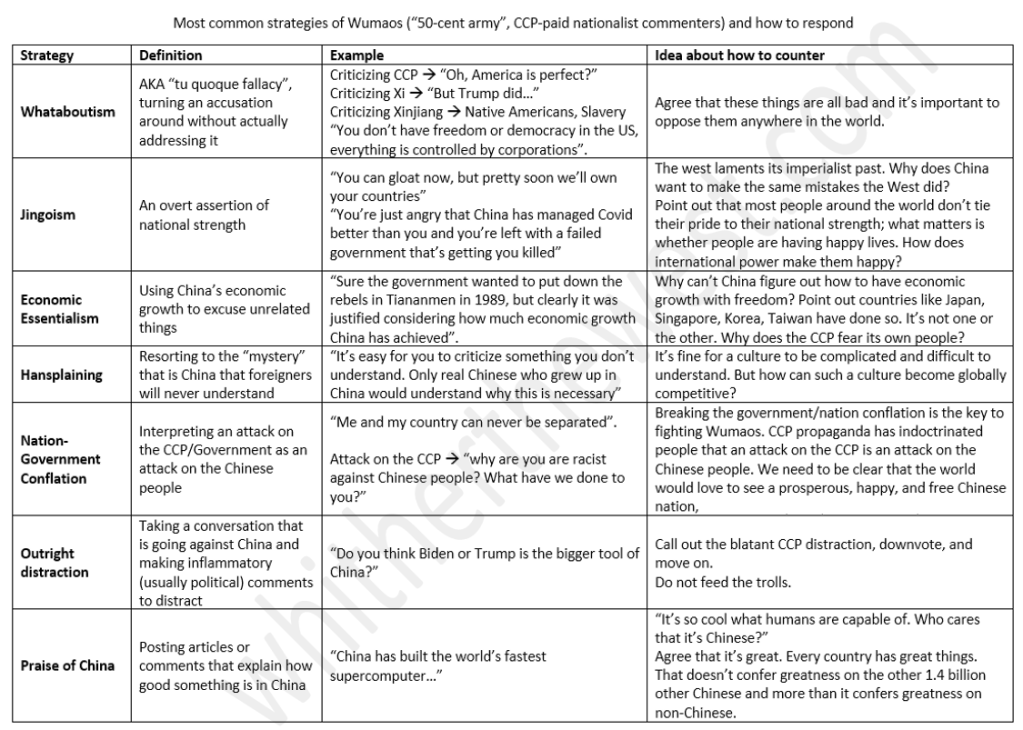
    I compiled a handy guide to some of the most common strategies and talking points by Chinese nationalists online (on forums like twitter and reddit). [Sharable image first, copy-able text follows.] This list is far from exhaustive, but should be a good base for combating most arguments. Please share additional talking points or strategies in the comments.

    One overriding thing to note: anyone in China has to use a VPN and violate Chinese law in order to be engaging on these forums in the first place. So don’t hesitate to draw attention to their hypocrisy and disrespect of Chinese law.
    Update: This was posted on reddit, and the discussion there generated many more arguments and responses. Consider

    These are really low hanging fruit. What about the more difficult points to combat that nationalists often make? How do we counter misinformation like this:

    “It’s easy to criticize the CCP, but don’t the people have a right to say they want a government and society that is different from what Americans have? How do you promote freedom and human rights without also weakening the institutions that maintain China’s independence and uniqueness we value which many other countries have lost to globalization and westernization?”

    “I think that the integration of China’s economy with the US has promoted the values we all want to see adopted by our government: free trade, freedom of movement, freedom of expression, etc. But now, the US is severing ties with China by imposing tariffs (even on goods like solar panels and EVs which are desperately needed to combat climate change), sanctioning and banning Chinese companies, and regressing to unfair trade practices like subsidizing domestic industry — practices it has criticized China for. How can the CCP in its current form be opposed when the good actors on the global stage like the US can’t be relied on to help in this fight and demonstrate correct behavior? How can we pressure the CCP when the US wants to punish China rather than shape China for the better?”

    “Whenever the extremely high incarceration rate in the US is brought up, the disproportionate imprisonment of minorities there, or the forced labor practices the US and its state governments engage in, people always do whataboutism and say hush, you have no room to talk when the CCP is doing the same and worse in Xinjiang and Tibet. I think we should oppose human rights violations no matter where they happen in the world, but the conversation always gets turned to sanctions against China and opposing the CCP. In contrast, you’ve never heard someone say ‘it’s time for regime change in the US’ or ‘why not have sanctions against the US for its crimes’, and that’s because the US is still the global policeman, judge, jury, and executioner. It’s above reproach, above the law, and unaccountable to anyone. The US should be expected to be a state party to the Rome Statute; it should be expected to support and comply with the WTO; it should be a state party in the Paris Climate Accords all of the time, not just when it feels like it. If not for its military power, the US would be considered a rogue state.”

    A (self-described) Chinese commenter replied to these points (my posting them here is not an endorsement):

    As a Chinese person to answer these questions:

    The Chinese people certainly have the right to choose a government that is different from that of the United States, but the Chinese Communist Party (CCP) has not given the Chinese people the power to choose a government that is different from that of the CCP

    The CCP has frantically suppressed civil society, from rights lawyers to investigative journalists to ordinary citizens. The CCP has used every means to crack down and persecute them. More than a decade ago, an old man took the initiative to monitor the misuse of public vehicles by officials. The CCP secret police lured him into prostitution with a scam and made it public. An attempt was made to ruin his reputation.

    The CCP does not practice free trade. Take the communications industry for example. The CCP pretended to open up the communications industry when it joined the WTO, and after it joined the WTO, it opened up only a very small number of proliferating businesses. The same thing happened to the insurance industry. The CCP has formulated a series of “documents” to create a glass ceiling for foreign investment. Foreign investors are not allowed to participate in the most important insurance business at all. By contrast, it was not until the Trump era that the US government began to restrict Chinese telecoms operators from doing business in the US.

    Liberalism itself encourages independence and uniqueness. Holding independence and uniqueness against Western civilisation, Hong Kong, the most liberal city in China, retains the most traditional culture. Under the rule of the Chinese Communist Party, people had been forced to destroy countless traditional cultures. They even destroyed the tomb of the legendary “Yellow Emperor”, the ancestor of the Chinese people. The independence that the CCP tries to retain is in fact their uninterrupted rule over the Chinese people.

    Every country violates international law to a greater or lesser extent. But the United States remains the foremost defender of the international order. On the question of the US supporting Ukraine with tens of billions of dollars against the Russian invaders, China is supporting Russia on a massive scale. Including, but not limited to, massive prepaid energy orders, drones, industrial equipment.

    Without further ado, the guide:

    StrategyDefinitionExampleIdea about how to counter
    WhataboutismAKA “tu quoque fallacy”, turning an accusation around without actually addressing itCriticizing CCP ➔ “Oh, America is perfect?”
    Criticizing Xi ➔ “But Trump did…”
    Criticizing Xinjiang ➔ Native Americans, Slavery “You don’t have freedom or democracy in the US, everything is controlled by corporations”.
    Agree that these things are all bad and it’s important to oppose them anywhere in the world.
    JingoismAn overt assertion of national strength“You can gloat now, but pretty soon we’ll own your countries”
    “You’re just angry that China has managed Covid better than you and you’re left with a failed government that’s getting you killed”
    The west laments its imperialist past. Why does China want to make the same mistakes the West did? Point out that most people around the world don’t tie their pride to their national strength; what matters is whether people are having happy lives. How does international power make them happy?
    Economic EssentialismUsing China’s economic growth to excuse unrelated things“Sure the government wanted to put down the rebels in Tiananmen in 1989, but clearly it was justified considering how much economic growth China has achieved”.Why can’t China figure out how to have economic growth with freedom? Point out countries like Japan, Singapore, Korea, Taiwan have done so. It’s not one or the other. Why does the CCP fear its own people?
    HansplainingResorting to the “mystery” that is China that foreigners will never understand“It’s easy for you to criticize something you don’t understand. Only real Chinese who grew up in China would understand why this is necessary”.It’s fine for a culture to be complicated and difficult to understand. But how can such a culture become globally competitive?
    Nation-Government ConflationInterpreting an attack on the CCP/Government as an attack on the Chinese people“Me and my country can never be separated”.
    Attack on the CCP ➔ “why are you racist against Chinese people? What have we done to you?”
    Breaking the government/nation conflation is the key to fighting Wumaos. CCP propaganda has indoctrinated people that an attack on the CCP is an attack on the Chinese people. We need to be clear that the world would love to see a prosperous, happy, and free Chinese nation.
    Outright distractionTaking a conversation that is going against China and making inflammatory (usually political) comments to distract“Do you think Biden or Trump is the bigger tool of China?”Call out the blatant CCP distraction, downvote, and move on. Do not feed the trolls.
    Praise of ChinaPosting articles or comments that explain how good something is in China“China has built the world’s fastest supercomputer…”“It’s so cool what humans are capable of. Who cares that it’s Chinese?”
    Agree that it’s great. Every country has great things. That doesn’t confer greatness on the other 1.4 billion Chinese and more than it confers greatness on non-Chinese.
  • Culture as a Trade Barrier

    Or one way illiberal states get the better deal on trade agreements

    A concept that I would have imagined was thoroughly discussed, but which I somehow cannot find discussed anywhere, is the concept of culture as a trade barrier. Now the idea that culture affects trade is nothing new – no one ever claimed that every country should buy equally all the products of the world; culture is a normal and expected part of the global marketing and trade landscape. But what I have never seen discussed is the extent to which culture can act as a hard barrier which can act one way more strongly than the other, or as one that is malleable for the purposes of statecraft – particularly in the hands of totalitarian societies that can shape public opinion and craft cultural trade preferences more easily than democracies.

    What I mean when I say that culture can be a trade barrier, and often should be studied and analyzed as one, is this: different peoples in different countries tend to buy different things. Sounds simple, right? But it’s not simple. Some cultures can be very fussy about the products they consume coming in particular forms or from particular places, and these preferences can make foreign producers of ostensibly similar products (replacement goods, to use the formal term) have to fight uphill battles to get their products into those markets, even if there’s not an equivalent in the other direction (I list several examples below). These preferences can take many different forms: sometimes people tend to buy things that are from their own country, or tend not to buy things that are from a specific country, for completely irrational reasons or even without any particular reason, just by background cultural “by-default” programming. Or sometimes, because of the cultural traditions and preferences of the country, there may be an extreme difficulty getting the citizens of the country to buy things from somewhere else. Critically, these preferences are not fixed, and are susceptible to marketing campaigns, but are equally susceptible to state programs of marketing or propaganda (depending on your perspective).

    Nationalized Preferences

    For an example of “national preference” trade barriers, we need only think of “buy American” campaigns. In the context of World Trade Organization or other free trade agreement (e.g. the European Union or USMCA), national governments have their hands tied on providing direct subsidies, protections, and benefits to the industries covered by the agreement. For example, if it is agreed that countries should trade bicycles without trade barriers, it would be a violation if a party to the agreement were giving government subsidies to their domestic bicycle industry, or doing something to restrict the imports of bicycles, causing an unfair advantage in their competition with trade partners; the WTO has mechanisms for levying punishments on violations by members. However, countries have the possible workaround of trying to shift national preferences. A campaign encouraging people to “buy American” can potentially have small effects that shift buying preferences and result in some difficulty in non-American products competing in certain contexts – a slight raising of the cultural trade barrier. Though in practice these campaigns don’t have much effect in the US, in other countries waves of national sentiment can constitute huge trade barriers: the Chinese government has long fanned the flames of anti-Japanese sentiment, causing Japanese shops and factories to be damaged and close due to Chinese protests, and even causing rebranding of Chinese brands accused of being “too Japanese”; when this happens, Japanese sales to China of many goods predictably fall. Critics may argue that preferences of national origins are often “signals” of quality (i.e. with no further information about products that appear identical, most western consumers would likely judge “made in China” to be lower quality than “made in Germany”), this is not a 1:1 correlation with preferences for buying things from a specific country – people may choose to buy from one’s own country even if it doesn’t mean cheaper or better quality, or buy from “friendly” countries over “unfriendly ones” as seen by American boycotts of French-sounding products at the outset of the Iraq War. So clearly there is something else going on aside from signaling.

    Denationalized Preferences

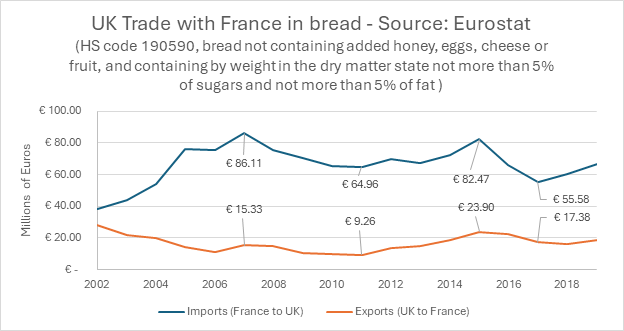
    For the denationalized “cultural preference” barrier, take milk for example. In country A people may be perfectly willing to buy and use UHT (Ultra-High Temperature pasteurized, i.e. shelf-stable) milk as any other milk. And in a neighboring country B people may overwhelmingly prefer to use fresh, refrigerated milk. As a result, country B can UHT-pasteurize and export all of its excess milk production into country A, but country A will have a much harder time shipping fresh milk to country B at affordable prices, since such shipments would require refrigerated trucks and much more efficient logistical planning to ship the milk larger distances over international borders. Thus, the culture of country B constitutes a form of trade barrier relative to that of country A. For a data-backed real-world example, consider the preferences in bread consumption of France versus the UK. In the UK, bread is often consumed, as in the US, in a soft, pre-sliced form, easy to pop in the toaster for breakfast, and just as easy to keep fresh on the shelves for days on end; in France, bread is by and large consumed fresh, with a crackly-crusty exterior while still being soft on the interior, a juxtaposition that breaks down within hours if wrapped in plastic, or becomes too dry and hard if left unwrapped – in short, impossible to pack and ship internationally. As a result, we got the following (before Brexit):

    French exports of bread to the UK dwarfed the inverse – France could produce and ship the kind of bread that Britons wanted to eat, but the UK couldn’t produce and ship the kind of bread that French wanted to eat. Thus French exports to the UK were, since 2005 or so, 3-6x UK bread exports to France. There are certainly other possible explanations for this phenomenon, but I imagine that the cultural barrier is a significant one.

    Another notable real-world example, though slightly more abstract, was salmon. Prior to the 1990s, Japan consumed very little salmon and almost exclusively in a cooked form, viewing salmon as a fish prone to parasites that should not ever be consumed raw, whereas in Norway raw or lightly smoked salmon is a staple of the national cuisine. In the late 1980s, Norwegian fishermen found themselves with a surplus of Salmon and insufficient markets to offload it into, and thus they sought to change the culture of Japan through a fierce marketing campaign that transformed the culinary culture of the land of the rising sun – salmon sushi is now arguably one of the most iconic emblems of Japanese cuisine. The culture of Japan constituted a trade barrier, and clever Norwegian marketing lowered, or even reversed, the cultural trade barrier.

    The Illiberal Advantage

    As I mentioned, one aspect of this discussion – the impacts of culture on trade – are nothing new. But what is often missed from these analyses is that it does not operate equally for all countries – some countries have much stronger cultural “walls” than others. It stands to reason that authoritarian regimes with tight media controls (e.g. China) have much more power to shift culture in a direction that  brings economic benefit – for example, encouraging Traditional Chinese Medicine as a way of stimulating the domestic market and raising a trade barrier to foreign pharmaceuticals, or perhaps doing behind-the-scenes manipulation to discourage state-affiliated firms (increasingly all major Chinese firms) from buying from geostrategic competitors. As such, liberal democracies have a strong incentive to understand this greater power of their non-democratic rivals and trade competitors to shape tradeflows and effectively circumvent and nullify aspects of free trade agreements. A solution would be to create monitoring offices at the WTO or embedded in trade agreement arbitration mechanisms to set limits on the scale or intensity of marketing campaigns or state manipulation of cultural preferences that affect trade.

  • Pride and Prosperity:

    The Pillars of CCP Legitimacy

    The Chinese Communist Party has ruled over the People’s Republic of China ever since its victory over Nationalist forces in 1949. For the past six decades it has maintained a monopoly on political power despite wars, crises and political dissent, and today is the largest and one of the longest-ruling political parties in the world. Nevertheless the party’s rule does not come easily, and the CCP has turned to various strategies over the years to end dissent and lend legitimacy to the one-party system. To solidify its rule, though, the CCP has turned consistently to two main ways of satisfying the 1.3 billion people of China: first, it taps into strong sentiments of nationalistic pride and identity and binds them to the CCP, and second, it seeks to improve the material quality of life of its citizens and endeavors to present itself as the best means of doing so. It is through these two avenues that the CCP has maintained its power in China both historically and today. Yet even these time-tested methods of legitimation have their intricacies and drawbacks, leaving the CCP in a precarious position of tentative rule.

    The Chinese sense of nationalism has been one of the grassroots bases of support for the CCP since the 1930s and the struggle against Japanese invasion and occupation. By the end of the war in 1945 the Communists had seized on nationalism as a powerful recruitment mechanism and articulated it even more effectively than the so-called Nationalists, garnering the momentum necessary to win the ensuing civil war but with the side effect of internalizing nationalist sentiment as a source of identity and legitimacy as a ruling party. On proclaiming the People’s Republic in 1949, Mao declared that “the Chinese people have stood up,” a humble yet blatantly nationalist remark that broke with the universalist Marxist ideology (e.g. “workers of the world unite!”) which the CCP at least nominally followed.

    Even as other claims to legitimacy have fallen to the wayside, nationalism still forms part of the backbone of CCP ideology, outlasting even the namesake communism. Indeed, “the Communist Party stirs patriotic feelings to underpin its legitimacy at a time when few, even in its own ranks, put much faith in Marxism” (Kahn). Various issues today lend strength to those Chinese citizens who take a hard line on nationalism as well as providing issues by which the CCP can articulate its nationalist identity, ensuring nationalism plays an important role in both domestic and foreign policy of the CCP.

    “Japan, which China says killed or wounded 35 million Chinese from 1937 through 1945, gets the most attention” on the Chinese nationalist front (Kahn). Of course, as the primary opponent against which the CCP built its nationalist identity, Japan naturally feels the brunt of Chinese nationalism. Anti-Japanese sentiment has surged in recent years, with events such as the outrage over the Zhao Wei dress incident and glorification of Feng Jinhua’s desecration of the Yasukuni shrine perhaps only the first in a long line of anti-Japanese outbursts in China (Gries “New Thinking” 832, 5).

    Though Japan may be the most prominent target on the CCP’s nationalist agenda it is certainly not alone, as “official propaganda and the national education system stress the indignities suffered at the hands of foreign powers from the mid-19th century through World War II,” known as China’s “Century of Humiliation” (Kahn). During that time period European, American, and Japanese interests subjugated China, inflicting wounds which still scar the Chinese consciousness. However, the re-acquisition of Hong Kong and Macau in the 1990s served as a rallying point for Chinese nationalist who depicted China as a lion roused from slumber, all of which played perfectly into the age-old narrative that the CCP was leading China to national might.

    However, amidst the pride of power comes apprehensiveness of weakness compared to the United States, as illustrated by the 1999 bombing of the Chinese embassy in Belgrade. The incident, despite American assurances that it was purely accidental, stoked a firestorm of anti-western and, more specifically, anti-American sentiment. However, through Chinese eyes, the bombing “was not an isolated event; rather, it was the latest in a long series of western aggressions against China” (Gries “CNN” 17). The Chinese public was outraged, and the CCP, reflecting such strong national sentiment, echoed the people’s outcries of intentionality and called for apologies from the US (Gries “CNN” 19-20).

    This illustrates an important change: the power of nationalism can be at times unwieldy and has become a force beyond the CCP’s control. “The 1990s witnessed the emergence of a genuinely popular nationalism in china that should not be conflated with state or official nationalism…the party’s legitimacy now depends on accommodating popular opinion” and as such the CCP has in recent years become subject to the force it once commanded (Gries “CNN” 20). This has dire ramifications for the future of Chinese power, as the CCP can no longer direct a course in its foreign affairs but must placate the hardliners in populist fashion. The issue of Japan is one which may play out worst for China’s future. The CCP is unable to pursue any conciliatory policies with Japan for fear of appearing “weak before nationalists at home” and thus cannot use Japan to counterbalance the influence of the United States – an outcome which is in the long-term worst interest of a China with global ambitions (Gries “New Thinking” 848).

    Thus nationalism, long one of the CCP’s reins of power, may have lost its power to effect loyalty and fully legitimize CCP rule. Instead of using nationalism to its advantage, it has become a necessity for party survival, even if its application may be to the long-term detriment of Chinese power. Unfortunately for the CCP, nationalism and foreign policy may not be the only areas wherein necessity, not desire, has become the call to action.

    The other traditional area in which the CCP has articulated its legitimacy has been its stewardship of the people, bettering their lives materially and reducing inequality and exploitation by the ruling class. At the outset of the People’s Republic this was the nominal goal of the communists (and indeed communism in general) but over the course of the next thirty years, disastrous policies in socialist and communist endeavors resulted in the Reform and Opening of the post-Mao era (Thornton). Since that time China has transitioned to a full market economy, shedding almost all vestiges of its communist origin and namesake, “gambling that people would overlook the failure of communism as an ideology if Communists could make them richer” (Pan 117). What has resulted, ironically, is the exact exploitation that the CCP came into power to eradicate: authorities systematically repress peasants, income inequality is on the rise, and corruption and graft deprive the people of wealth and opportunity. Yet the CCP attempts to address all of these issues and others, managing to cleave tentatively to power by supposedly bettering the lives of its people.

    Pension reform represents a major way in which the CCP has averted unrest in recent years while simultaneously addressing issues of inequality, with efforts to provide a basic social safety net  materializing in the Social Insurance Law passed in 2010. Representing “a major step in the CCP’s efforts to tackle problems of income inequality and inadequate welfare” the legislation aims to unify and codify many of China’s disparate and inadequate welfare systems (Frazier 386). By this increase in welfare and pension benefits, the CCP sought to avoid the “often dramatic urban protests” which “posed multiple challenges to the CCP’s legitimacy” and thus the party shored up support amongst the urban poor and re-affirming its narrative of working for the betterment of the people.

    One of the longest-standing and most well-known of the CCP’s solutions has been the One Child Policy which is aimed at controlling once-unsustainable birthrate by limiting most families to having one child. Through the policy, “officials have sought to curb the excesses and inequities and have argued that the policy has prevented roughly 400 million births and allowed the country to prosper and better live within its resources” allowing material wealth and opportunity to be distributed amongst fewer people overall, helping to secure their welfare in the long term (Yardley). However, the policy threatens a future drawback: demographic crisis. “China’s fertility rate is now extremely low, and the country’s population is aging rapidly,” indicating that in the near future, young workers may be insufficient to sustain the more populous elderly (Yardley).  In response to this looming issue, CCP policymakers have flirted with altering or ending this longstanding policy, demonstrating that working for the good of the people has been the goal all along: first reducing birthrates to prevent overpopulation, then relaxing restrictions to prevent demographic collapse, both of which work in the interest of national stability, ensuring government legitimacy.

    Perhaps most importantly, the struggle against corruption has been one in which the CCP aims to garner loyalty by casting itself as a staunch defender of the people, against abusive local officials. In recent years corruption cases such as that of party officials in Shenyang and “shoddy construction” of earthquake-felled buildings in Sichuan has revealed enormous corruption at the local level (Pan 131, Alpert). Without fail, however, the “state media [present] the case[s] as an example of the party’s resolve to keep its cadres honest” and unerringly portrays corruption as a purely local issue and anathema to the CCP’s national practices and ideals (Pan 131).

    Yet despite all its toil and propaganda, the CCP’s decades-old narrative of working for the good of the people may finally be beginning to wither away, for “China’s propaganda machine…is sometimes hamstrung in the age of the Internet, especially when it tries to manipulate a pithy narrative about the abuse of power” (Wines). As news such as the Li Gang case spreads around the country and the national populace becomes aware of the “scale of malfeasance” transpiring around them, it may not be long before the legitimacy of one-party rule is irreparably damaged (Pan 131).

    So how does the Chinese Communist Party maintain its power today? It does so in the same ways it always has. By taking up the banner of national pride and strength, the CCP earns the support and loyalty of nationalist elements. And by portraying itself as the supporter and benefactor of the people it gains the trust of the common man. But as the tides of history turn and the people learn to contest the monopoly of Communist power, the CCP may find its twin pillars of legitimacy looking remarkably fragile in the coming years.

    Works Cited

    • Alpert, John and Matthew O’Neill. China’s Unnatural Disaster: The Tears of Sichuan Province. Dirs. Jon Alpert and Matthew O’Neill. 2010.
    • Frazier, Mark. “From Status to Citizenship in China’s Emerging Welfare State.” Gries, Peter Hays and Stanley Rosen. Chinese Politics: State, Society and the Market. RoutledgeCourzon, 2010. 386-404.
    • Gries, Peter Hays. “China’s “New Thinking” on Japan.” The China Quarterly (2005): 831-850.
    • —. China’s New Nationalism. Berkeley: University of California Press, 2004.
    • Kahn, Joseph. “Beijing Finds Anti-Japan Propaganda a 2-Edged Sword.” The New York Times 3 May 2005.
    • Pan, Philip. Out of Mao’s Shadow. New York: Simon & Schuster, 2008.
    • Thornton, Patricia. “Comrades and Collectives in Arms: Tax Resistance, Evasion, and Avoidance Strategies in post-Mao China.” Gries, Peter Hays and Stanley Rosen. State and Society in 21st Century China. RoutledgeCourzon, 2004.
    • Wines, Michael. “China’s Censors Misfire in Abuse-of-Power Case.” The New York Times 17 November 2010.
    • Yardley, Jim. “China wants gradual shift away from its one-child policy.” The New York Times 8 December 2008.