Category: Uncategorized

  • We are (probably) all Modernists

    I was asked recently to respond to an angsty college freshman who laid out a fairly textbook understanding of postmodern moral relativism:

    People define values in their own ways…humans define good and evil…for those who disagree with the majority opinions of society, society is hell…If we want to define a massacre as morally okay, nothing is stopping us other than constructing a majority moral opinion to allow that.

    The thing is, there’s a lot more to it than that. One of the first blows against this conception is Game Theory, specifically such ideas as the Tragedy of the Commons or Prisoner’s Dilemma – essentially, although, yes, everyone can assert their own values and their own moralities and pursue their own goals, there are mathematically and physically provable situations in which everyone benefits from cooperation, whereas everyone pursuing their selfish interests actually causes a total detriment to society. Laws and Moralities don’t just benefit the majority at the expense of the individual – they benefit the individual as well, by creating dependable, predictable surroundings. Morality and Law and Order may come at the expense of some liberties (e.g. taxation, legal restrictions) but they are necessary preconditions for other sorts of liberties: the liberty to travel the world, to read new books, to cultivate individual interests, for example, would not exist without moral and legal agreements about airline safety, about copyrights or university educations or infrastructural and logistics systems, of shared norms about the free flow of information and guarantees about freedom of inquiry and expression. There are strong reasons societies tend not to deem wanton massacres as “okay”: because all people benefit from living in societies where they aren’t okay.

    This paradigm is struggling to be standardized at the global level (e.g. Universal Human Rights). However, a gadfly tends to get in the way: Moral Relativism. Who is the Human Rights-slinging West to tell other countries what they can or cannot do? Who gave Liberal Democracy – the ideology of the former oppressive colonizers – moral ascendancy over other ideologies like traditional religions? The problem is that this appeal to tradition and the rights of local societies is often a cover to perpetuate atrocities: if someone is truly Morally Relativist, they must be okay with slavery, with genital mutilation, with pedophilia, for these things are part and parcel of many traditional cultures and religions. However, to that extent that we oppose these things, we are not truly Morally Relativist (believing that all moral systems are equally valid) and we are not truly Postmodernist (believing in the hollowness of any broad claims to authority and believing in sovereignty of the individual to determine his or her own morality). To the extent that we oppose these things, we are at least partially Modernist – we believe in a broader morality, we believe in a certain shared sense of human rights, and we believe that securing these rights is a form of Human Progress.

    We – most people reading this blog – believe in Modernism, in at least some sense. We believe that there are moral victories for mankind. We rejoice in a country throwing off the shackles of tyranny. We think that computers should be getting faster and cheaper. We believe that there should be more medical treatments available tomorrow than today. We rejoice in the liberation of enslaved girls. Why? Because we believe that we as a species can and must aspire for more.

    But where do those ideas come from, and what does that future look like? That is to be hashed out in your comments and in future posts in this blog.

  • Not Postmodern

    What is the West?

    Not Postmodern.

    Now, a lot of people like to use these terms like “modern”, “postmodern” and even “anti-postmodern” without knowing exactly what they mean. So for the sake of having some common vocabulary for once, let’s define our terms.

    Modernism – the philosophical outlook that defined the West through the late 19th and early 20th century. Essentially, a belief in progress, a belief in objective success in human development, and a belief that a better and more prosperous and free world could be achieved through the right combination of technologies and institutions. Modernism requires a belief in an objective truth, a belief in some sort of scale upon which human societies can be judged, and a belief in the power of human intellect and spirit.

    The Nobel Prize, the World Health Organization, and the Kellogg-Briand pact were examples of applied Modernism.

    So were Colonialism, Communism, and Nazism.

    Gulags, concentration camps, and apartheid were seen as necessary means for these grand visions of social progress. In the eyes of many “moderns”, force and death were unfortunate but necessary means of making way for humanity’s future, of eliminating the unwanted vestiges of the old to make way for the new.

    It is no surprise, then, that in the wake of the Second World War, some people began to question the tenets of Modernism. “Who are you,” the first post-modernists might ask, “to determine what a better society should be? What does ‘better’ even mean? How is it defined? These are socially constructed terms that don’t mean anything. I am entitled to an opinion about social progress as much as you are”.

    In the past few decades, this postmodern discourse has proven startlingly successful. Though initially postmodernists scored excellent political points against racist, sexist, and other repressive ideals, these memetic ideas, having run out of monsters to slay, have been turned in praetorian fashion against some of the core pillars of Western civilization. The attitude that “everything is opinion, and everyone is entitled to their own” and “there are no objective facts, only narratives” have taken the West by storm. This cynical weaponized postmodernism has propelled Brexit supporters to grow “tired of experts”, have propelled Trump supporters to create their own “alternative facts”, and the impulse to “question everything and think for yourself” has subsidized the rise of Flat Earthers, Intelligent Design subscribers, creationists, anti-vaccine advocates, and birthers, content to believe that “what they feel to be true” is just as valid as empirical evidence, for, after all, we are all entitled to our opinions. The pendulum of philosophical dialectic has swung far too far.

    To put it squarely – albeit perhaps too on-the-nose – postmodernism is anti-Western, for it is against the large group identities such as those of civilizations. Post-modernism is a critique of all collective values, a critique of shared assumptions, even if those values are freedoms of inquiry and debate, and those assumptions are rational and scientific ones.

    Post-modernism says “why should we privilege traditional western freedoms over other kinds of values? Why should we privilege scientific mindsets over other kinds of mindsets?”

    The Neomodernist West must respond: “because they make everything better”.


  • Not China

    I begin this blog in China, where I have just begun a sojourn of several years, so forgive me if some of the early posts in this blog ostensibly about the West discuss China. However, there is an incidental benefit to beginning in this way: in the same way that F. Scott Fitzgerald or Langston Hughes had to escape the confines of their upbringings in order to truly understand the nature of such upbringings, perhaps it is only here in China that I can begin to contemplate what it really is I understand and care about with regard to the West.

    What is the West?

    Perhaps the easiest way to define something is to point out what it is not. Some people group the Arab World into the West; some put the former USSR on the list; Latin America, Africa, the Indian Subcontinent, are all, due to their long histories of Western colonial influence, blurry areas that are in some ways Western and some ways not. Many areas seek to attenuate Western influence and cultivate native traditions and cultures, but few areas understand themselves in stark opposition to the West. China is an exception.

    In China, this is a Zhōng/Wài or 中/外 distinction. Things are of the Middle (often better translated as Central) Kingdom (中国, Zhōngguó),or they are from outside (外面, Wàimiàn).

    What is the West? Well, for starters, it’s not China.

    These days it is common to think of the world in terms of the growing rivalry between the US and China, the looming clash of civilizations before the rising China, with its billion workers, omnipresent surveillance state, social credit system, and tightly controlled media apparatuses, overwhelming the world with a model antithetical to western social norms – valuing order, stability, tradition, and social harmony over traditional Western values like freedom of speech, inquiry, and criticism, disruptive problem-solving or avant-garde creativity.

    I want to push back on that to an extent, and at least for now to say that the West is not going anywhere anytime soon. Though the West will no longer occupy the driver’s seat of global geopolitics that it has for the past 3+ centuries, the West will remain a distinct civilization that will have to be understood on new terms, without all the sinews of power and global hegemony. A post-omnipotent West; a post-hegemonic West.

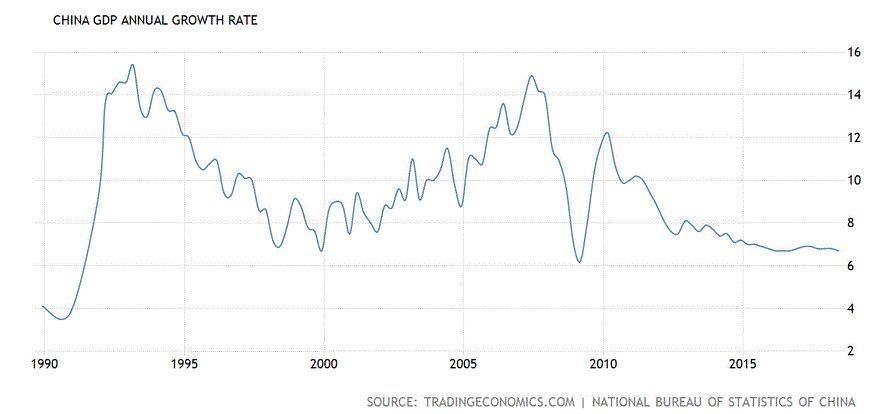
    The problem with the above model about the Chinese tide is that it blindly extrapolates China’s growth over the past 20 years into the future 20 years. The simple fact, however, is that this has already begun to change:

    ChinaGrowth

    The 8-15(!)% annual GDP growth rates that shook the world economy between 1993and 2008 have been in the rear-view mirror for nearly a decade now. Just last year, China declared that it would be a global AI leader; then just last month, China walked back all such ambition, calling for an international approach to AI development. There is now renewed talk of China sliding into the so-called Middle Income Trap, which I will elaborate on in a later post, but which is in simple terms a status in which a country can lead middle-income industries like automobile manufacturing, but fail to accrue enough human and financial capital to spark a transition into a high-value, knowledge-based economy.

    If I am permitted to make one very strong claim that I cannot prove, but would like to see if it plays out, I would say this: a culture which, like China, prides itself on order, stability, and respect for social harmony, and which limits disruptive speech and ideas, will inherently always struggle to make the transition to a creative, knowledge-based economy. The Chinese Film Industry is perhaps the most blatant example. Though the spark in Silicon Valley may have been lost, it was at one point the atmosphere of unabashed entrepreneurial creativity that led to the Digital Revolution. I shall not say that it is impossible, but from right now I struggle to see how the culture of stability, order, and harmony can push the envelope into a broad-based 21st century economy.

    I recently attended a talk by Ted Plafker, Beijing correspondent for the Economist, in which Mr. Plafker noted that China’s Great Firewall and other media policies had a significant drag on economic and scientific growth, as Chinese researchers, businesses, and innovators in all fields had an ongoing struggle to acquire data and inspiration from the rest of the world (there’s another side to the Great Firewall which I will discuss in a later post).

    Anyway, let’s see if I’m wrong.

  • To Explain is Not to Excuse

    Scott Alexander recently posted his thoughts on the merits of social shaming of explainable sociopsychological phenomena. Beginning his discourse with the new hyperprogressive idea that “lazy-shaming” should be ended, Alexander counters that

    I imagine [an anti-Lazy shamer] believing he has a fundamental value difference with people who use the term “lazy”. They think that some people are just bad and should be condemned, whereas he wisely believes that everything has a cause and people who have issues with motivation should be helped. But it’s not clear to me that this is a real difference.

    Alexander’s dialogue goes in a more semiotic and semantic direction than I would think about this subject from, but nonetheless touches on an important idea that should perhaps be one of the cores of neomodernism: being able to explain the origins or nature of problem does not necessarily excuse it. We should strive to explain and understand as much as possible. But once explained and understood, we must then strive to decide which things are good or bad, and encourage those things which are good and reduce those things which are bad. Body image/weight/fat-shaming discourses fall into the same category as the Lazy-shaming discourse above. There are many reasons that people gain excess weight — social, psychological, emotional, genetic, habitual, economic — the list goes on. No one should ever be bullied or abused for their physical condition. Yet at the end of the day, obesity is an extremely deleterious condition that is for the most part correctable — and to the end that it is correctable, social carrots and sticks must continue to demonstrate that obesity is condition to be escaped and avoided.

    To some extent, I am a supporter of the to explain is to excuse mindset with regard to socioeconomic conditions. A person who grew up and lives in a “poor” community may be subject to many socioeconomic memes that influence his or her behaviors in ways that are not conducive to his or her socioeconomic advancement. This is not that person’s fault, and thus, to some extent, we should not poor-shame on the personal level. On the one hand, it is simply, unarguably, better not to be “poor”, and in some aspects this is a correctable condition based on some changes such as saving (do more), spending (fewer depreciable and consumable assets), and behavioral (don’t smoke or drink too much alcohol) habits. And then on the other hand, in other aspects (the majority of aspects, likely), there are areas of this that are completely uncorrectable by individual means (educational background, job availability, level of income).

    With laziness as discussed by Alexander, there are many similarities — often, laziness is simply the result of bad memetic input: people have learned the wrong habits, have not learned the right habits, etc. But there is a difference between explaining how or why someone becomes lazy and condoning or accepting it as a should.

    Neomodernism must avoid the pitfalls of modernism: the anti-human, unexplaining, undeterred drive to some form of grand betterment. But it must too avoid the excesses of postmodernism: the all-accepting particularism that sees no difference between the is and the should be. It’s important to break the perception that explanation and condemnation are some kind of substitutes for one another and that they exist on the same spectrum. Rather, one can ideally strive to explain everything and then figure out what to condemn after the fact, and not let the status quo become synonymous with the should.

    Applicability to Academic Freedom/Freedom of Inquiry

    There is another aspect to this Explain/Excuse relationship: often, seeking to academically explain or research a topic, or to publish information on a topic, is seen as apologetics or excuse for heinous things. People who interview or research terrorists, KKK members, pedophiles, etc., may all be shamed for even engaging in such practices. “How can you even listen to what this person has to say? You’re giving them a platform! You’re validating them!” This was often the case with Trump supporters, for example, in the lead up to the 2016 election.

    This enters into murky waters. On the one hand, freedom of inquiry and expression means very little if it does not grant the ability to research topics that offend and disgust us. On the other hand, there are some highly offensive fringe views or objective behaviors that do get amplified and normalized by their publication and repetition.

    What do we say to this dilemma?

    The answer, I think, is to research and publish these ideas, but to do so from an objective, neomodern lens (“these people have their own reasons to believe these things, but they are factually wrong”), and never from a relativist postmodern perspective (“these people believe these things, and how do we really know that their truths are less valid than our own?”). I contend that a core problem with modern academia, journalism, and other sorts of “publicative/promotional” media is not bias, but rather the fact that in attempting to avoid bias, journalism has cultivated a relativism and apathy toward objective fact. There is a difference between apathy to valid opinion based on objective fact (whether, given racial socioeconomic discrepancies, there should be affirmative action programs, for example), and apathy toward the basic facts themselves (whether or not significant portions of welfare recipients are lying and manipulating the system to receive free money).

    This is what a neomodern research and journalism should be about: understanding the perspective of others, understanding that different interpretations exist, but being firm and unyielding in the face of abuse or falsification of objective fact. To Explain is not to Excuse.

  • Pareto Efficiency and Racial Inequality – a speculative analysis

    Has racial sociocultural standing reached a sort of Pareto Frontier in American society?

    Let’s explain the concept: what does this Pareto thing mean, anyway?

    A Pareto-efficient situation is a state in an economy in which there is essentially no free room to maneuver. It is a state in which a gain in any one area — say, hypothetically, economic growth — has to come at the expense of something else — say, environmental health. Any gains in one come at the expense of the other. In the chart here, K and N are not yet Pareto efficient states: there is room to grow. But A-H are Pareto efficient: there is no option in which one can increase either Item 1 or Item 2 without decreasing the other.

    Pareto efficiency makes no assessment of what is best, what is most fair, what produces the most positive ends. Those are the judgements that the analyst and pundits put upon the situation. Pareto efficiency is only an assessment of the status quo, and what things are necessarily tradeoffs.

    I would posit, therefore, that in American society, we have reached a Pareto Frontier in terms of the sociocultural standing of various racial and ethnic groups. In prior decades (and I would appreciate critique on this assessment) American socioculture had arguably not reached Pareto saturation. Democratic activism and participation were growing. Television growth was growing. Recorded music consumption was growing. Motion Picture Consumption was growing. Overall consumption and participation in socioculture were growing. Ethnic and cultural minorities could carve out spaces for themselves in the sociocultural hierarchy — there was low-hanging fruit in Civil Rights in which overall gains could be made for sociocultural growth and dynamism without a necessarily “loss of standing” for the dominant WASP culture. In short, American society was at a K or N position in the chart above. Subaltern newspapers, television channels, etc. could be founded to cater to different groups, and yet WASPy culture reigned supreme in Hollywood, in Washington, and on the nightly news.

    Has something fundamental changed? Has the room for growth declined, so that we are now competing for the same space? Have we reached Pareto efficiency? If so, it means that any gains in standing in non-dominant ethnocultures can only come at the expense of loss of standing of the dominant ethnoculture. Perhaps Black Lives Matter, Blue Lives matter, and Trumpism are manifestations over the struggle of Pareto Efficiency for American sociocultural standing. Hopefully we are not at the Pareto Frontier yet, or better yet these are not incompatible tradeoffs at all. Perhaps there is no Pareto Frontier in this area. But if the model fits the data, then it may be useful to consider the implications.

  • Panama Papers and The Unequal Factors of Production (Old)

    In case you’ve managed to miss it (which is possible, considering the vulgar paucity of coverage it has received in the US), the biggest global news story in a long time broke less than two days ago. How big is it, you might ask? So big that at least one head of government has already stepped down because of it, and many more names, including Vladimir Putin and Xi Jinping, are on the naughty list. What happened was that documents were leaked that revealed that many of the world’s most important political leaders, sports officials, and financial institutions were involved in a shell company scheme in Panama. The documents that revealed this scandal were so numerous and in so many different languages that media outlets around the world took over a year to collaboratively decode them before releasing them simultaneously this past weekend, and the process of engineering that collaboration will probably get the Spotlight treatment itself in a few years.

    So what exactly is a shell company? I wasn’t entirely certain either, but in a gem of wit, Reddit user DanGliesack explains here on the “Explain Like I’m 5” subreddit:

    When you get a quarter you put it in the piggy bank. The piggy bank is on a shelf in your closet. Your mom knows this and she checks on it every once in a while, so she knows when you put more money in or spend it.

    Now one day, you might decide “I don’t want mom to look at my money.” So you go over to Johnny’s house with an extra piggy bank that you’re going to keep in his room. You write your name on it and put it in his closet. Johnny’s mom is always very busy, so she never has time to check on his piggy bank. So you can keep yours there and it will stay a secret.

    Now all the kids in the neighborhood think this is a good idea, and everyone goes to Johnny’s house with extra piggy banks. Now Johnny’s closet is full of piggy banks from everyone in the neighborhood.

    One day, Johnny’s mom comes home and sees all the piggy banks. She gets very mad and calls everyone’s parents to let them know.

    Now not everyone did this for a bad reason. Eric’s older brother always steals from his piggy bank, so he just wanted a better hiding spot. Timmy wanted to save up to buy his mom a birthday present without her knowing. Sammy just did it because he thought it was fun. But many kids did do it for a bad reason. Jacob was stealing people’s lunch money and didn’t want his parents to figure it out. Michael was stealing money from his mom’s purse. Fat Bobby’s parents put him on a diet, and didn’t want them to figure out when he was buying candy.

    Now in real life, many very important people were just caught hiding their piggy banks at Johnny’s house in Panama. Today their moms all found out. Pretty soon, we’ll know more about which of these important people were doing it for bad reasons and which were doing it for good reasons. But almost everyone is in trouble regardless, because it’s against the rules to keep secrets no matter what.

    In slightly more grown-up terms, many countries charge different tax rates depending on what you do with your money – investments often get taxed less highly than money deposited in a bank since, supposedly, they’re doing productive work in the economy. So a shell company is essentially a bank that poses as a company taking investments, so that “investors” can simply store their money safely in a bank while getting the tax discount as if they were investing. Got it? Good.

    This entire scandal raises far more questions than it answers.

    First of this non-exhaustive list, how did this scheme stay secret for so long, especially since reporters around the world knew the gist for a year before going public?

    Second, why are there so few Americans on the list?

    Third, what does this scandal say about the nature of globalization and inequality?

    I can’t begin to answer the first one. To the second, I recently learned that the United States – or, more specifically, Reno, Nevada – has become a financial safe haven that is rivaling or eclipsing Switzerland, the Caymans, etc. The reason for this is that the United States in recent years has become a sort of financial watchdog for international capital flows of Americans, attempting to crack down on tax avoidance by increasing reporting requirements from offshore or Swiss bank accounts. However, one country on which the United States has not been particularly harsh during this crusade is the United States, meaning that many Americans may have chosen to find less risky domestic methods of tax evasion rather than doing so abroad.

    The third question is more to the meat of economic philosophy. The traditional factors of production – the things you have to acquire in order to make economies work and that can shift between countries and industries over time – are land, labor, and capital. That trifecta had emerged by the 19th century, and perhaps it is fitting to add new factors like “energy” and “bandwidth” or “data” into some modern calculations. But the critical thing to grasp is that individuals and entities all possess at least one of these factors, and trade them for the use of, or product of, other such factors, and that forms the basis of a market or an economy.

    Now, if you notice, the fluidity with which some of these factors of production move across borders or between industries is not equal. Land pretty much stays where it is, barring military conquest or switching between industries (e.g. turning a cattle ranch into a solar array). Capital was once extremely immobile (e.g. in the ancient world wherein you would have to tote a bag of gold around wherever you went) but as banking networks began to spread in the late middle ages capital has been increasingly liberated every century, and with digitization it now moves at the speed of light or at the regulated speed limit of financial transactions. Labor, the third in the traditional trifecta, can vary immensely. Slaves, serfs and the like have little labor mobility; residents of nation-states can move much more easily within their own countries than if they try to cross borders; and in modern post-national institutions like the European Union people can move around from country to country as long as they can handle the changes in language, culture, and institutions. Factors such as access to transportation or cultural tendencies to migrate also play an important role.

    Now, generally speaking, these factors of production all have ways of working themselves out. An economy that is rich in land but poor in capital and labor may attract settlers and investors willing to seek their fortunes, like in the settlement of the American West; a trade metropolis that grows rich in capital may develop inflation, be willing to pay higher wages, and attract denizens of the hinterland seeking their fortune in the big city; an overpopulated region, or one that has just experiences a loss of jobs, may see an exodus of workers like the Rust Belt-Sun Belt migrations in the US, or see an influx of capital investors seeking cheap labor, such as with outsourcing today.

    As some perceive, however (my opinion on the matter is far from settled), global agreements in the post-WWII era have “unfairly” liberated the flow of capital far more than they have liberated the flow of labor. NAFTA, for instance, allows the owners of capital in the US and Canada to build factories in Mexico; however, Mexico, which is relatively richer in labor than in capital, cannot send its labor to the capital-rich US with nearly the same ease, and can only, in this scenario, reap benefits from the exchange on the terms of the owners of the capital in that they can decide if and when to invest in Mexico.

    This general dynamic brings us back to the main point of this rambling post: an unemployed American, say, in Oklahoma, especially a middle-aged one who has spent his life working on oil rigs, or a West Virginia Coal Miner, cannot up and move to Manhattan or Silicon Valley and hope to take advantage of the relative abundance of capital, much less can they move to globally capital-rich countries like Oman, Norway, or Monaco. On the other hand, a wealthy Icelander or Russian can invest their [yes, I am intentionally using a singular ‘they’!] capital wherever they want around the world with relative ease, investing in an Oklahoma oil company or West Virginia coal company if they so choose, but also investing in a New York hedge fund or Silicon Valley Startup if they so choose.

    One of the several ways in which this system can work for the benefit of those unemployed oil patch workers or coal miners is if governments tax the money international investors make from those international investments, putting it back into the educational system or social welfare system.

    When international investors hide that money away, however, in international tax havens, or place their savings in shell companies to avoid negative interest rates, for example, that money is not taxed, and those individuals who make their livings by renting out their labor instead of renting out their capital get a decidedly worse part of the deal.

    Now, there are plenty of other ways in which the system does provide different benefits for them, but that’s another post entirely.
  • Pride and Prosperity:

    The Pillars of CCP Legitimacy

    The Chinese Communist Party has ruled over the People’s Republic of China ever since its victory over Nationalist forces in 1949. For the past six decades it has maintained a monopoly on political power despite wars, crises and political dissent, and today is the largest and one of the longest-ruling political parties in the world. Nevertheless the party’s rule does not come easily, and the CCP has turned to various strategies over the years to end dissent and lend legitimacy to the one-party system. To solidify its rule, though, the CCP has turned consistently to two main ways of satisfying the 1.3 billion people of China: first, it taps into strong sentiments of nationalistic pride and identity and binds them to the CCP, and second, it seeks to improve the material quality of life of its citizens and endeavors to present itself as the best means of doing so. It is through these two avenues that the CCP has maintained its power in China both historically and today. Yet even these time-tested methods of legitimation have their intricacies and drawbacks, leaving the CCP in a precarious position of tentative rule.

    The Chinese sense of nationalism has been one of the grassroots bases of support for the CCP since the 1930s and the struggle against Japanese invasion and occupation. By the end of the war in 1945 the Communists had seized on nationalism as a powerful recruitment mechanism and articulated it even more effectively than the so-called Nationalists, garnering the momentum necessary to win the ensuing civil war but with the side effect of internalizing nationalist sentiment as a source of identity and legitimacy as a ruling party. On proclaiming the People’s Republic in 1949, Mao declared that “the Chinese people have stood up,” a humble yet blatantly nationalist remark that broke with the universalist Marxist ideology (e.g. “workers of the world unite!”) which the CCP at least nominally followed.

    Even as other claims to legitimacy have fallen to the wayside, nationalism still forms part of the backbone of CCP ideology, outlasting even the namesake communism. Indeed, “the Communist Party stirs patriotic feelings to underpin its legitimacy at a time when few, even in its own ranks, put much faith in Marxism” (Kahn). Various issues today lend strength to those Chinese citizens who take a hard line on nationalism as well as providing issues by which the CCP can articulate its nationalist identity, ensuring nationalism plays an important role in both domestic and foreign policy of the CCP.

    “Japan, which China says killed or wounded 35 million Chinese from 1937 through 1945, gets the most attention” on the Chinese nationalist front (Kahn). Of course, as the primary opponent against which the CCP built its nationalist identity, Japan naturally feels the brunt of Chinese nationalism. Anti-Japanese sentiment has surged in recent years, with events such as the outrage over the Zhao Wei dress incident and glorification of Feng Jinhua’s desecration of the Yasukuni shrine perhaps only the first in a long line of anti-Japanese outbursts in China (Gries “New Thinking” 832, 5).

    Though Japan may be the most prominent target on the CCP’s nationalist agenda it is certainly not alone, as “official propaganda and the national education system stress the indignities suffered at the hands of foreign powers from the mid-19th century through World War II,” known as China’s “Century of Humiliation” (Kahn). During that time period European, American, and Japanese interests subjugated China, inflicting wounds which still scar the Chinese consciousness. However, the re-acquisition of Hong Kong and Macau in the 1990s served as a rallying point for Chinese nationalist who depicted China as a lion roused from slumber, all of which played perfectly into the age-old narrative that the CCP was leading China to national might.

    However, amidst the pride of power comes apprehensiveness of weakness compared to the United States, as illustrated by the 1999 bombing of the Chinese embassy in Belgrade. The incident, despite American assurances that it was purely accidental, stoked a firestorm of anti-western and, more specifically, anti-American sentiment. However, through Chinese eyes, the bombing “was not an isolated event; rather, it was the latest in a long series of western aggressions against China” (Gries “CNN” 17). The Chinese public was outraged, and the CCP, reflecting such strong national sentiment, echoed the people’s outcries of intentionality and called for apologies from the US (Gries “CNN” 19-20).

    This illustrates an important change: the power of nationalism can be at times unwieldy and has become a force beyond the CCP’s control. “The 1990s witnessed the emergence of a genuinely popular nationalism in china that should not be conflated with state or official nationalism…the party’s legitimacy now depends on accommodating popular opinion” and as such the CCP has in recent years become subject to the force it once commanded (Gries “CNN” 20). This has dire ramifications for the future of Chinese power, as the CCP can no longer direct a course in its foreign affairs but must placate the hardliners in populist fashion. The issue of Japan is one which may play out worst for China’s future. The CCP is unable to pursue any conciliatory policies with Japan for fear of appearing “weak before nationalists at home” and thus cannot use Japan to counterbalance the influence of the United States – an outcome which is in the long-term worst interest of a China with global ambitions (Gries “New Thinking” 848).

    Thus nationalism, long one of the CCP’s reins of power, may have lost its power to effect loyalty and fully legitimize CCP rule. Instead of using nationalism to its advantage, it has become a necessity for party survival, even if its application may be to the long-term detriment of Chinese power. Unfortunately for the CCP, nationalism and foreign policy may not be the only areas wherein necessity, not desire, has become the call to action.

    The other traditional area in which the CCP has articulated its legitimacy has been its stewardship of the people, bettering their lives materially and reducing inequality and exploitation by the ruling class. At the outset of the People’s Republic this was the nominal goal of the communists (and indeed communism in general) but over the course of the next thirty years, disastrous policies in socialist and communist endeavors resulted in the Reform and Opening of the post-Mao era (Thornton). Since that time China has transitioned to a full market economy, shedding almost all vestiges of its communist origin and namesake, “gambling that people would overlook the failure of communism as an ideology if Communists could make them richer” (Pan 117). What has resulted, ironically, is the exact exploitation that the CCP came into power to eradicate: authorities systematically repress peasants, income inequality is on the rise, and corruption and graft deprive the people of wealth and opportunity. Yet the CCP attempts to address all of these issues and others, managing to cleave tentatively to power by supposedly bettering the lives of its people.

    Pension reform represents a major way in which the CCP has averted unrest in recent years while simultaneously addressing issues of inequality, with efforts to provide a basic social safety net  materializing in the Social Insurance Law passed in 2010. Representing “a major step in the CCP’s efforts to tackle problems of income inequality and inadequate welfare” the legislation aims to unify and codify many of China’s disparate and inadequate welfare systems (Frazier 386). By this increase in welfare and pension benefits, the CCP sought to avoid the “often dramatic urban protests” which “posed multiple challenges to the CCP’s legitimacy” and thus the party shored up support amongst the urban poor and re-affirming its narrative of working for the betterment of the people.

    One of the longest-standing and most well-known of the CCP’s solutions has been the One Child Policy which is aimed at controlling once-unsustainable birthrate by limiting most families to having one child. Through the policy, “officials have sought to curb the excesses and inequities and have argued that the policy has prevented roughly 400 million births and allowed the country to prosper and better live within its resources” allowing material wealth and opportunity to be distributed amongst fewer people overall, helping to secure their welfare in the long term (Yardley). However, the policy threatens a future drawback: demographic crisis. “China’s fertility rate is now extremely low, and the country’s population is aging rapidly,” indicating that in the near future, young workers may be insufficient to sustain the more populous elderly (Yardley).  In response to this looming issue, CCP policymakers have flirted with altering or ending this longstanding policy, demonstrating that working for the good of the people has been the goal all along: first reducing birthrates to prevent overpopulation, then relaxing restrictions to prevent demographic collapse, both of which work in the interest of national stability, ensuring government legitimacy.

    Perhaps most importantly, the struggle against corruption has been one in which the CCP aims to garner loyalty by casting itself as a staunch defender of the people, against abusive local officials. In recent years corruption cases such as that of party officials in Shenyang and “shoddy construction” of earthquake-felled buildings in Sichuan has revealed enormous corruption at the local level (Pan 131, Alpert). Without fail, however, the “state media [present] the case[s] as an example of the party’s resolve to keep its cadres honest” and unerringly portrays corruption as a purely local issue and anathema to the CCP’s national practices and ideals (Pan 131).

    Yet despite all its toil and propaganda, the CCP’s decades-old narrative of working for the good of the people may finally be beginning to wither away, for “China’s propaganda machine…is sometimes hamstrung in the age of the Internet, especially when it tries to manipulate a pithy narrative about the abuse of power” (Wines). As news such as the Li Gang case spreads around the country and the national populace becomes aware of the “scale of malfeasance” transpiring around them, it may not be long before the legitimacy of one-party rule is irreparably damaged (Pan 131).

    So how does the Chinese Communist Party maintain its power today? It does so in the same ways it always has. By taking up the banner of national pride and strength, the CCP earns the support and loyalty of nationalist elements. And by portraying itself as the supporter and benefactor of the people it gains the trust of the common man. But as the tides of history turn and the people learn to contest the monopoly of Communist power, the CCP may find its twin pillars of legitimacy looking remarkably fragile in the coming years.

    Works Cited

    • Alpert, John and Matthew O’Neill. China’s Unnatural Disaster: The Tears of Sichuan Province. Dirs. Jon Alpert and Matthew O’Neill. 2010.
    • Frazier, Mark. “From Status to Citizenship in China’s Emerging Welfare State.” Gries, Peter Hays and Stanley Rosen. Chinese Politics: State, Society and the Market. RoutledgeCourzon, 2010. 386-404.
    • Gries, Peter Hays. “China’s “New Thinking” on Japan.” The China Quarterly (2005): 831-850.
    • —. China’s New Nationalism. Berkeley: University of California Press, 2004.
    • Kahn, Joseph. “Beijing Finds Anti-Japan Propaganda a 2-Edged Sword.” The New York Times 3 May 2005.
    • Pan, Philip. Out of Mao’s Shadow. New York: Simon & Schuster, 2008.
    • Thornton, Patricia. “Comrades and Collectives in Arms: Tax Resistance, Evasion, and Avoidance Strategies in post-Mao China.” Gries, Peter Hays and Stanley Rosen. State and Society in 21st Century China. RoutledgeCourzon, 2004.
    • Wines, Michael. “China’s Censors Misfire in Abuse-of-Power Case.” The New York Times 17 November 2010.
    • Yardley, Jim. “China wants gradual shift away from its one-child policy.” The New York Times 8 December 2008.